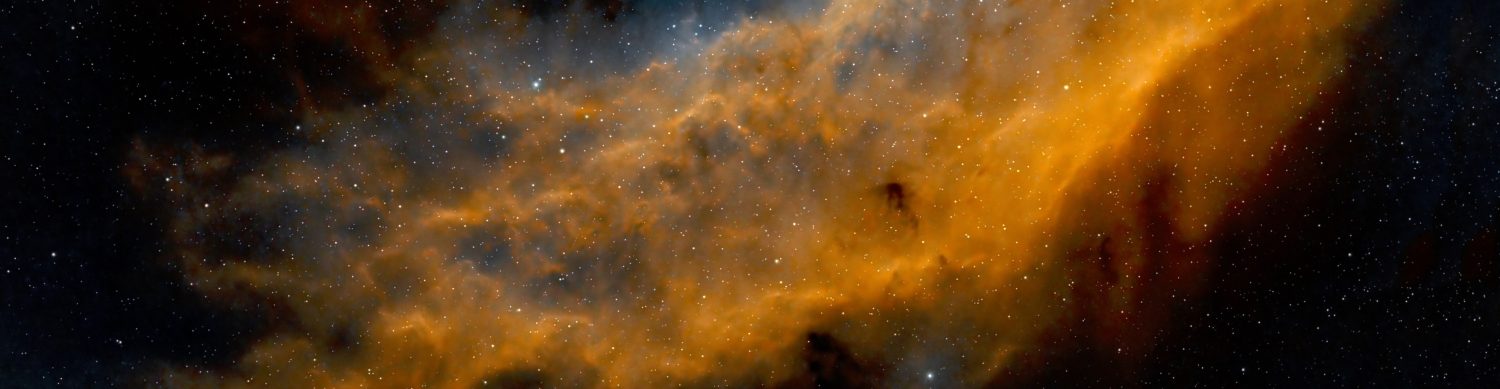
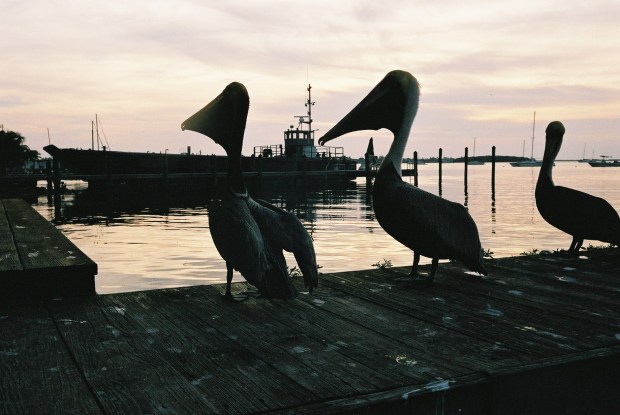
Located 3o west of the star Deneb in the Cygnus constellation, the North America Nebula is an emission nebula spanning some 50 light-years across, which contains numerous areas of astronomical interest that form some excellent imaging targets. In the past I’ve usually concentrated on the ‘continent’ of North America itself but on this occasion moved my attention off the ‘east coast’ in search of the distinctive Pelican Nebula – it really does look like a pelican!
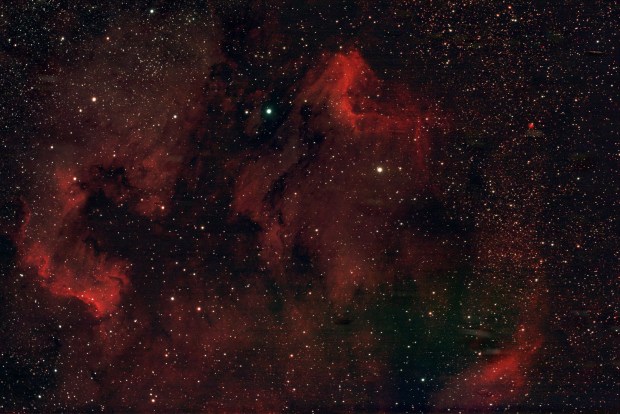
North American Nebula (left) & Pelican Nebula | WO GT 81 & modded-Canon 550D | 2015
Separated from its neighbour by a molecular cloud of dark dust, the dominant HII region of the Pelican Nebula responds well to Ha imaging and I therefore sought to capture the ‘bird’ in this and other narrowband wavelengths. Detail within the main cloud is further highlighted as a result of ionization from within created by young star formation, making for some pleasing and often spectacular effects.


Whilst image capture went well I was concerned by the outcome of stretching the Ha-image after stacking; the stacked image in DSS looked bright and detailed but after using Levels in Photoshop to establish the dark and light points the resulting image was somewhat dull in appearance and without the finer detail I had previously seen in DSS. Responses to a question on the SGL Forum post made it clear that I needed to be bolder when stretching in order to achieve the desired result; I am further persuaded that I’ve been too timid with such processing techniques in the past and may need to revisit and reprocess some older data when time permits.
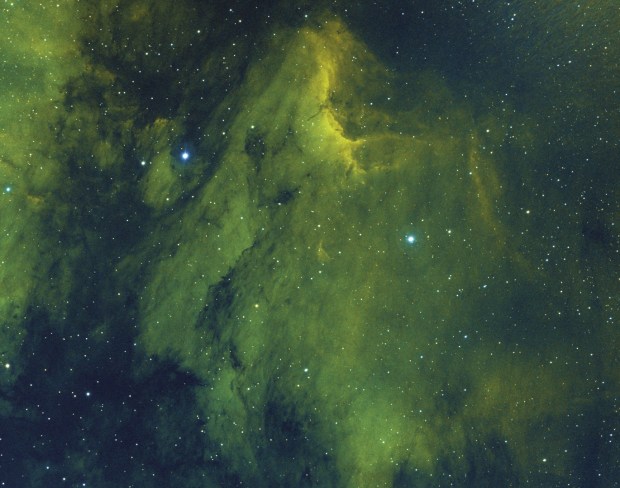
Pelican Images 10th August 2017 in order below:
Ha – Bicolour – SHO narrowband
WO GT81 & ZWO1600MM-Cool + x0.80 focal reducer | 180 sec Gain 300 Offset 10 @ -20C
10xHa + 10xOIII + 5x SII + full calibration
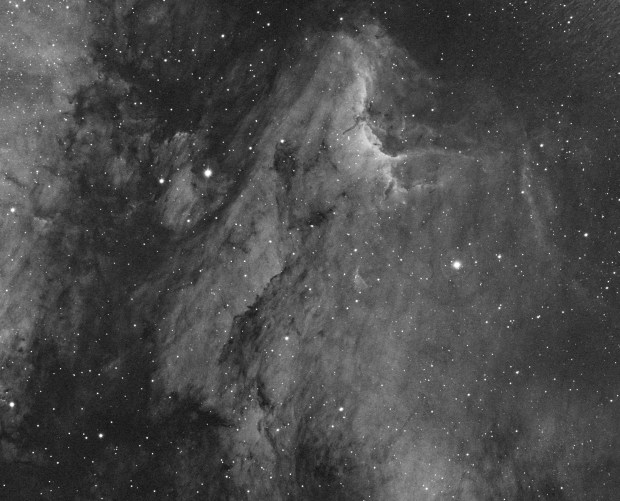
I went on to process the full narrowband data in both SHO and Bicolour, with interesting results. The aforementioned assessment of linear stretching resulted in a much improved Ha-image, which subsequently impacted positively on the final compiled image. However, there’s still much to consider when processing the combined channels, in particular in narrowband.
Some aspects of manipulation used during processing can have a material impact on the final image and I’ve long been concerned whether the resulting astrophotography presents a factual representation – in the case of narrowband the answer must surely be no. Depending on the quality of data capture, detail and structure will usually be accurately recorded but subsequent ‘playing’ with the colour channels is most likely to produce a final image that is pleasing aesthetically to the photographer rather than factual; in the case of narrowband the colours available will be correctly determined by the respective filter wavelengths but there is no definitive measure of what actual colour should be in the final image.
 In this case the Ha-image of The Pelican that was obtained demonstrated the significant improvements that can be achieved with the CMOS based ZWO1600MM-Cool camera compared to a DSLR. I’m still learning about processing and in particular, with the plethora of options available when using LRGB and narrowband subs the issues have now escalated exponentially. Notwithstanding the aforementioned issues I’m very pleased with my ‘new’ bird The Pelican Nebula.
 WATCH THIS SPACE(MAN)