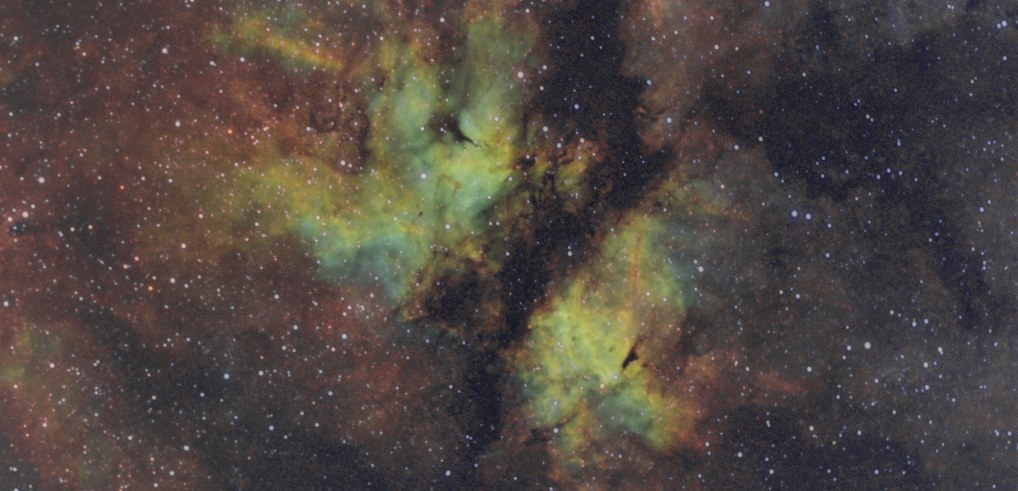

The learning curve was steep in my first year of astronomy and to my dismay I soon learned that there was unfortunately no do-it-all telescope. The optical quality of the William Optics GT81 is excellent, which combined with a modified Canon 550D has provided me with good images of large particularly HII-type targets but the aperture and camera are much less suitable for capturing faint, small objects. However, with good alignment, all the equipment now working well together and an unusually prolonged period of good night sky conditions at the end of 2016, just for the fun of it I decided to try imaging some of the winter sky’s more challenging DSO features.
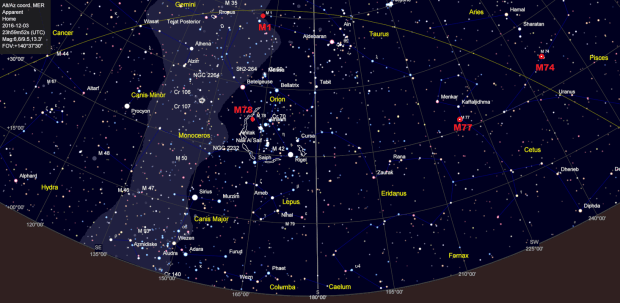
With a x0.80 field flattener, the aforementioned telescope and camera produces a field-of-view of 3.34o x 2.23o at a resolution of 2.32” / pixel. As a result, anything less than say 10’ x 10’ in size is difficult to image and even at that scale it is very marginal. Despite my new guiding skill which allows longer exposures and thus captures more photons, small objects of +8.0 apparent magnitude or less are therefore something of a stretch to photograph. Nonetheless, on this occasion I set out to image four such targets in the region of 30o and 60o altitude as they passed the Meridian during the evening; the results were mixed but very interesting.

-
All the following images were taken on 3rd December 2016 with a Williams Optics GT81 telescope + Canon 550D DSLR & 0.80 field flattener, with calibration & processed in Photoshop.
With the exception of something as large as Andromeda and M33, I’ve regretfully found that galaxies are generally beyond the capabilities of my current equipment. It was therefore no surprise that on this occasion M74 and M77 appeared as not much more than grainy smudges in the image – but they are there! However, clearly present is the spiral nature of the former galaxy and a number of other neighbouring galaxies are very apparent in the latter.


Located within the Orion constellation, above the star Alnitak, though noisy the reflection nebula M78 came out surprisingly quite well, with part of the nearby Barnard’s Loop also evident towards the top edge of the main image and (I think) the orange giant star 51 Orionis shows near the bottom right-hand corner.
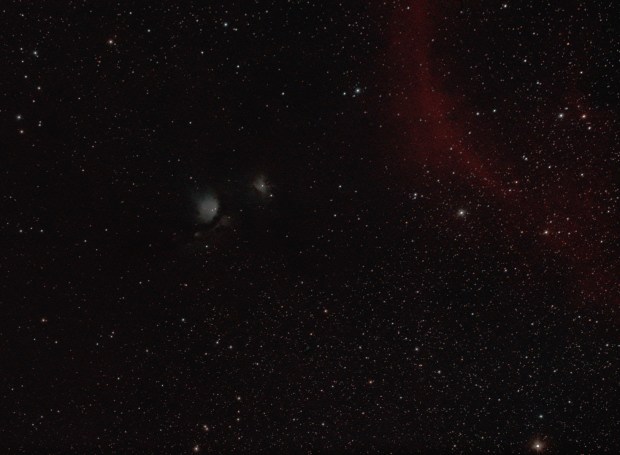
M78 reflection nebula | 12 x 300 sec @ ISO 800
But my most satisfying result of the night was M1, the Crab Nebula, one of the winter night sky’s iconic features. Although a little grainy, the filament structures and colours of this remnant supernova is quite visible.
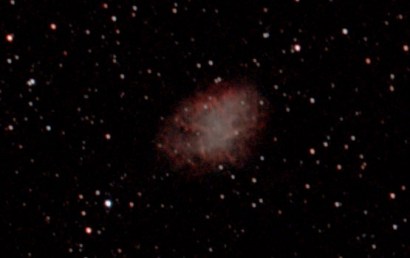
M1 Crab Nebula | 13 x 300 sec @ ISO 800
All-in-all the experiment turned out well and was also good fun, though it is clear that better images of these nice but dim (and small) objects will have to wait until I own more suitable equipment.

 WATCH THIS SPACE(MAN)