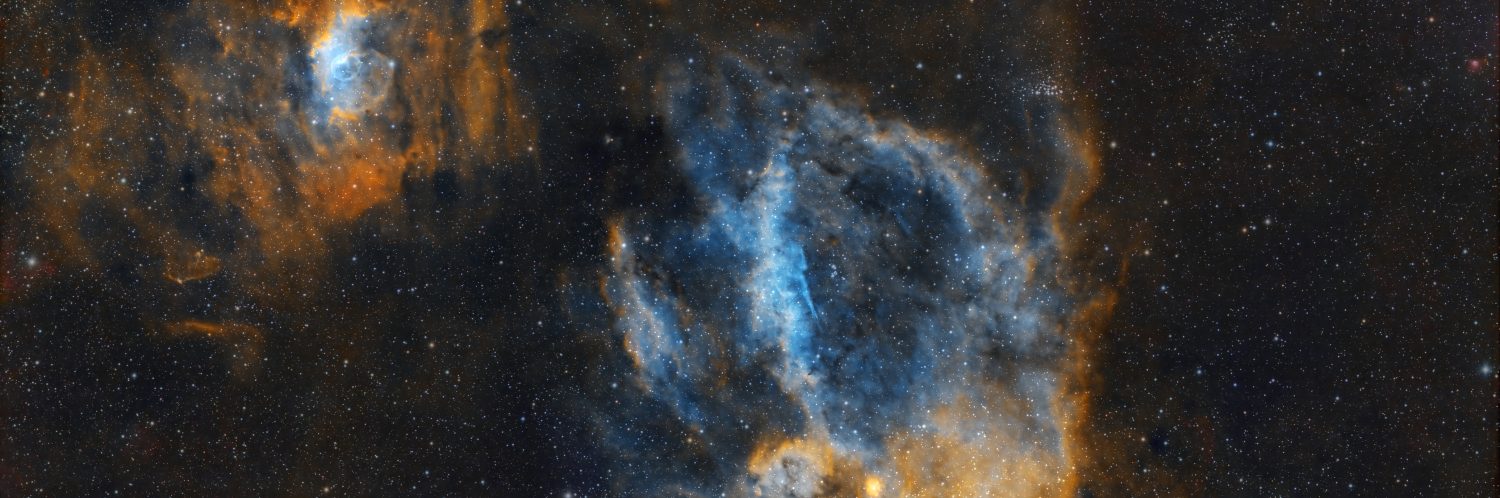
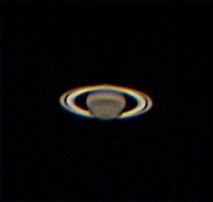
The night sky is full of wonderful worlds, which themselves consist of amazing objects and features. I was originally drawn to astronomy by viewing Saturn through a telescope, which to this day retains a fascination and beauty for me. Of course it is Saturn’s rings that make it stand out as perhaps the iconic object of the night sky; even to the lay person their nature and colour tell us something special is taking place. The rings and associated shepherd moons indicate that something is happening to bring all the particles and objects precisely together in a disc that rotates around the planet – gravity. Perhaps surprisingly this force remains a mystery to science, although it is now clear that it has an overarching impact on the development of the Universe itself.
Another fascinating feature of gravity is the formation of globular clusters, which I find both beautiful and bewildering. Bound tightly by gravity, each cluster is made of at least several hundred thousand very old stars, typically between 8 to 10 billion years, which usually orbit at a far distance outside and at right angles to the galactic disc. So far about 158 globular clusters have been identified around the Milky Way and we now know such objects are also commonly associated with other galaxies. During the summer and autumn many of these enigmatic star clusters can be seen across the sky, which form wonderful imaging targets.
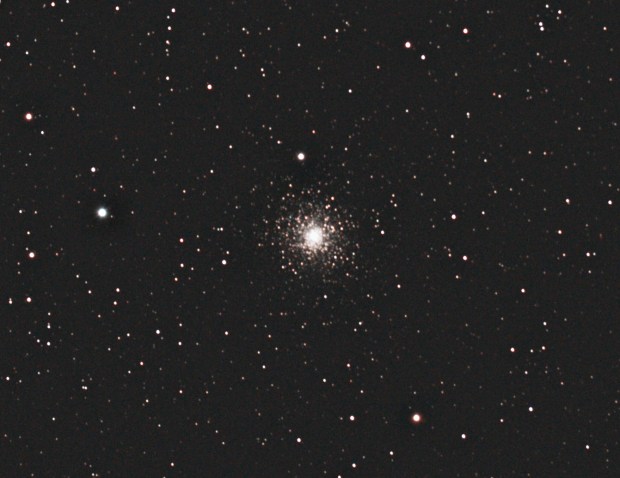
M15: 12bn light-years old globular star cluster | Constellation Pegasus, 33,600 ly from Earth, apparent mag. +6.2, size 18.0′ (diameter 176 ly) | WO GT81 + modded Canon 550D & FF | 10 x 300 sec @ ISO 800 & full calibration | 22nd October 2016
Although I have previously spent time observing and imaging Saturn and various globular clusters, as well as notable single stars such as Betelgeuse and Altair, for some reason I have neglected their binary relations. And so in early autumn this year I turned the telescope and camera towards two of the better examples of these double or binary stars. So-called Doubles consist of two stars orbiting around a barycentre, captured by each other’s gravity. The challenge is to ‘split’ the stars, thereby differentiating each star as individual features and if relevant by colour, either by observing though the telescope or in an image.
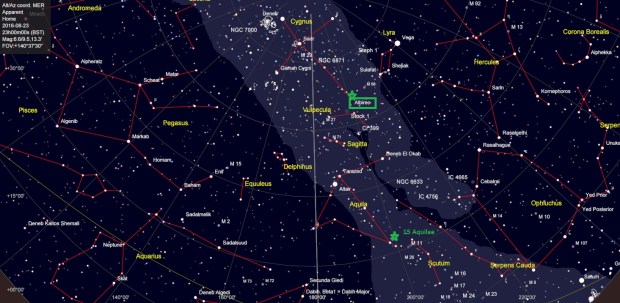
My initial target was the beautiful Albireo (below), a double star consisting of the mag. +3.1 gold coloured Beta Cygni A and its mag. +5.1 bright blue partner Beta Cygni-B. At a distance of 430 light-years from Earth and separated by 35 arc seconds, the stars have an implied orbital period of at least 100,000 years. Together with Deneb, Sadr, Gienah and Delta Cygni, Albireo forms the Northern Cross asterism, which lies almost overhead at midnight during the late summer months in the Northern Hemisphere. Situated at the head of the Cygnus (Swan) constellation, Albireo is also known as the “beak star”. The contrasting colours of the two stars form one of the most beautiful doubles of the summer sky and forms an attractive imaging target.

Located in the nearby constellation of Aquila but less notable than Albeiro, is the double 15 Aquilae (below). Some 4-billion years old and a hot 11,000oC in temperature, the larger mag. +5.4 orange giant star is located some 190 light-years from Earth. Its smaller partner is a cooler white mag. +7.7 star, situated 38 arc seconds away but ‘only’ 4,400oC hot. Such features abound in the Aquila constellation and I hope to return to this region of the sky again next year for more double fun!

Doubles are a real treasure of the night sky that are surprisingly common but are easy to overlook. They are often interesting as well as beautiful to observe and image – I can’t think why it’s taken me so long to get round to them?
 WATCH THIS SPACE(MAN)