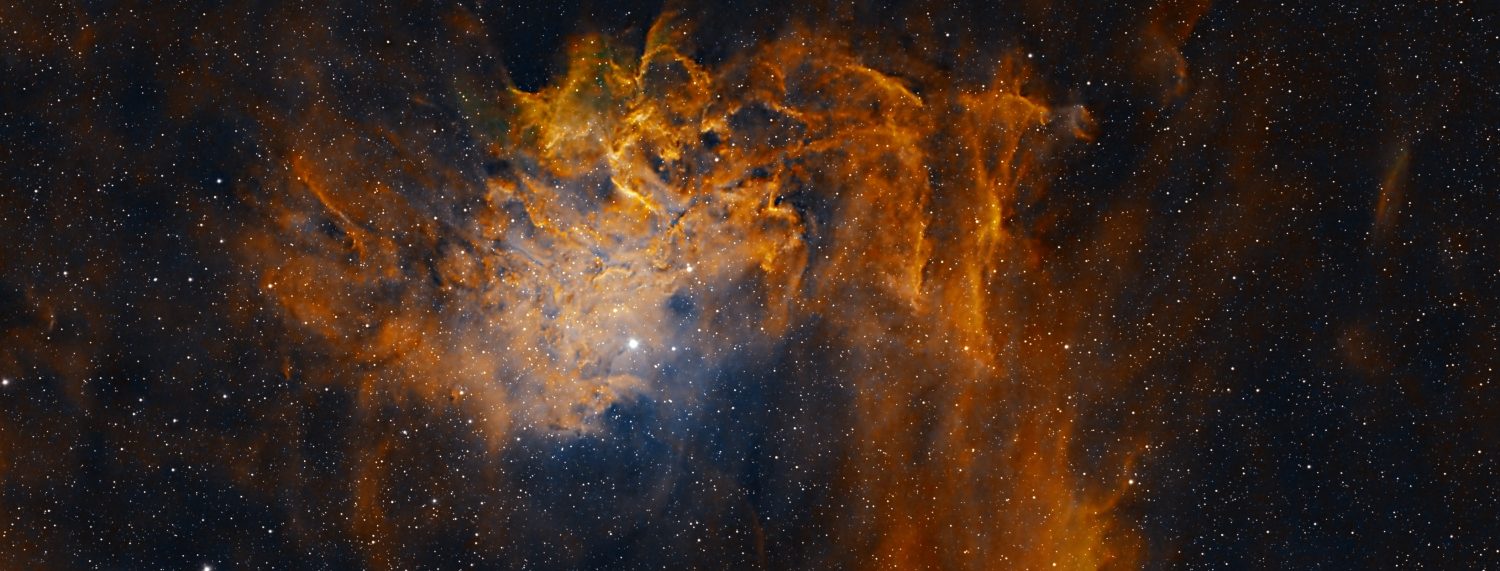
Earlier this month the weather and clear skies produced particularly good imaging conditions that resulted in some excellent pictures; it’s already a distant memory as the weather has since turned cold and cloudy day-after-day – or at least every night except when there’s a full Moon! With these images knowingly in the bag and the telescope well aligned, I took the opportunity to indulge in a short session imaging some galaxies that happened to be around the Meridian at this time which, as it turned out, were located in proximity to the constellation of Pegasus.
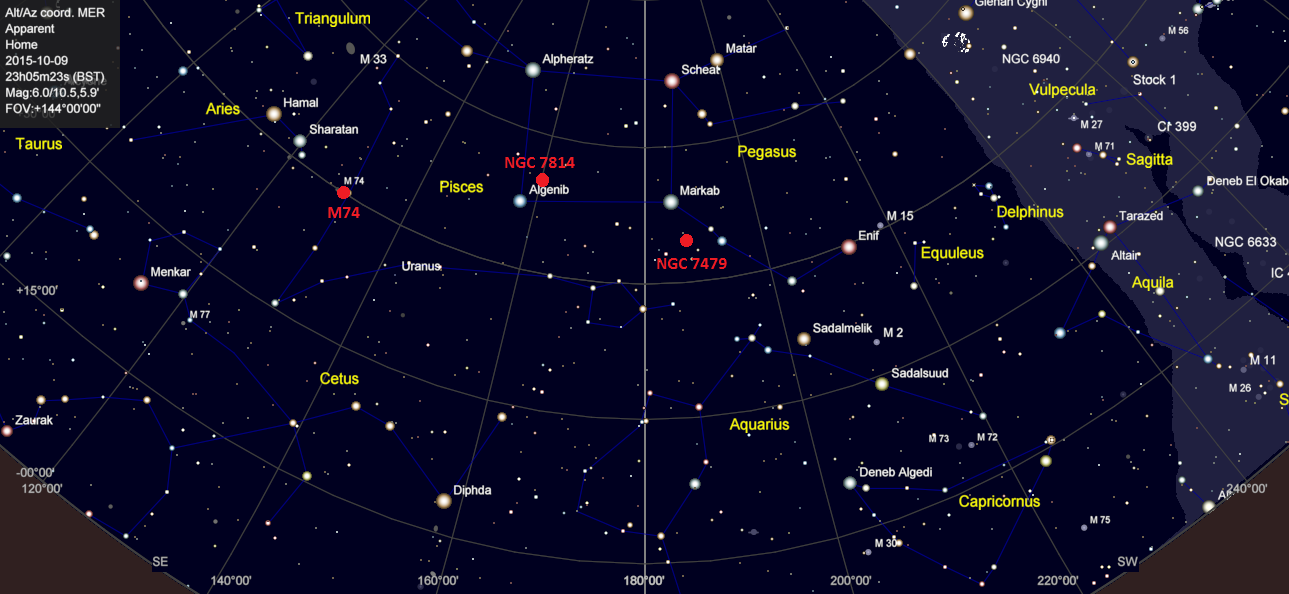
Two of the objects (M74 & NGC 7814) were confined to just ten shots and the third fifteen, all at 180 seconds exposure and ISO 1,600. For such dim and distant objects this in itself was obviously insufficient but still it was fun to experiment. As expected the resulting images are feint and noisy but the object’s form can be clearly seen and, in the case NGC 7814 – the Little Sombrero, even the edge-on dust lanes are evident.
In order to better understand the limits of the equipment, a comparison of the images with the objects’ physical information given side-by-side illustrates the problems and possibilities for the future. The truth is that these are all at or beyond the realistic limit of my current set-up but I was interested to see what results could be achieved and I always enjoy their beauty, even if imperfectly captured.

Apart from the obvious problem of size, mainly a function of distance in this case, their apparent magnitude is also challenging. It is interesting to consider that using the 18 megapixel Canon 550D and WO GT81, each camera pixel which measures 4.30μm samples just 1.855 arc seconds per pixel and therefore even the largest of these objects (M74) spans an area of just about one tenth of a degree (0.10o). Better alignment and longer exposure should tease out more detail but as the recorded image of each object is no more than 2% of the total image the reality is that I am pushing my luck.
Still it is fun and I have managed to capture a few of the photons that left these galaxies so long ago. As my equipment, techniques and knowledge continue to improve then hopefully so will the limits. Watch this space!
 WATCH THIS SPACE(MAN)