
As we pass the Autumn Equinox the promise of long and exciting Winter skies is not far off but there are still some wonderful late Summer features around worth imaging before they move away from the Meridian and out of view from Fairvale Observatory. Following a major operation earlier in the year I’ve been unable to move the heavy equipment outdoors until very recently and have therefore almost completely missed the Summer skies; even as I’ve been getting better in recent weeks, poor skies and other circumstances have stopped my return to astronomy – until now.
Up until shortly before midnight the Cygnus constellation is favourably located close to the Meridian at the moment and at a very high, southerly altitude – perfect for my location – it was therefore here that I chose to make my long awaited resumption to astroimaging last Saturday. The weather forecast in the morning showed clear skies for that night but by early evening had changed to cloud and looked like being another lost opportunity; on this basis the Flamsteed Astronomy Society had already cancelled their planned evening astronomy session. However, unlike previous attempts in recent weeks when clear skies were forecast and the cloud rolled in unannounced, this time the outcome was very different, with a clear moonless sky throughout the night – I sometime wonder if the weather forecasters have windows and bother to look outside!
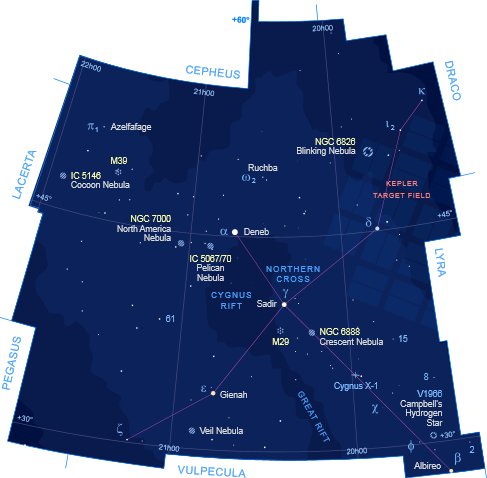
Located northeast of the first magnitude star Deneb and some 1,600 ly from Earth is NGC 7000 or the North America Nebula, an enormous H II region that in outline resembles the North American continent. I first encountered this emission nebula at a similar time last year, which was my first experience of such a feature and I was therefore thrilled to capture part of it in my picture; my blog title at the time captures my feelings – WOW! However, taking the image using the longer focal length Skywatcher 150PL with a smaller field-of-view (FOV), the picture only captured part of the ‘USA’ and the ‘Gulf of Mexico’. Furthermore, using an unmodded camera much of the red H-alpha light that is characteristic of these nebulae was not recorded.
Since then my equipment has changed in a number of important ways, so that the William Optics GT81 with a wider FOV would now enable me to image more of the nebula, whilst using a modded DSLR camera would also record much more of the H-alpha light; an additional year’s experience also helped. This time my target was the related IC 5070 and IC 5067 H II regions otherwise known as the Pelican Nebula, situated just west of NGC 7000 and close to Deneb.

The Pelican Nebula, IC5070 & IC 5067
WO GT81 & modded Canon 550D + FF cropped | 30 x 120 secs @ ISO 1,600 + calibration | 19th September 2015
With an apparent magnitude of +8 the Pelican is generally less bright than its larger +4 neighbour but is no less exciting. The bright double star Cygnus 57 and binary Cygnus 56 shine conspicuously just in front of the ‘bird’ and within the ‘body’ respectively. In addition a bright area at the northern top of the ‘bird’s head’ is an active area of star formation, which ionizes the gases creating the glowing red area.
Whilst missing the impact of being my first H II nebula last time, the larger image of the North America Nebula now captures most of the ‘continent’ and encompasses ‘Central America’. As a result the picture clearly shows the Cygnus Wall, another bright area of star formation that runs along ‘Baja California’ / ‘northern Mexico’ area.
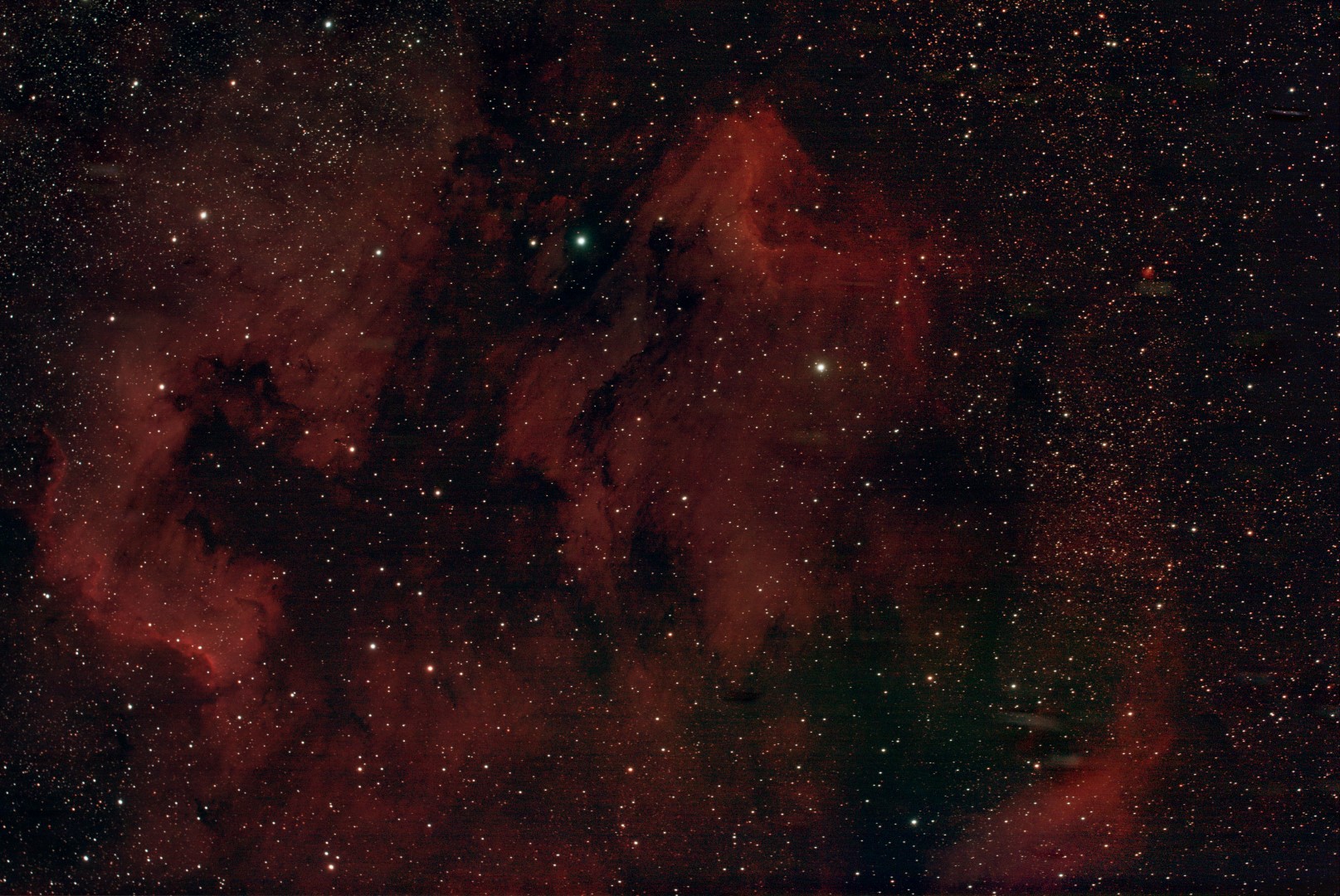
NGC 7000 The North America & Pelican Nebulae
WO GT81 + modded Canon EOS 550D + FF | 30 x 120 secs @ ISO 1,600 + calibration | 19th September 2015
The combined Pelican and North America Nebulae span some 50 ly across, which when imaged together makes a wonderful picture of these spectacular features. I would be happy with this image at any time but after nearly six months away from astroimaging it’s a very pleasing result. I feel re-invigorated, like the phoenix has risen again.
 WATCH THIS SPACE(MAN)