
I thought I was finished with Orion for this winter but a high pressure system and clear weather provided an unexpected opportunity on Sunday evening that I couldn’t resist. The good news: as Orion is passing the Meridian by 8.00 pm it provides an early start. The bad news: being near Gatwick Airport, at this time of the evening the sky is full of aeroplanes at Fairvale Observatory, most of them flying directly through the Orion field of view!
With such good weather, I also decided to try out computer control for the first time. I installed EQMOD before Christmas and have since been reading and watching tutorials on its use and experimented operating with it indoors. Frankly I am somewhat intimidated by the large collection of software that is required to go to the next level with imaging and EQMOD is just the first step. However, eventually I just have to do it and this would be the night to start!
EQMOD is a software project written and run by enthusiasts which provides computer control to the mount, thus dispensing with the SynScan handset. It also does much, much more and in general provides far superior control and flexibility, in particular linking control with a chosen planetarium programme – usually either the excellent Stellarium or Carte du Ciel, all of which is free!
Notwithstanding, I still have the major problem of polar alignment as my house completely obstructs all views of the northern sky. For the moment I adopted a belt-and-braces approach, first achieving polar alignment using the SynScan routine before switching to EQMOD control; once comfortable using EQMOD I plan to try out alignment software called Alignmaster, which I hope will allow me to completely dispel with SynScan. On this occasion EQMOD worked a treat. For alignment, just clicking on the object you want to see in the planetarium software (with which EQMOD is linked), the telescope slews and after accurately aligning the scope with the star you press a sync button. It’s so quick that it is easy to rapidly establish five or six (or more) star alignment points, thereby constructing a triangular matrix from which the mount can then track more accurately. There are many other features I have yet to use but so far I like what I see and am in awe of those who have written and maintain the system.
With EQMOD computer control thus established successfully, I set out to image some old ‘friends’ in Orion. Having only recently acquired a modded Canon 550D, it seemed only right to take another look at M42 the Great Orion Nebula and The Flame and Horsehead nebulae.
The impact of modification was immediately evident with M42, it now being much redder than before and with greater detail exhibited in the nebulosity. The tracking also looked OK, though a few stars looked a little bloated, suggesting there’s still work to do on another day i.e. autoguiding.
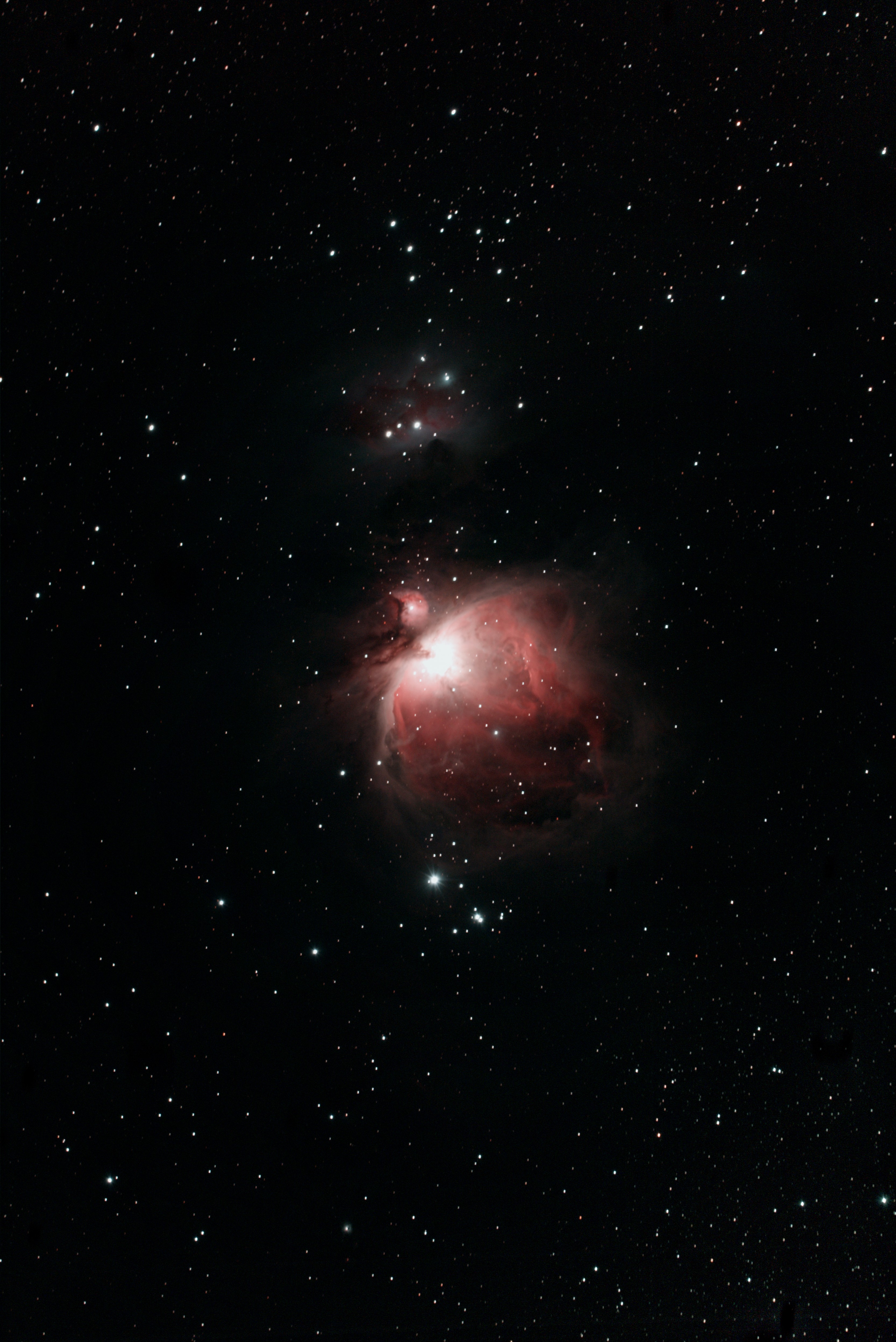
Orion’s Sword: M42 The Great Orion Nebula, Running Man Nebula & NGC 1981 Star Cluster
WO GT81 + modded Canon 550D & FF | 10 x 180 secs @ ISO 800 & darks calibration | 8th February 2015
The Flame and Horsehead nebulae also show similar improvements and, in the case of the Horsehead, the actual ‘head’ is much clearer than before.
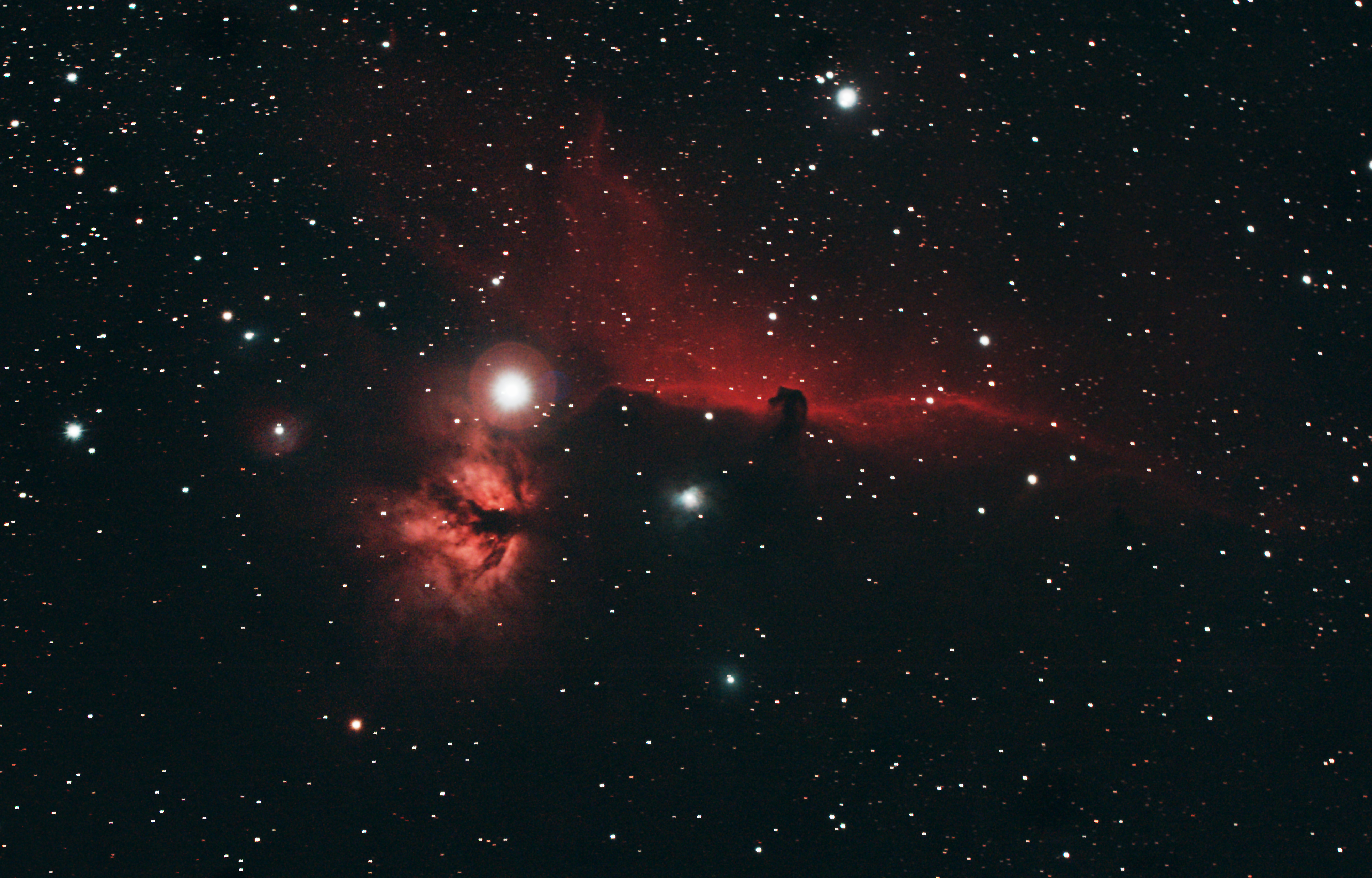
NGC 2024 Flame & Horsehead Nebula; NGS 2023 relection nebula just below/left of the Horsehead
WO GT81 + modded Canon 550D & FF | 10 x 180 secs @ ISO 800 & darks calibration | 8th February 2015
With Orion by now well past the Meridian and the weather holding up well I then decided to try my luck once again with Jupiter, which by now is well located high in the south east sky. Unfortunately like sport, astronomy is a game of two halves. Following the success using EQMOD my experience with Jupiter was a complete failure.
I had previously encountered significant problems with my webcam last year, that mostly stemmed from problems with the capture software and it was here that I was to stumble (fall more like it) once again. Initially Firecapture seemed to boot up OK and recognised the camera, though try as I may I could not see Jupiter on the screen; I knew it was there as I had previously centred and focussed it there. I therefore decided to reboot the software, which was a big mistake. This time Firecapture would not recognise the camera and on trying to de-bug the problem I ended up with the dreaded ‘black screen of death’. Here was the downside of computer control, with the black screen going nowhere I also lost all control of the mount! I therefore retreated to SynScan, parked the telescope and deliberately crashed the computer; I have not yet investigated the problem further since then – watch this space!
It was therefore something of an ignominious end to the evening. However, I was still buoyed by the earlier success of EQMOD and more than happy with what may be my parting shot of Orion for this winter. Au revoir.
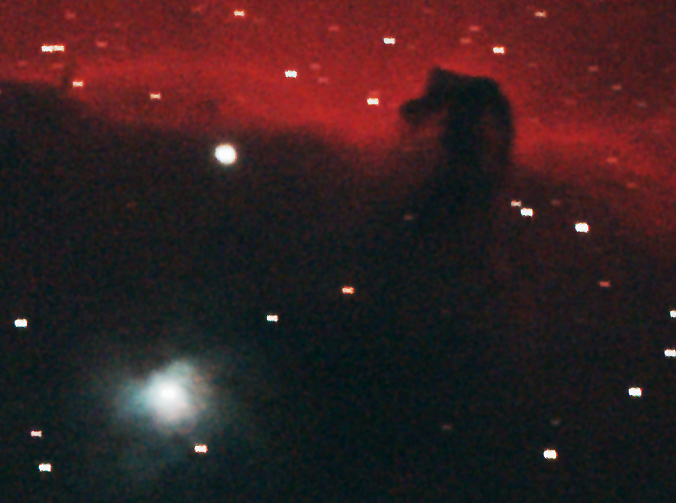
Horsehead Nebula with the NGC 2023 reflection nebula, bottom left
 WATCH THIS SPACE(MAN)
%26rotation%3d86.169372544%26name%3dHorsehead%2b%26%2bFlame%2bNebula%2bfrom%2bSurrey%26reverseparity%3dFalse%26scale%3d5.42531032437%26thumb%3dhttps%3a%2f%2ffarm9.staticflickr.com%2f8706%2f16866837535_195d26f29c_q.jpg%26ra%3d85.3006658728%26y%3d540%26x%3d844%26dec%3d-2.25939577878%26wtml%3dtrue)
Pingback: Nocturnal Safari | WATCH THIS SPACE(MAN)
Pingback: Fairvale Observatory Part-3, Progress: modded DSLR, EQMOD / ASCOM computer control, autoguiding etc. | WATCH THIS SPACE(MAN)
Pingback: Dark Matters | WATCH THIS SPACE(MAN)
Pingback: It’s All Relative | WATCH THIS SPACE(MAN)
Pingback: Eleventh Hour | WATCH THIS SPACE(MAN)
Pingback: The Horse & Flame | WATCH THIS SPACE(MAN)