Whilst I know of Gemini I have limited knowledge about this constellation that, like Monoceros, starts to play a more prominent part in the night sky here after 10 pm at this time of the year. Located immediately above Monoceros and north east if Orion, Gemini is Latin for twins and its asterism appropriately forms two stickmen whose ‘heads’ are formed by the stars of Castor and Pollux, also suitably twin brothers from Greek mythology.

At the western extremity of Gemini, beyond Tejat Posterior (which means back foot), just above the ‘left foot’ of the upper stickman, lies the open cluster M35. Located at the heart of the Milky Way and 2,700 light-years from Earth, M35 is formed of some 2,700 young stars of between 100 and 200 million years old. On the same clear, cold evening I recently photographed the Rosette Nebula, I also produced an interesting image of M35 with good colours, including some yellow-orange stars.
Because of its short focal length, the relatively wide field-of-view of the William Optics GT81 can be both a good and sometimes a bad feature, depending on the size of the object being viewed. From experience so far, it seems that the scope and DSLR camera produces good to fair resolution for objects down to about 5 arcminutes. Whilst objects below this size can be identified, the power of the scope and sensitivity of the camera sensor can usually only show the presence of such features without providing useful detail. However, at other times this set-up is perfect for wider but still detailed images that sometimes lead to me other, unexpected objects in the same picture. The image of M35 is just such an example.
At the time of imaging, the less-than clear initial RAW images from the camera, with a dark blue hue from the CLS light pollution filter, nevertheless indicated that M35 was nicely positioned at the centre of the picture, with good resolution of the component stars. However, it was evident that there were also some other bright features away from the M35 open cluster which I had not anticipated. Notable amongst these was what seemed like a pale yellow smudge to the immediate west, the importance of which only became apparent after stacking and post processing.
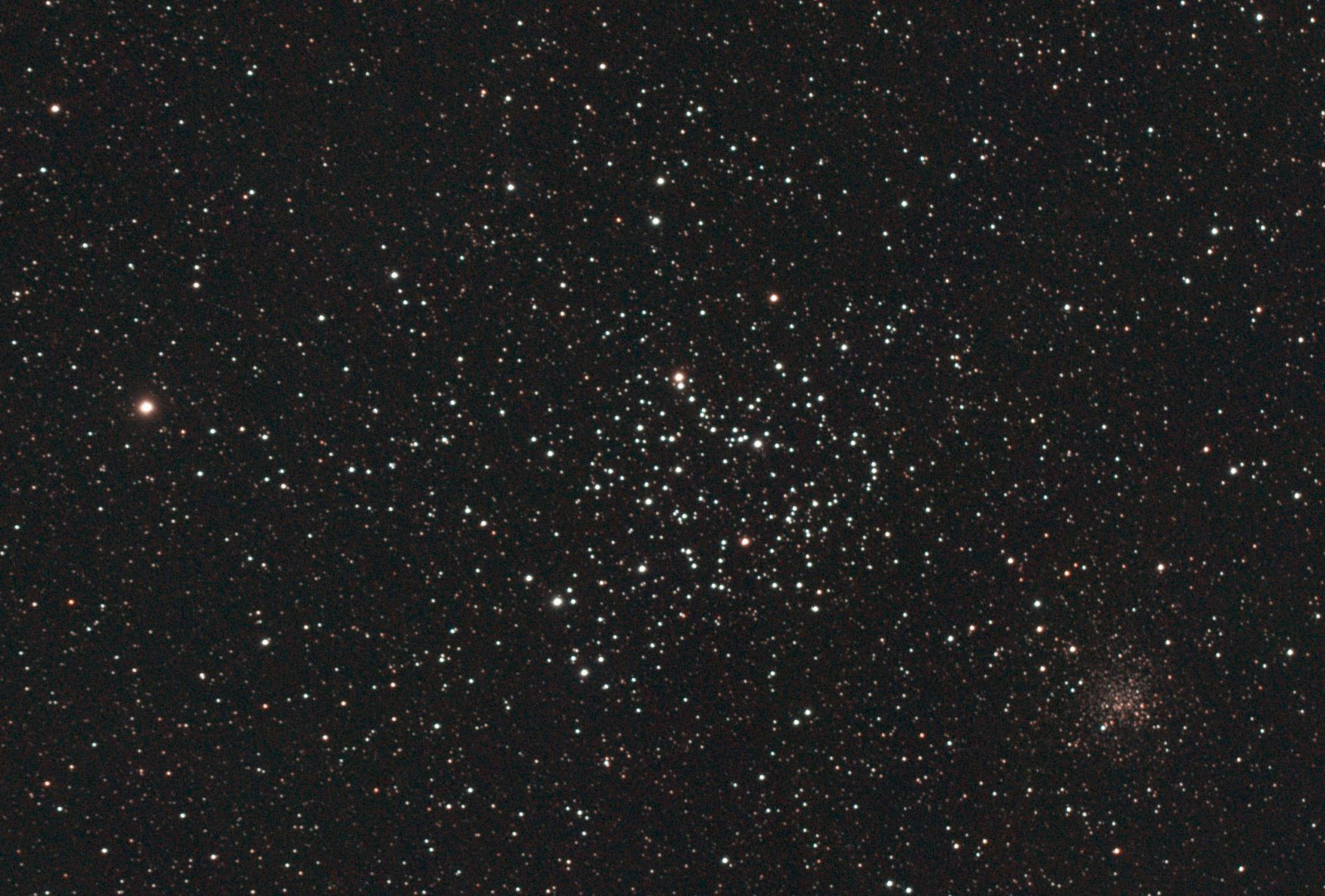
M35 (Centre) & NGC 2158 (Lower right) Open Clusters
WO GT81 + Canon 700D (unmodded) | 15 x 120 secs @ ISO 1,600 & calibration
It turns out that M35’s neighbour, 20 arcminutes to the south-west, is no less than NGC 2158 – another cluster. To the eye NGC 2158 seems to form an attractive, golden globular cluster. In fact it too is an open cluster but located more than 9,000 light-years beyond M35 and at 2 billion years, is much older. As they say, with age comes beauty, and I find this feature to be the more interesting of the two, all the more so as I was not expecting to see anything there, instead I got 2 for 1.
 WATCH THIS SPACE(MAN)