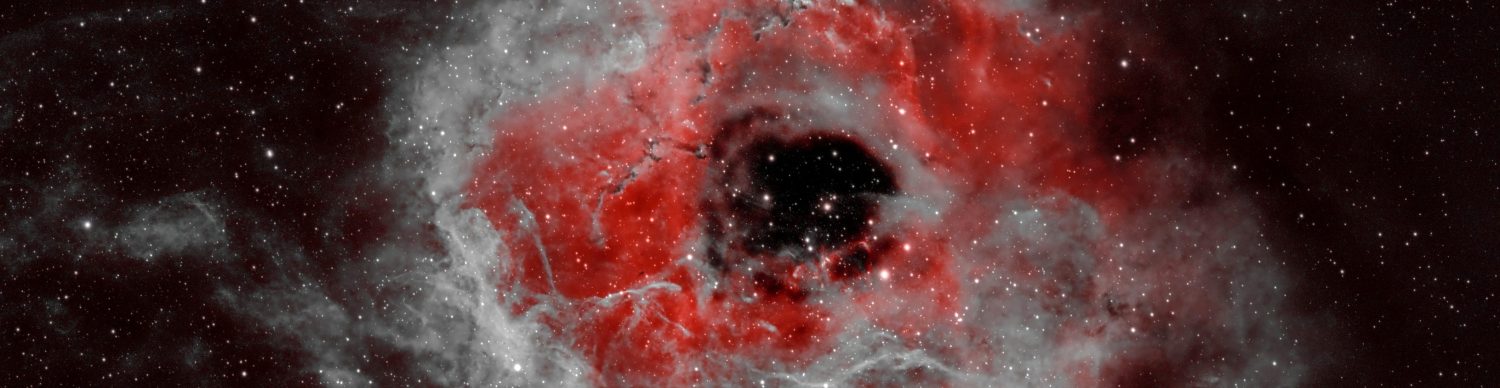
There is no doubt in my mind that the Orion Constellation is the most spectacular of the year and right now comes into imaging view at Fairvale Observatory at about 11pm, about the same time the waxing Moon disappears over the horizon; for once the timing is perfect. So before the presence of the Full Moon later this week rules out astrophotography, last Saturday evening provided an excellent opportunity.
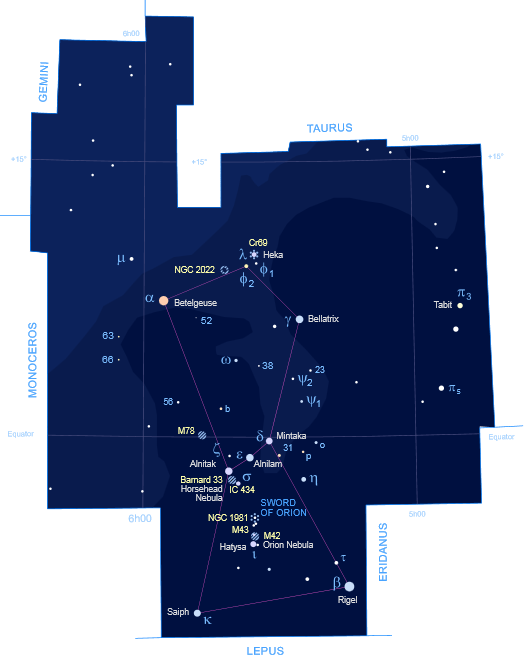
The more I look at the Orion Constellation the more there is to see and image, as well as some other attractive objects that will be around until at least the New Year and in some cases well beyond. One lesson I have learned early on with astrophotography is the need for good planning: what’s around to image? when is it in the best location i.e. near the Meridian? what equipment is needed and is it working? set it up in good time and ensure good alignment. Given the aforementioned favourable conditions and the arrival of Orion, my list of objects this month is considerable:
Early evening: M32 Andromeda Galaxy & NGC 1499 California Nebula.
Late evening / midnight: Orion Constellation – NGC 2024 Flame Nebula, IC 434 Horsehead Nebula, M42 & M 43 Great Orion Nebula, NGC 1977 Nebula, NGC 1981 Emission Nebula, NGC 1909 Witch Head Nebula, SH 2-276 Barnards Loop, SH 2-264 Angelfish Nebula, M78 reflection nebula and more. Other – M1 Crab Nebula, Hyades (Taurus), M77 barred spiral galaxy and Jupiter, which together with its four moons is also looking very nice after 1 a.m. at the moment.
With such an array of possibilities it can be difficult to know where to start but having recently achieved good images of the Great Orion Nebula and the Flame and Horsehead Nebulae, the next target was an easy choice – it had to be NGC 1977, which with the William Optics GT81 field-of-view also takes in NGC 1981 and M42, three for the price of one!

Orion’s Sword. Top to bottom: NGC 1981 Open Star Cluster, NGC 1973/75/77 Nebulae, M42 & M43 Great Orion Nebula & the binary star Hatysa.
WO GT81, Canon 700D + FF | 30 x 120 secs + darks/bias/flats @ ISO 800
There is so much going on in this photograph that merits attention. The view encapsulates all the major components that form Orion’s Sword, notably from top to bottom: the open star cluster NGC 1981, the star Theta Orionis C in the Trapezium cluster – itself within M42 and the star Hatysa (Iota Orionis), which forms the tip of the sword. Obviously M42, The Great Orion Nebula dominates the scene but two other major features are worthy of attention too.
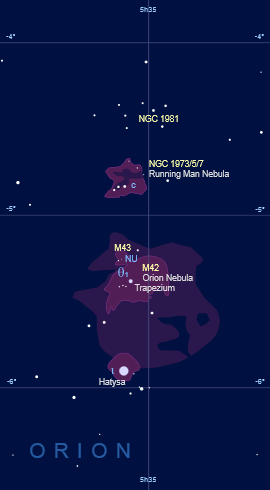
Orion’s Sword – detail
The aforementioned NGC 1981 is an open cluster of about 20 stars located 40 light years closer to Earth than M42. But it is what’s between M42 and NGC 1981 that was my main target this time: the reflection nebulae of NGC 1977 and related NGC 1973 & 1975, AKA the Running Man Nebula, so named because it looks like a running man! The three nebulae are illuminated by the blue light shining from young stars that are forming within each area of nebulosity, which are separated by dark zones of interstellar dust in the form of a man running – not unlike Eadweard Muybridge’s pioneering photographic images of motion taken at the end of the 19th Century, I am sure he would have appreciated the analogy.
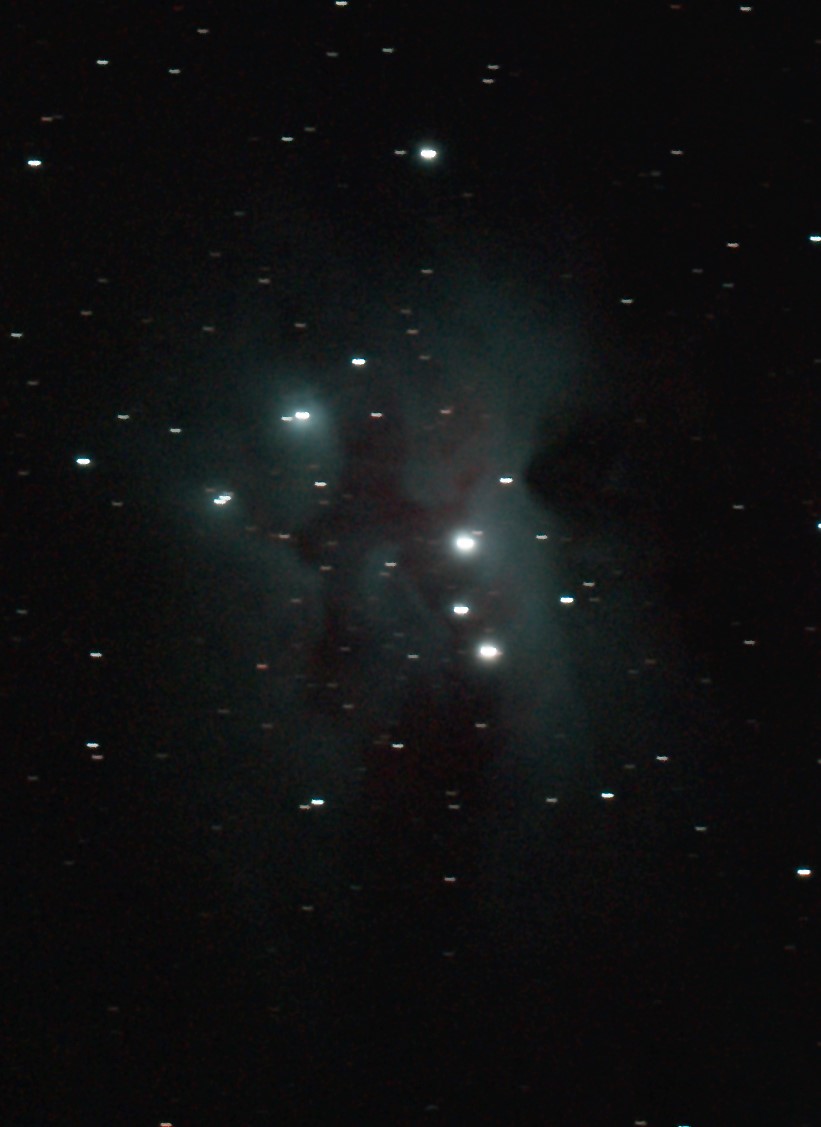
NGC 1973/75/77 The Running Man Nebula (rotated – North is left)

Eadweard Muybridge’s photographic studies of a running man, late-19th Century
 WATCH THIS SPACE(MAN)
Pingback: Orion in Perspective | WATCH THIS SPACE(MAN)
Pingback: Parting Shot | WATCH THIS SPACE(MAN)