With the full moon early in the month and some truly awful weather, I have been unable to get out at Fairvale Observatory since October 31st! Notwithstanding , this has been an opportunity to spend time learning more about the dark art of processing, which can sometimes be more important than image capture itself, so is hopefully time well spent. Apart from the usual assistance of Mr Google, I have purchased the excellent online ‘book’ of Jerry Lodriguss, Photoshop for Astrophotographers – which I am slowly working through, and watched the equally excellent YouTube tutorials by Doug German on the same matter. It is often said that a picture is worth a thousand words, and Doug’s tutorials are probably the easiest and most accessible way into the use of Photoshop for astrophotography – I also enjoy his dry sense of humour. Finally, I am currently trialling Russell Croman’s Gradient Exterminator, which is intended to remove the external light gradient that inevitably creeps into even the best of images; it’s early days but I think I like it – it’s tricky to use and Doug German’s video tutorial is very helpful in this regard too.
The extended absence of clear night skies for astronomy also benefits subsequent viewing as the sky has changed, in this case a lot. We have now moved on to winter skies, which are best exemplified by the constellation of Orion here in the northern hemisphere. I was initially successful in imaging the iconic Orion Nebula early in October but only by getting up very, very early. At Fairlvale Observatory it now comes into view at about 10pm and after 11pm can be imaged. With clear skies finally arriving last Sunday evening, albeit accompanied by very cold temperatures, I was finally able to get out again – this time to spend more time with Orion.
In my ignorance, what has surprised me about Orion is the extensive presence of spectacular nebulae throughout the constellation: M42 Orion Nebula, M43 De Mairan’s Nebula, NGC 1973/5/7 The Running Man nebula, M78 between Alnitak and Betelguese etc, etc. But, I had also somehow overlooked the ‘Horse & Flame’, located above the Orion Nebula nearby the lower end of Orion’s belt: Mintaka – Alnilam – Alnitak. In close proximity to Alnitak (a triple star), which with an apparent magnitude between +2.0 and +4.0 is a problem for imaging, the sky is full of spectacular nebulae – notably the Flame Nebula and the iconic Horsehead Nebula. Having latterly learnt of their presence in the same part of the sky, I had to try and image them.
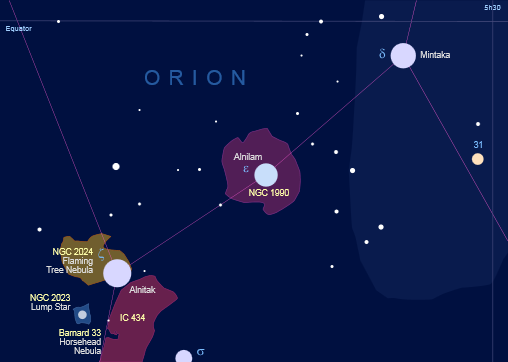
The Horsehead Nebula is a cloud of interstellar dust and gas that, as a result of it’s density, appears dark against the surrounding red nebulous ‘curtains’. The resulting shape looks like, well a horse’s head and has therefore become an iconic and well known image. However, located on the other north-eastern side of Alnitak is perhaps the real star (no pun intended) of the show, the Flame Nebula – NGC 2024. A combination of dark gas and dust with glowing hydrogen gas, energised by ultraviolet light emitted from Alnitak. Such is the form of these materials that the resulting effect is that of a burning flame. I was therefore thrilled that after my enforced indoor sojourn to be able to capture the Horse and Flame (sounds like a pub I’d like to visit!) together in one beautiful picture.
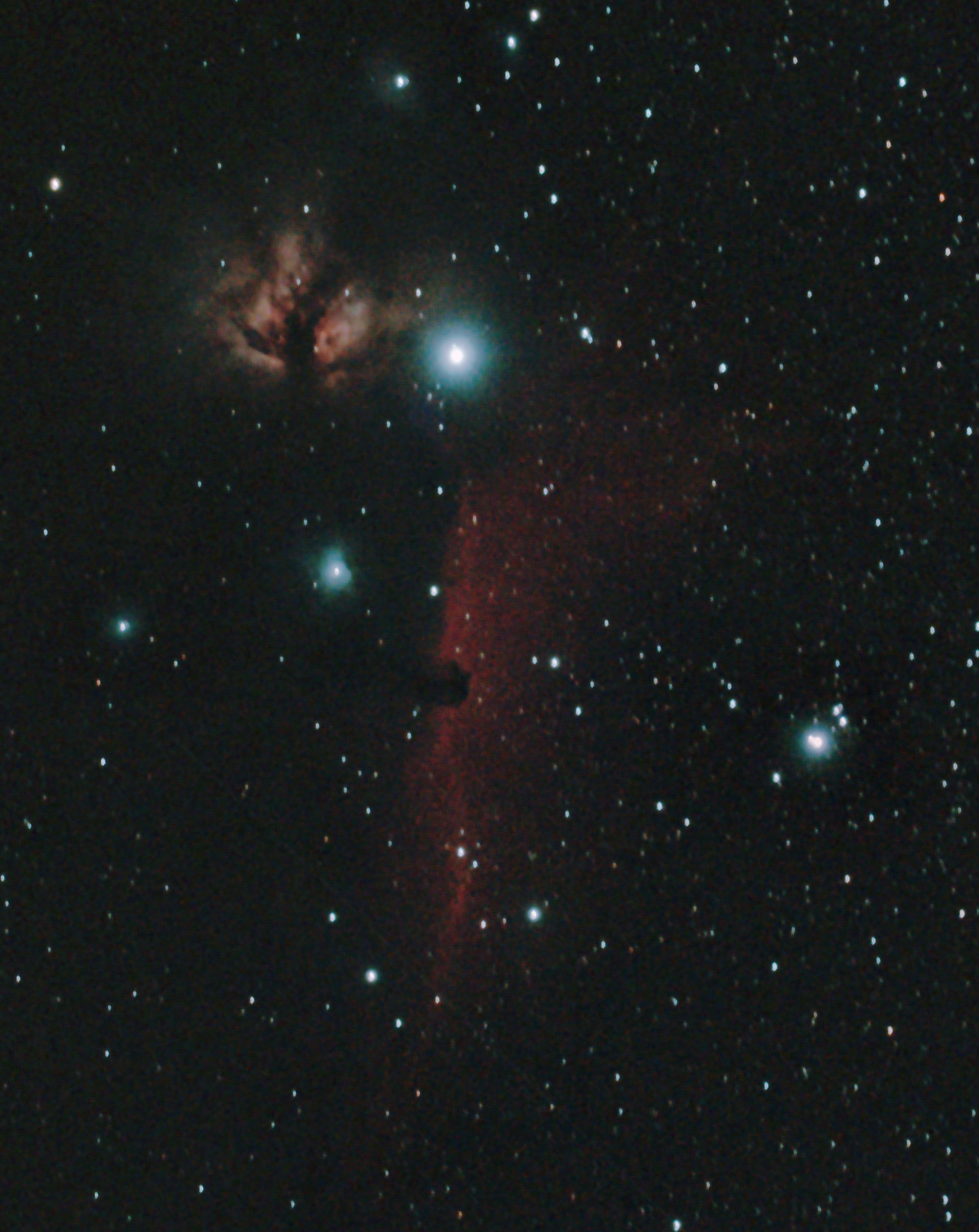
The Horsehead and Flame Nebulae. The Horse is located directly below (south) the large bright Alnitak triple star which forms the eastern (left) end of Orion’s belt, about half way down the image, sticking its ‘head’ into the red curtain of nebulosity. The Flame is just to the left (east) of Alnitak.
WO GT81, Canon 700D + FF | 28 x 90 secs + darks/bias/flats ISO 1,600 | Photoshop processed + Gradient Exterminator
 WATCH THIS SPACE(MAN)