In my opinion the current 12th Time Lord, Peter Capaldi, is one of the best doctors yet but it’s all just a good yarn, isn’t it? At the level of quantum physics the potential of time travel has recently been shown to be feasible and even the paradox of Schrödinger’s cat has now been experimentally demonstrated at a quantum level i.e. the same thing can exist in two places at the same time. Still, intuitively time travel seems unlikely but nevertheless last week I travelled back 400 million years without moving from Fairvale Observatory!
As a result of good viewing conditions and excellent alignment of the mount and telescope, I sought to capture light that left on its journey 300 million years ago. This time marks the end of the late Carboniferous era, taking its name from the period of worldwide formation of coal deposits, which resulted in the highest atmospheric oxygen levels the Earth has ever experienced (35%) and lead to an abundance of giant insects and amphibians as the first reptiles also appeared on Earth.
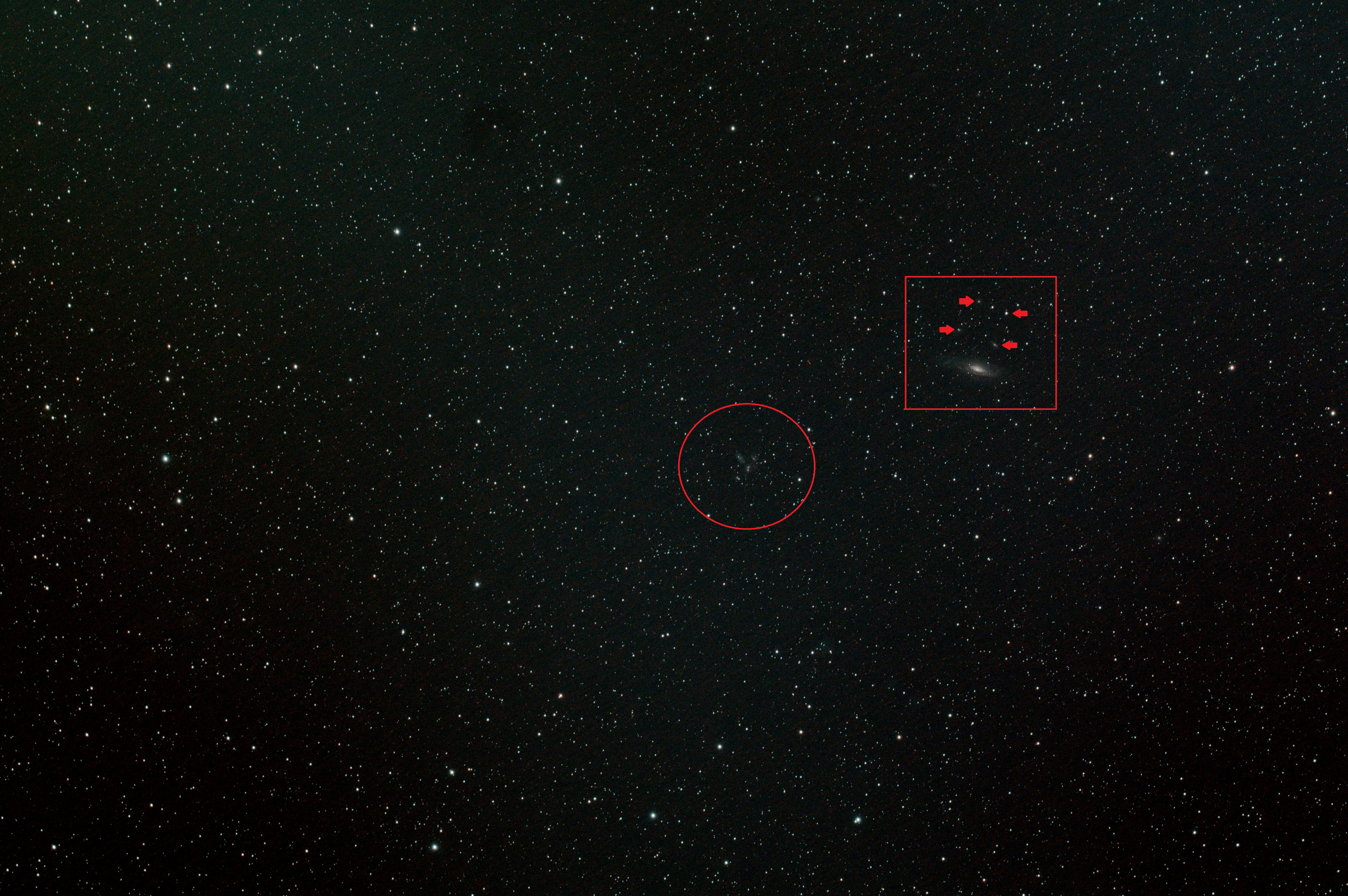
Widefield view of Stephan’s Quintet (red circle) and NGC7331 + Deer Lick Group (red box)
WO GT81, Canon 700D + FF | 20 x 120 secs + darks/bias/flats @ ISO 1,600
Located in the constellation of Pegasus, Stephan’s Quintet is a group of four galaxies whose respective gravities lock them in a cosmic dance with each other that will inevitably lead to their coalescence. The fifth and brightest member of the group, NGC 7320, is in fact just 40 million light years away but viewed from Earth appears to be spatially associated with the aforementioned group and thus makes up the fifth member of the quintet. Unfortunately my 80 mm telescope only shows a smudge of light from Stephan’s Quintet but it is light that has just arrived here at Fairvale Observatory after making a 300 million year journey, it is literally looking back in time. A more substantial Hubble image shows us exactly what was happening to these galaxies at that moment – it seems probable that they have by now come together but we’ll have to wait another 300 million years to see that.
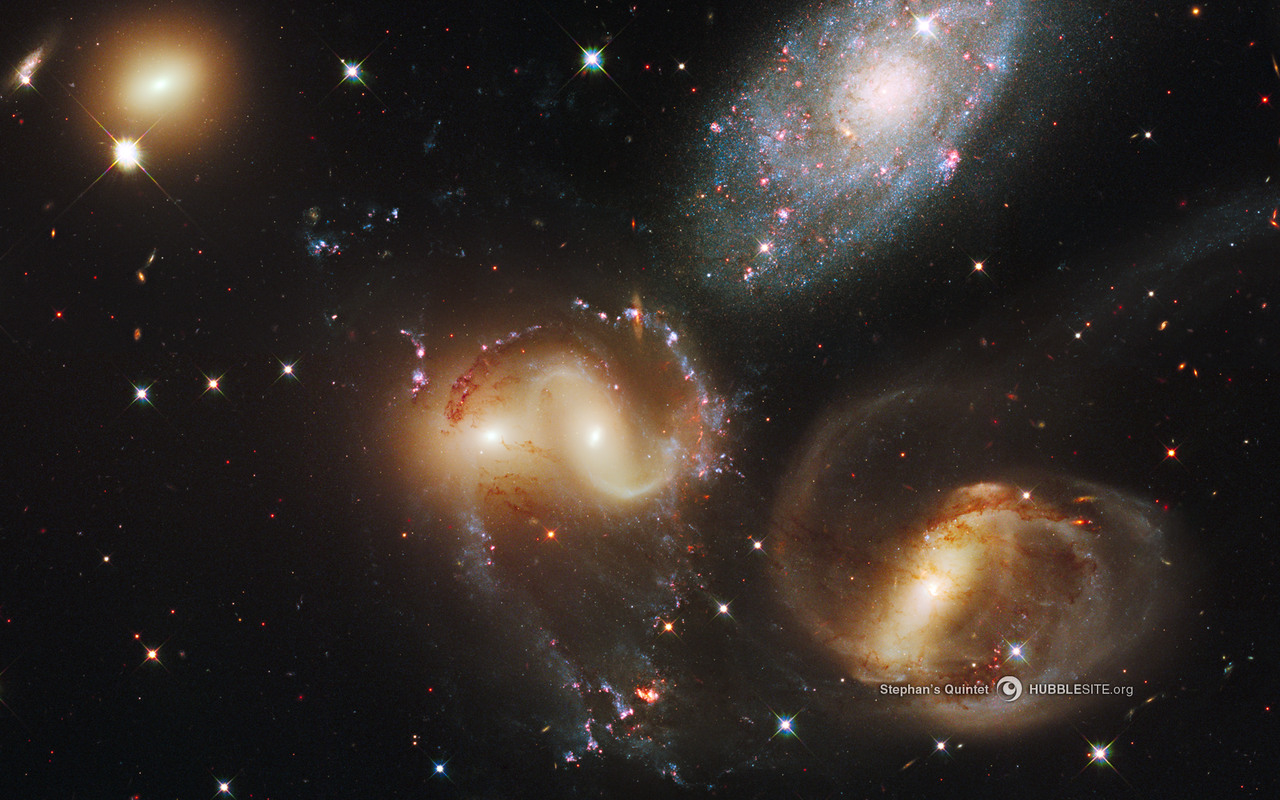
Stephan’s Quintet taken by the Hubble telescope
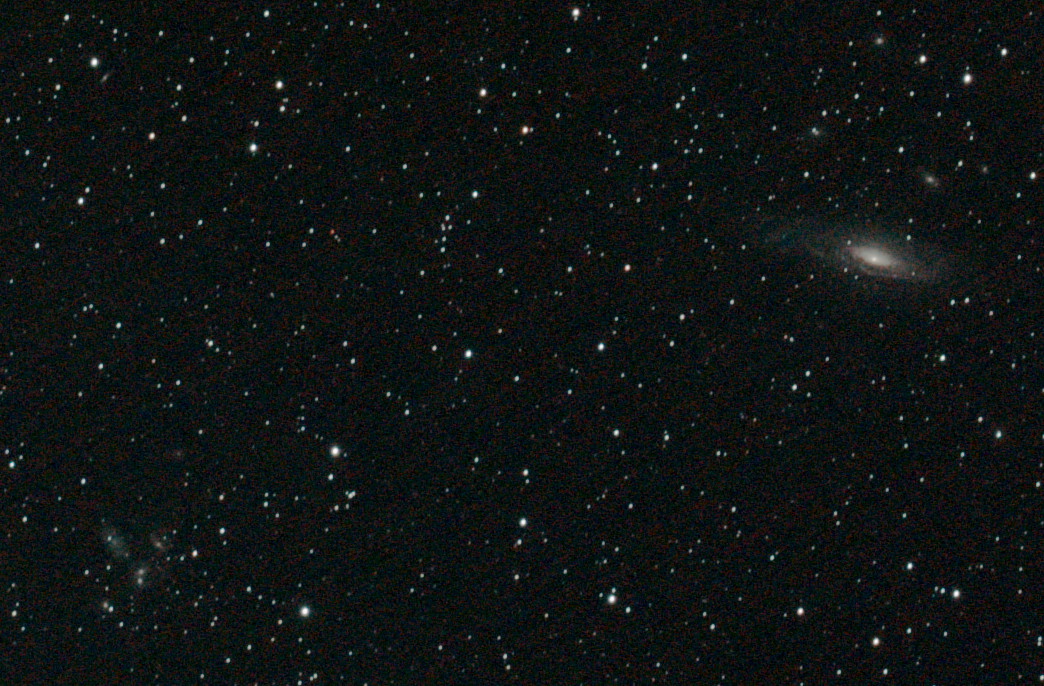
Stephan’s Quintet (bottom left) and NGC 7331 + Deer Lick Group (top right)
One advantage of the smaller 80mm William Optics refractor telescope is that its field of view is quite large and whilst seeking to capture Stephan’s Quintet, I also inadvertently managed to image another group of galaxies. In this case the dominant NGC 7331 galaxy with, apparently close-by but actually located up to ten times further away, the Deer Lick Group of galaxies. The magnificent NGC 7331 is a mere 50 million light years from Earth and is thought to be similar to our very own Milky Way. The Deer Lick Group (indicated by four red arrows in the main picture above) is however some 400 million light years* away – thus corresponding to the mid-Devonian period or the Age of Fishes; named after the red rocks first identified in Devon, UK and particularly known for its plethora of fish that developed at this time. I am quite sure that even The Doctor would be impressed by the time travelled by the light from these objects as it arrives here on Earth after such a long journey and provides us with a glimpse of the past, today.
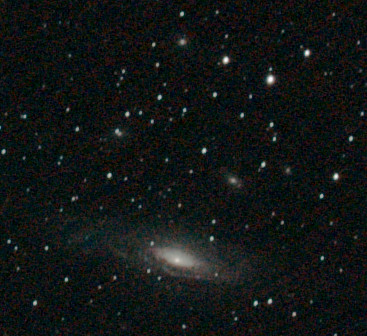
NGC 7331 spiral galaxy (foreground) and Deer Lick Group above (see main anotated picture for detailed location). Light from the Deer Lick Group of galaxies is over 400 million years old.
* For the record, light travels 670 million miles in one hour or 6 trillion miles in one year.
 WATCH THIS SPACE(MAN)