As a geologist the centre of the world is very clear to me. Depending on where you are, on top of Everest, in the Mariana Trench but more relevant here at Fairvale Observatory in Redhill, the centre is approximately 7,900 miles beneath my feet. Less geologically minded will argue this is the centre of the Earth and might instead therefore like to adopt Mr Wikipedia’s definition of the geometric centre of all land surfaces, which is 40°52′N 34°34′E (180 km northeast of Ankara, Turkey). However, for an astronomer and mankind in general wanting to navigate either the sky or the world it is the Prime Meridian, which passes just over 5 miles east of here at Fairvale Observatory – I often cycle across it, though you wouldn’t know it!
The notion of longitude was developed by the Greek Eratosthenes (c 276 – 195 BC) and Hipparchus (c 64BC – 24BC) but it was Ptolemy (c AD90 – 168AD) who first used a consistent meridian for his map in Geographia. Subsequently various other ‘meridians’ were adopted over the following centuries by various cultures and map makers, located according to local, scientific and often political interests.
In the early eighteenth century the quest had become urgent to improve the determination of longitude at sea, leading initially to the development of the chronometer by John Harrison. But it was the development of accurate star charts, mainly by the first British Astronomer Royal , John Flamsteed, between 1680 and 1719 and continued by his successor, Edmund Halley, that enabled navigators to use astronomical methods of determining longitude more accurately. Following the success of Neville Maskelyne’s Nautical Almanac between 1765 and 1811, today’s Prime Meridian was finally established by Astronomer Royal, Sir George Airy in 1851 at the Royal Observatory, Greenwich in London and has since formed the principal basis of all earthly (longitude) and celestial (right ascension or RA) navigation; these two are not the same but are both derived from the prime meridian as a starting point. The Prime Meridian established in 1851 passes through the Airy transit circle at 51° 28′ 40.1247″ North 0° 0′ 5.3101″ West at the Greenwich Observatory.

The Greenwich Meridian (marked by a stainless steel line and globe) viewed from just behind Airy’s transit telescope. On a wet day school children line up along the meridian line, which separates the western hemisphere of the world on the left of the picture from the eastern hemisphere on the right.
I am currently a member of the Flamsteed Society, an amateur astronomy group based at the Royal Observatory and National Maritime Museum in Greenwich and earlier this week spent the day there to attend some astronomy shows and lectures, whilst also viewing exhibits, some of which I first saw as a teenager in the 1960’s. Professional British astronomy has long since ceased at the Observatory due to London’s light pollution; at first moving on to Herstmonceaux in East Sussex, then La Palma and now (I believe) Chile? However, the site remains steeped with an unparalleled history of time, navigation and astronomy, which are fascinating and marvellous to behold – a must-see for any astronomer.
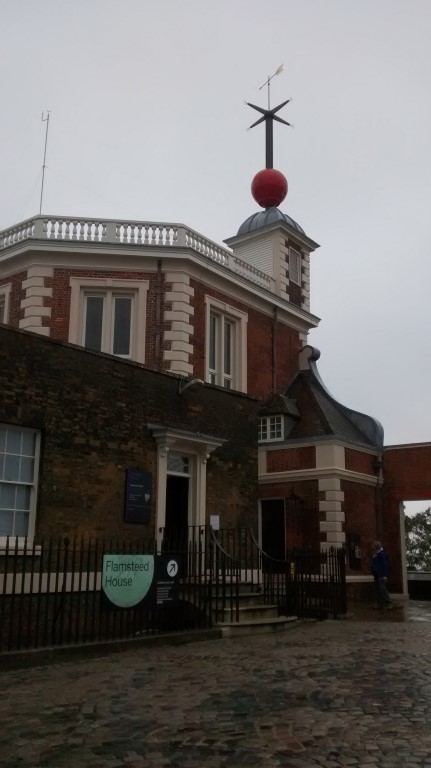
Flamsteed House designed by Sir Christopher Wren in 1675 – today the building houses various permanent and occasional exhibits related to time and astronomy. First used in 1833, each day at exactly 12.55 the red ball (the Time Ball) on the roof rises half way up the mast and at 12.58 continues to the top, when at exactly 13.00 it drops so those around can tell the time accurately once a day.
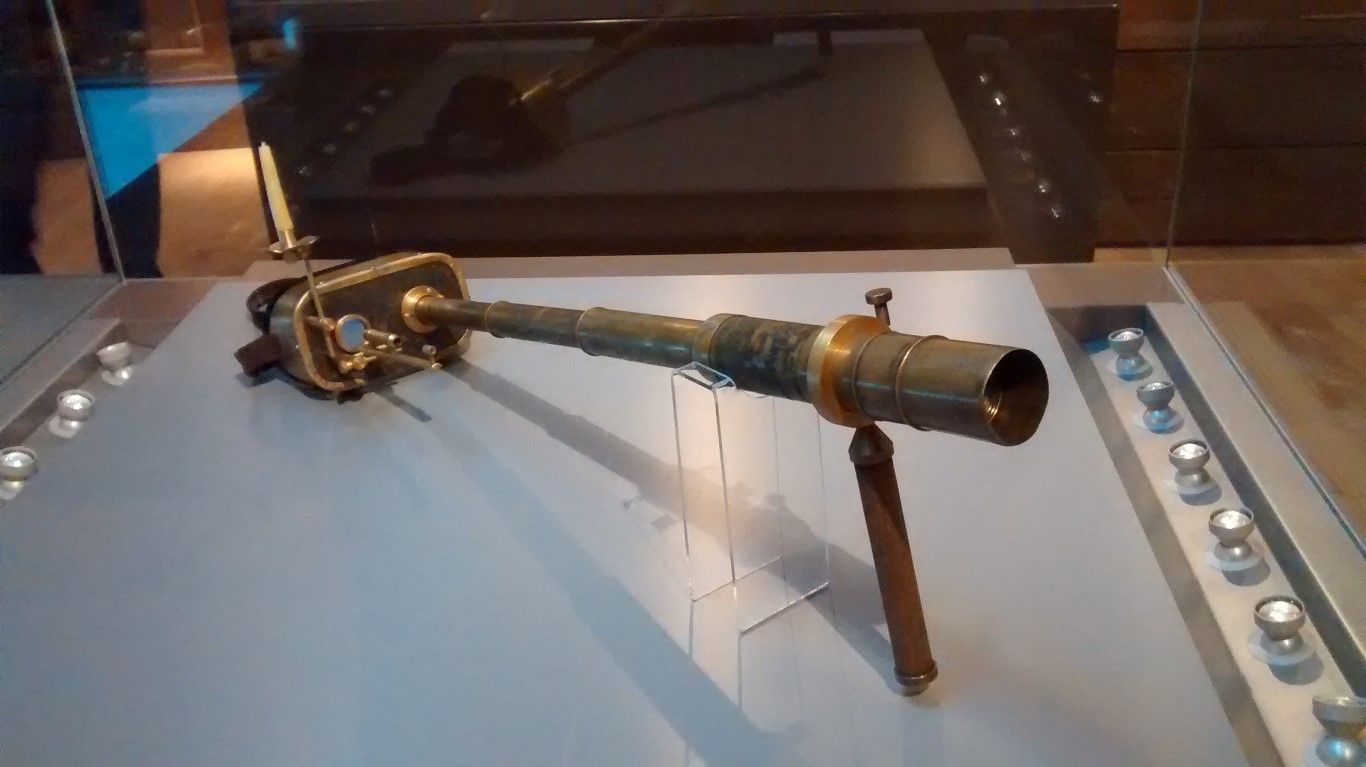
A telescope that is worn on the head (note straps) and has a candle to assist with seeing where you are!
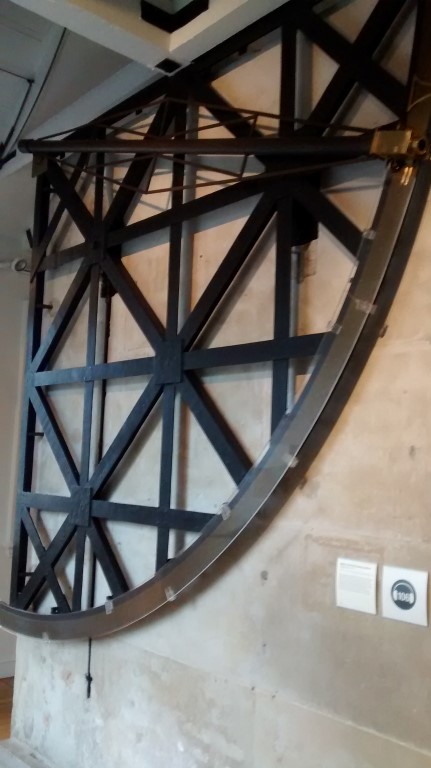
Edmund Halley’s Quadrant, used to measure and record the transit of his eponymous comet.
I am proud of my nation’s achievements in the establishing The Prime Meridian and it is strangely of comfort that the Meridian passes close to my front door. However, as a result of modern satellite navigation and a more accurate understanding of the Earth’s shape and gravitational effects, today’s Prime Meridian 0o 00’ 0.00” – or International Reference Meridian as it is now officially known – has shifted 5.3 arc seconds to the east of Airy’s original line (I make this a whopping 102.96 metres). Furthermore, and pleasingly British in nature, the meridian used by the Ordnance Survey for its mapping is about six metres west of Airy’s meridian, known commonly as the Greenwich Meridian; having been previously established in 1801 by the third Astronomer Royal, James Bradley in a room adjacent to and therefore six metres away from the location of Airy’s transit instrument used to establish the Greenwich Meridian – the OS have simply continued to use Bradley’s Meridian to this day!
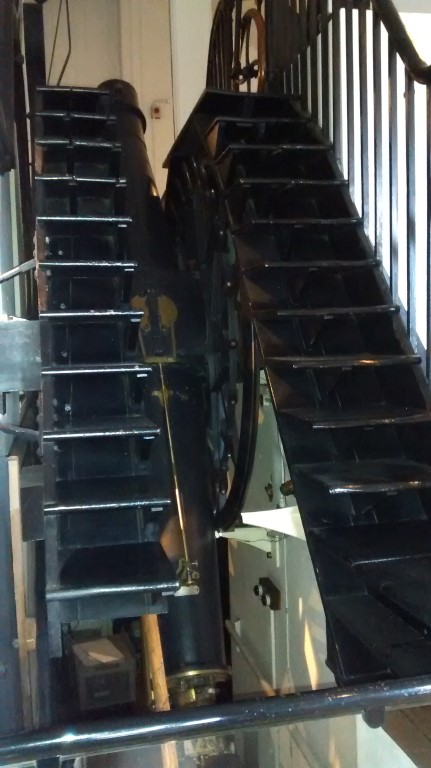
Airy’s transit telescope, used to establish the Greenwich Meridian in 1851 – viewed from behind looking south i.e. east is left and west is right.
 WATCH THIS SPACE(MAN)
Pingback: Reflections – 2014 | WATCH THIS SPACE(MAN)