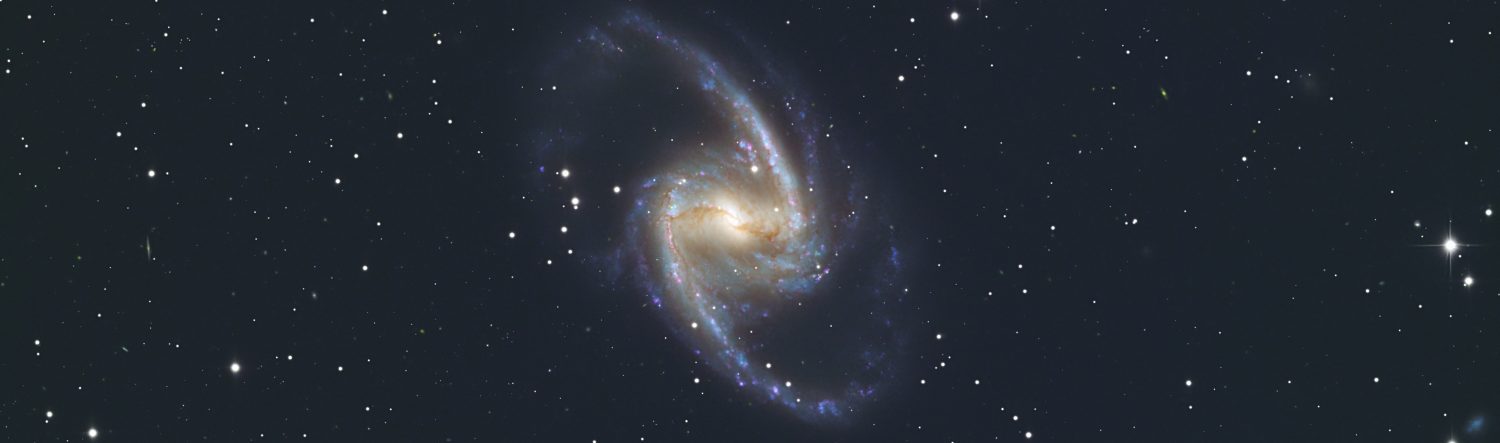
A big surprise to me since starting astronomy has been star clusters, which I was strangely unaware of before. They come in two basic varieties – globular and open – their general nature is, as so many things astronomical, mind blowing. The Milky Way has about 160 globular clusters, with highly elliptical orbits to the galaxy, whilst more distant galaxies such as M87 have over 13,000. Each globular cluster typically contains hundreds or even millions of stars held together by gravitational forces in a roughly spherical form, generally packed into regions of ‘just’ 10 ly to 30 ly diameter.
Globular cluster stars are considered to be some of the oldest known objects in the Universe, formed just a few hundred million years after the formation of the Universe itself, and appear to be some of the first produced during galaxy formation. Most of the stars are red and yellow Population II stars or ‘metal poor’, which have formed after a supernova. More rare blue stars, known as blue stragglers, may also exist in globular clusters and are thought to be formed in the dense inner regions of stellar mergers. Notwithstanding, the origin of globular star clusters is still poorly understood but research suggests they may be survivors of galactic mayhem 13 billion years ago.
http://www.mpa-garching.mpg.de/mpa/institute/news_archives/news1202_aaa/news1202_aaa-en-print.html
No known globular clusters display active star formation today, which is consistent with the view that globular clusters are typically among the oldest objects in the Universe and were some the first collection of stars to form.
And so the other evening I turned the camera on a globular cluster, M15 or NGC 7078, located by the constellation of Pegasus. Estimated at 12 billion years old, it is one of the oldest globular clusters, 33,000 ly from Earth and one of the more densely packed clusters in the Milky Way, containing some 100,000 stars. Notably M15 contains a number of variable stars, pulsars, one neutron star and also unusually, a planetary nebula. All-in-all quite a catch though I am still mystified and intrigued by their occurrence!
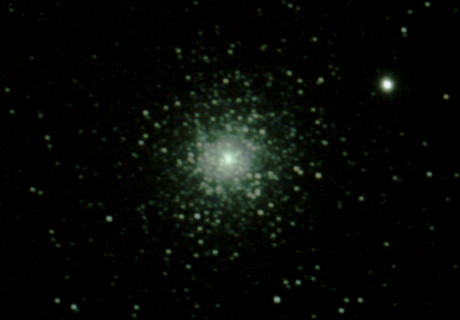
M15 Globular Cluster
Canon 700D unguided | 20 x 90 secs + darks / bias / flats @ ISO 800
 WATCH THIS SPACE(MAN)