
Appearances can be deceiving. WYSIWYG was a term used in 1980’s computing (maybe it still is?) when printing, to indicate that what you saw on the computer screen e.g. formatting and layout, would be the same when printed: What You See Is What You Get. Being the early days of computing for the ordinary ‘man’, when Microsoft and Apple were just emerging from being start-up companies, the growing choices of hardware and software were not always fully compatible, frequently resulting in a lack of WYSIWYG’ness or put plainly, rubbish printing output. Even in the 21st century everything is still not WYSIWYG.
I have just completed building and now started to use the new External Astronomy Control Centre (EACC) at Fairvale Observatory. I am unable to have a full blown, dedicated observatory here at Fairvale, so have to set-up and take down all the astronomy equipment on the patio outside each time I want to carry out viewing or imaging. It’s a chore, particularly since getting the new and much heavier AZ-EQ6 GT mount and many other pieces of equipment and gizmos; I know this accumulation of equipment and related computing will only continue for the foreseeable future – I am now certain this is an immutable law of astronomy!
Central to controlling all this equipment is the computer. Currently its main function is for planetarium software and image control and capture: camera settings-up and auto-capture, thus making the large number of images required (subs, darks, bias and flats) less of a chore and, in general, easier to carry out. I soon hope to extend such computer control to the mount, auto-guiding and tracking correction, plus linking all this to the planetarium for easier navigation.
For the moment this requires that I take my laptop computer outside in order to connect it to the various pieces of equipment, which as the longer, colder nights become more prevalent, exposes it to potentially damaging conditions e.g. dew; I may eventually be able to move the computer inside but for the moment it has to be outside. Furthermore, even using red-screen software to produce a red hue over the computer screen in order to reduce light spilling during image capture (it also helps the eyes to remain adjusted to night vision), the resulting red light is still quite bright and potentially detrimental to imaging. As a result of these issues I decided to embark on the construction of the aforesaid EACC.
The EACC design needed to be such that it is light, mobile and easy to set-up, whilst primarily achieving two main functions to combat the above problems: (i) protect the computer and leads from the environment – mostly cold and dew, and (ii) as much as possible, contain and thus restrict light spillage from the computer screen. After detailed consideration of possible designs, the resulting EACC has so far proved to be very successful in meeting these objectives. However, acronyms and fancy names can be deceptive – the EACC is a cardboard box!
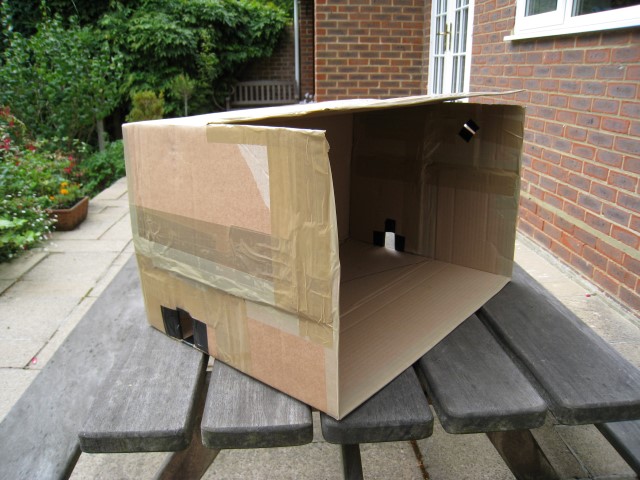
EACC in development
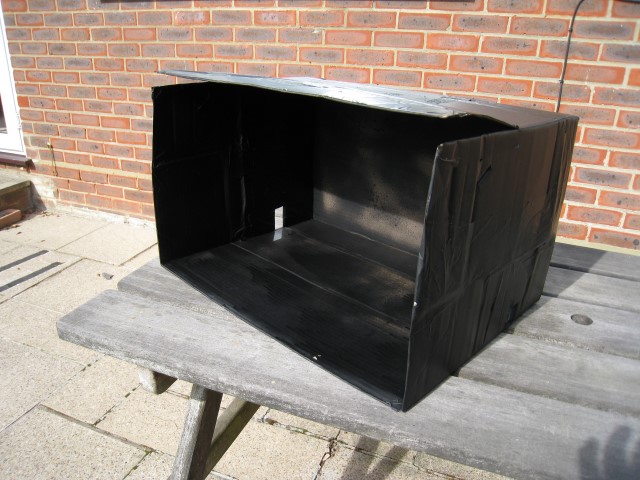
EACC completed (there have been a few minor amendments)
Notwithstanding, it is turning out to be a very useful cardboard box.
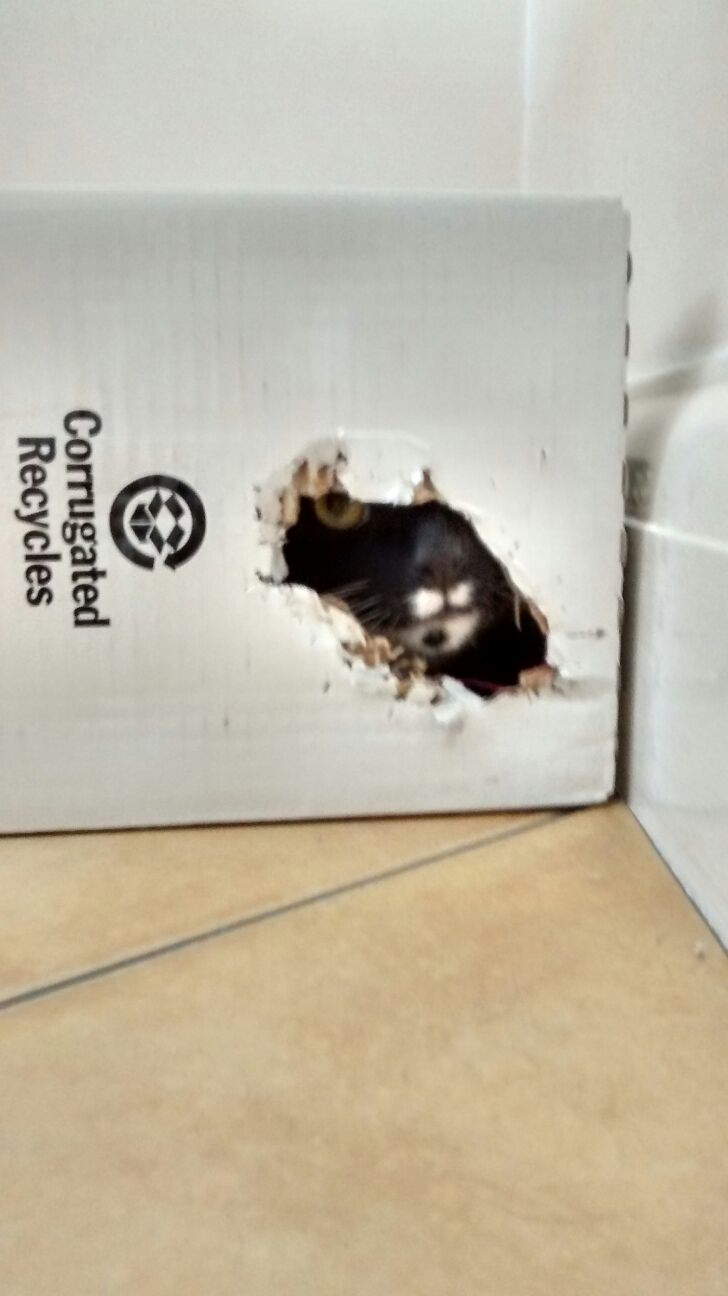
Other recent cardboard box developments – in this case my daughter Alison’s cat Alan looking out of a box, he is particularly keen on attacking and ‘catching’ feather dusters offered up to the hole.
Of course, it won’t stand up to extreme weather conditions but then I won’t be carrying out astronomical viewing and imaging in such conditions. It has been very successful in restricting light, though it is still important that the AP (AP = access portal = front) is directed away from the telescope in order to direct light spillage away. Once I had established its usefulness, I sprayed it with a mat black paint to further reduce reflected light and make it a little more damp resistant – it is after all cardboard. All-in-all a very useful EACC (cardboard box), which however is not what it might at first appear to be – much like the vision technician, or window cleaner!
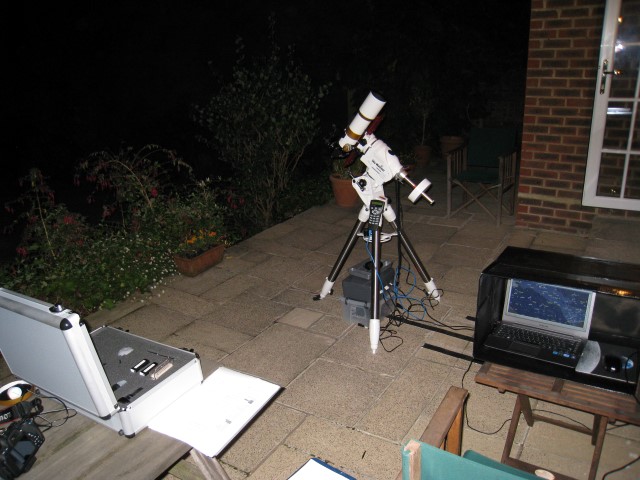
Last night the EACC in use
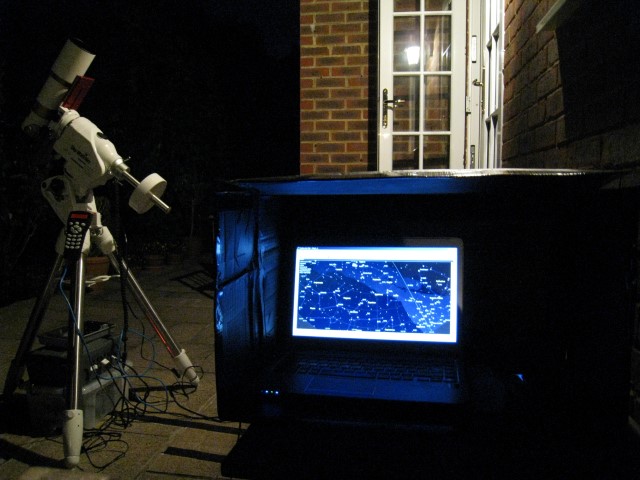
The cunning EACC design usefully deflects computer screen light away from the telescope & camera whilst imaging
 WATCH THIS SPACE(MAN)