The Bat

It’s Halloween time of the year and I don’t like it.  My problem is that in the UK this used to be a minor event, treated as a bit of fun for some and ignored by most.  However, it’s been given the North American makeover and pumped up as a big deal, mainly on commercial grounds. Grrrrr!

Less seasonable has been the weather, which thankfully continues to be warm and sunny with occasional clear night skies. Hooray!  A great combination enhanced further by the appearance of winter astronomy objects and since last weekend’s change of clocks 1-hour backwards, darkness from early evening.  What’s not to like for the astronomer?  Starting at 6 pm I was therefore able to spend more than 7 hours on Monday night imaging a procession of DSOs as they approached and passed the meridian.  Moreover, I achieved almost perfect alignment and for the first time was able to obtain good exposures of between 120 and 180 seconds; had I tried I suspect even longer periods could have been achieved.

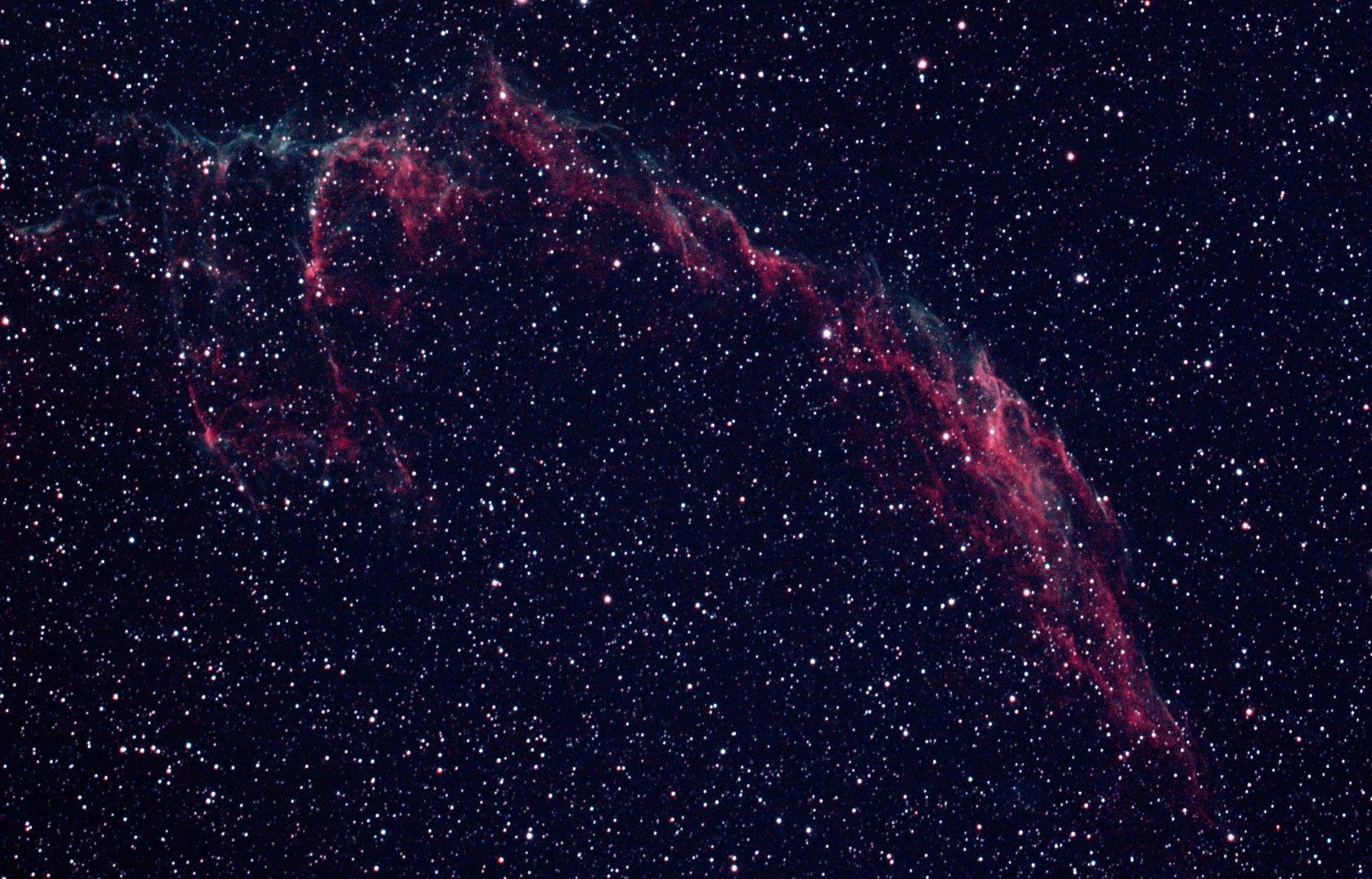
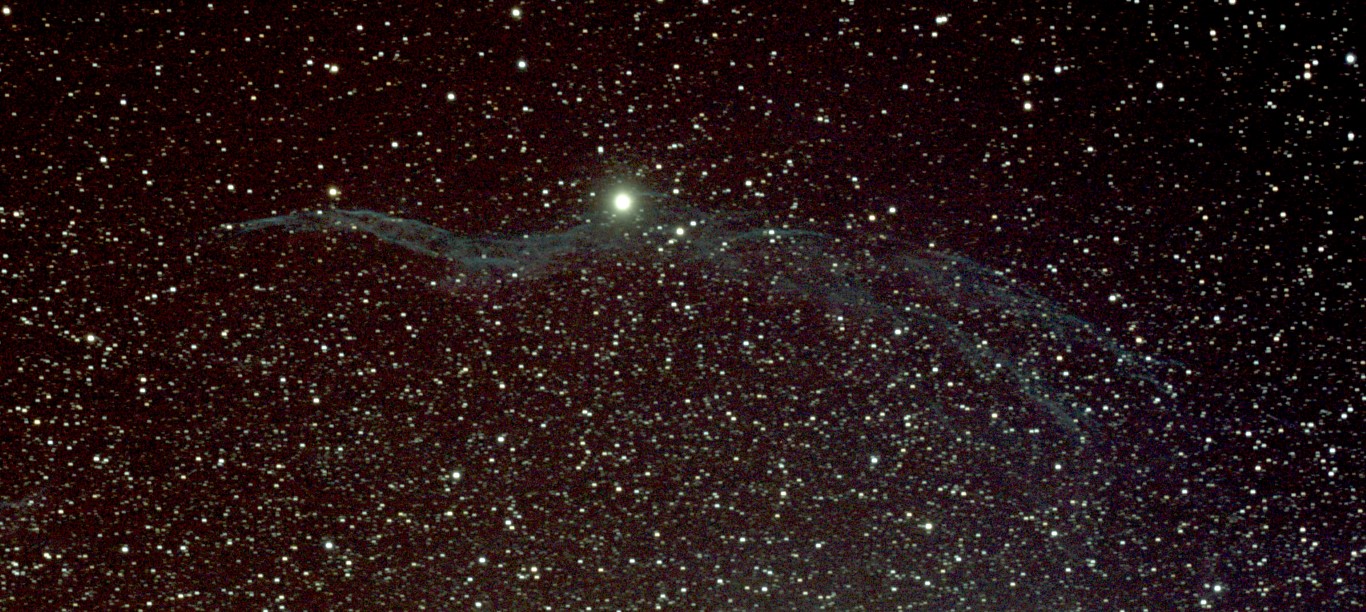
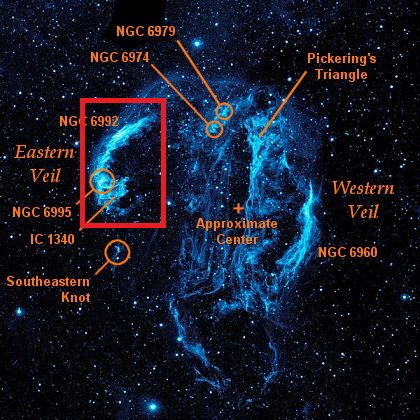
First off the rank was the Veil Nebula, part of the even larger Cygnus Loop, a massive supernova remnant.  Located about 1,470 light years away and between 5,000 and 8,000 years old, much of this this emission nebula is not in the visible spectrum and what is is feint and difficult to image.  I have already obtained a good photograph of the Western Veil of the nebula, also known as NGC 6960 or the Witch’s Broom https://watchthisspaceman.wordpress.com/2014/10/04/the-witchs-broom/ .  Now with such good conditions and my best ever alignment, I decided to turn my attention to the Eastern Limb, or NGC 6992 and NGC 6995.

Cygnus Loop (Veil Nebula)  in untraviolet light. Image area of the Western Veil highlighted by red box.

Cygnus Loop (Veil Nebula) in untraviolet light. Image area of the Eastern Veil highlighted by red box.

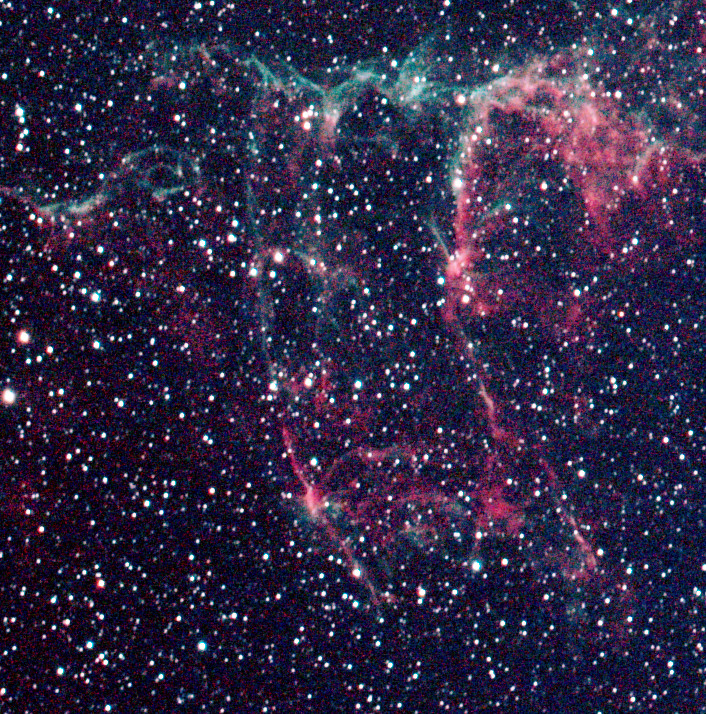
Using the new CLS light pollution filter and 30 x 120 second exposures, the resulting image from the camera immediately showed the full extent of this magnificent object, even before processing. Post processing the feature really comes to life, with large billowing waves of nebulous ionized gas and interstellar dust. The brighter, right-hand side (northern) of NGC 6992 trails off to the left (southerly) section of NGC 6995, also known as the Bat Nebula – well it is Halloween!

Eastern Veil Nebula - NGC  6992 (right) & NGC 6995 (left). WO GT81 + Canon 700D & FF | 29 x 120 secs + darks/bias?flats @ ISO 1,600

Eastern Veil Nebula – NGC 6992 (right) & NGC 6995 (left).
WO GT81 + Canon 700D & FF | 29 x 120 secs + darks/bias/flats @ ISO 1,600

NGC 6995 AKA The Bat Nebula (look carefully and you'll see him!)

NGC 6995 AKA The Bat Nebula (look carefully and you’ll see him!)

The Pinwheel

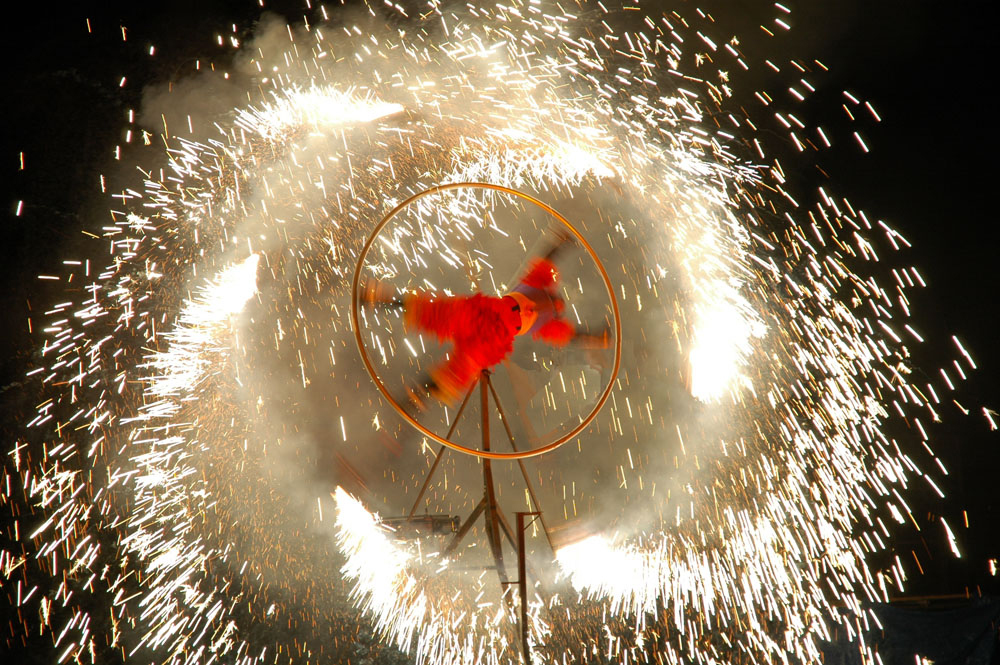
Just under two weeks until Guy Fawkes Night, which commemorates Guido Fawkes failed attempt to blow up Westminster Palace (The Houses of Parliament) on 5th November 1605 – a very British (English) event.   In its own way the Universe has a myriad of its own fireworks and it therefore seemed a fitting moment to attempt an image of one last week, which given their spectacular form and similarity to the popular Catherine wheel, AKA a Pinwheel firework, had to be a spiral galaxy.

The firework is named in commemoration of a Catholic martyr and is worth describing here before returning to matters of astronomy, simply because of it’s graphic nature.  Catherine of Alexandria lived during the fourth century A.D. but in a male dominated society, was unusually well educated and successfully converted many highly placed individuals to Catholicism.  As a result, she was condemned to “breaking the wheel”, which involved having one’s limbs broken and threaded through an abundantly spiked wheel.  The victim would succumb to his or her injuries, but only after several days.  However when Catherine touched the wheel it miraculously flew into pieces, so she was beheaded instead!
A human Catherine Wheel (Pinwheel)!

A human Catherine Wheel (Pinwheel)!

Having researched the current night sky using the Cartes du Ciel planetarium programme and taking account of the weather, it seemed feasible to image both Andromeda and M33 galaxies in a three hour period around midnight.  However, despite my thorough preparations I was to succumb to the best laid plans of mice and men and a return to previous frustrations.  

I have recently added a number of excellent widgets to the front page of WTSM: the current Moon phase, real-time world daylight map and Moon position, live sunspot activity and the excellent astronomy weather site Clear Outside, developed and maintained by First Light Optics.  There are also other weather sites listed under the Favourites menu.  All these indicated clear skies on Tuesday from 9pm and onwards throughout the night – so I planned to set up at 10pm and by 11pm, as Andromeda approached the Meridian would start imaging, followed by M33 shortly after midnight.  Contrary to the forecasts, at 10pm the clouds rolled in and did not clear until well past 11pm. Next, whilst my initial polar alignment wasn’t too bad but on a second iteration it got worse and after altogether five separate x2-star and subsequent polar alignments was not much better.  My new found skill had deserted me and by now it was past 1am – Andromeda had passed, so I just had to have a go at M33 before it too moved well past its optimal Meridian position.

For this session I decided to use my new CLS light pollution filter and subsequently tried to apply some of the processing advice gleaned from two excellent astrophotography books: Long Exposure Astrophotography by Allan Hall and Making Every Photon Count by Steve Richards.  I bought both these books earlier in the year, read them cover to cover at the time and then hadn’t picked them up since, which was a mistake as they’re full of good advice and information relevant to my current issues and problems; they are now required bedtime reading.

The CLS filter works by removing the wavelengths associated with light pollution but, as a result, leaves a dominant blue hue to the camera’s image, making it is necessary to rebalance the colour afterwards during processing.  A useful SGL blog points the way on how to do this by setting the Background Calibration (bottom left) in the Stacking Parameters ‘Light’ tab of Deep Sky Stacker (DSS) to RGB Channels.  DSS then normalises all three colour channels to the same value during stacking, producing a natural dark rather than blue background http://stargazerslounge.com/topic/82975-astronomik-cls-clip-canon-7d-very-blue-images/ .  The result is quite effective, though I am not completely sure that the process has not introduced a slight red shift which subsequently needed to be dealt with in Photoshop.

This time, on the Advice of Allan Hall, I also adopted a number of other settings using DSS:

  • RAW Process settings – (1) turn off all White Balance choices (2) set the Bayer matrix transformation to Adaptive Homogeneity-Directed (AHD) rather than Bilinear Transformation – changing the way the RGB Bayer weightings work (3) set the Black Point to zero.
  • Stacking Settings – this determines the type of stacking i.e. which algorithm is used to interpolate between one pixel and another. I have previously been using Average but this time, on the advice of Allan Hall, Steve Richards and others adopted either (1) Kappa-Sigma Clipping or (2) Auto Adaptive Weighted Average for each set of images, Lights, Darks, Bias & Flats. Some further experimentation of other settings in this area, such as Alignment, will probably be worthwhile at a later date.
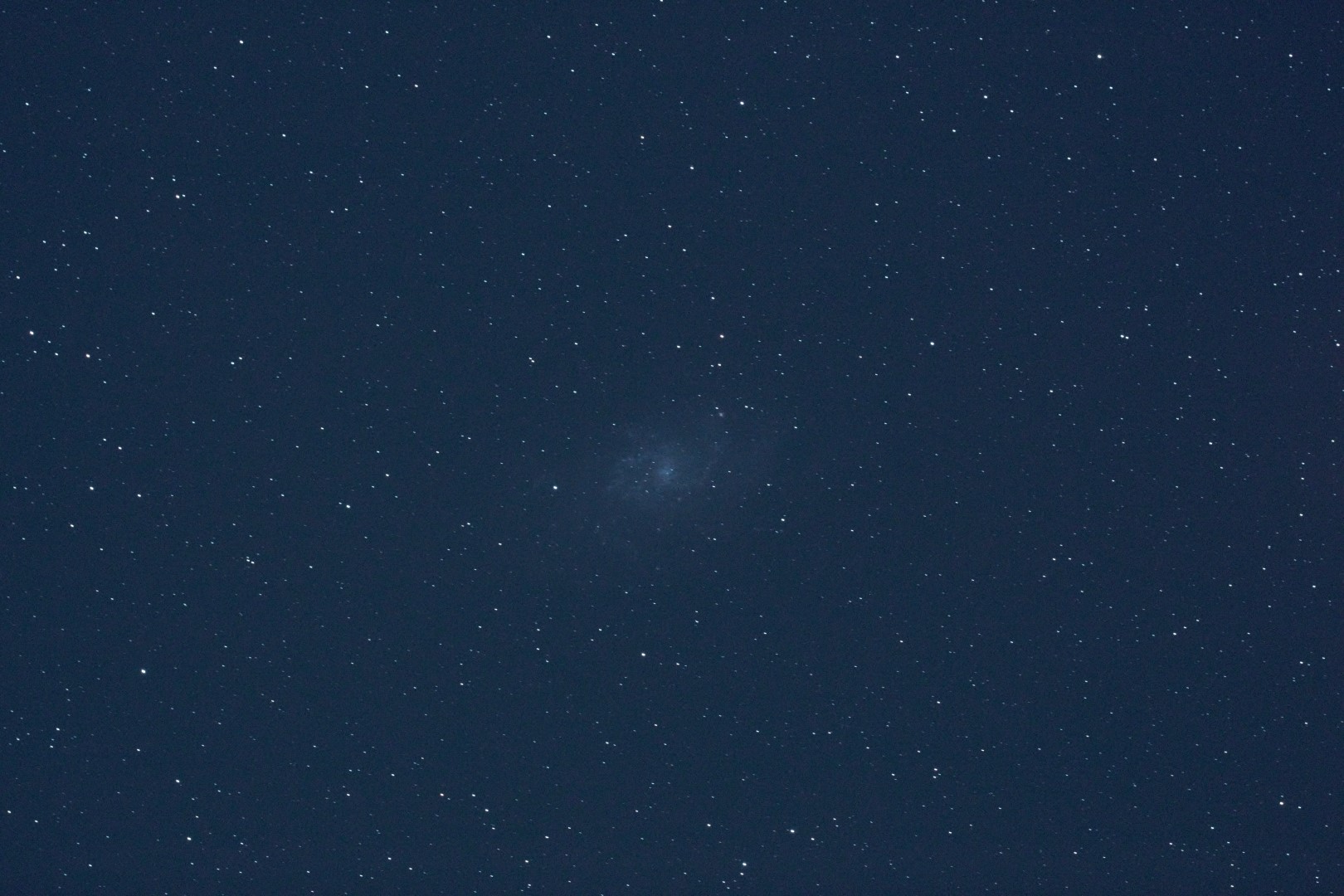
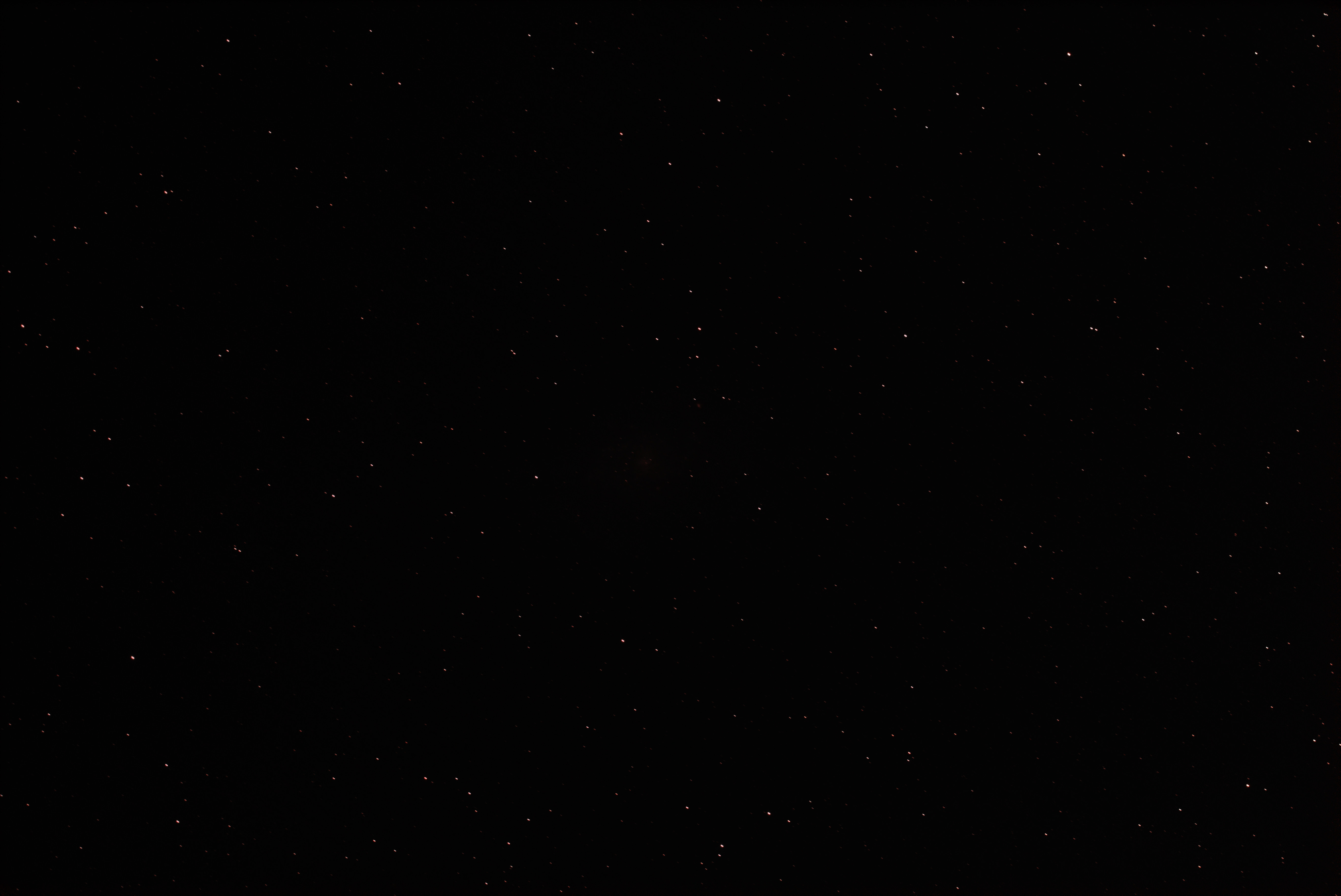
M33 - initial RAW image using CLS filter

M33 – initial RAW image using CLS filter
M33 - x20 90secs @ ISO 1,600, stacked with background calibration applied and Kappa- Sigma  Clipping, pre-stretching and post processing

M33 – x20 90secs @ ISO 1,600, stacked with background calibration applied and Kappa- Sigma Clipping, pre-stretching and post processing

Finally, following further advice from the aforementioned books, Mrs G and other sources I am also starting to delve deeper into the dark art of post processing using Photoshop.  The scope here to change images is almost endless and I am concerned about where reality stops and the software takes over, particularly with colour choices.  Notwithstanding these concerns it is a great programme, almost indispensable (GIMP is also a good & free alternative which I subsequently use for JPEG compression), the main purpose of which is to stretch the image and thereby reveal information otherwise hidden in the data – the impact is incredible and totally transforms the image.

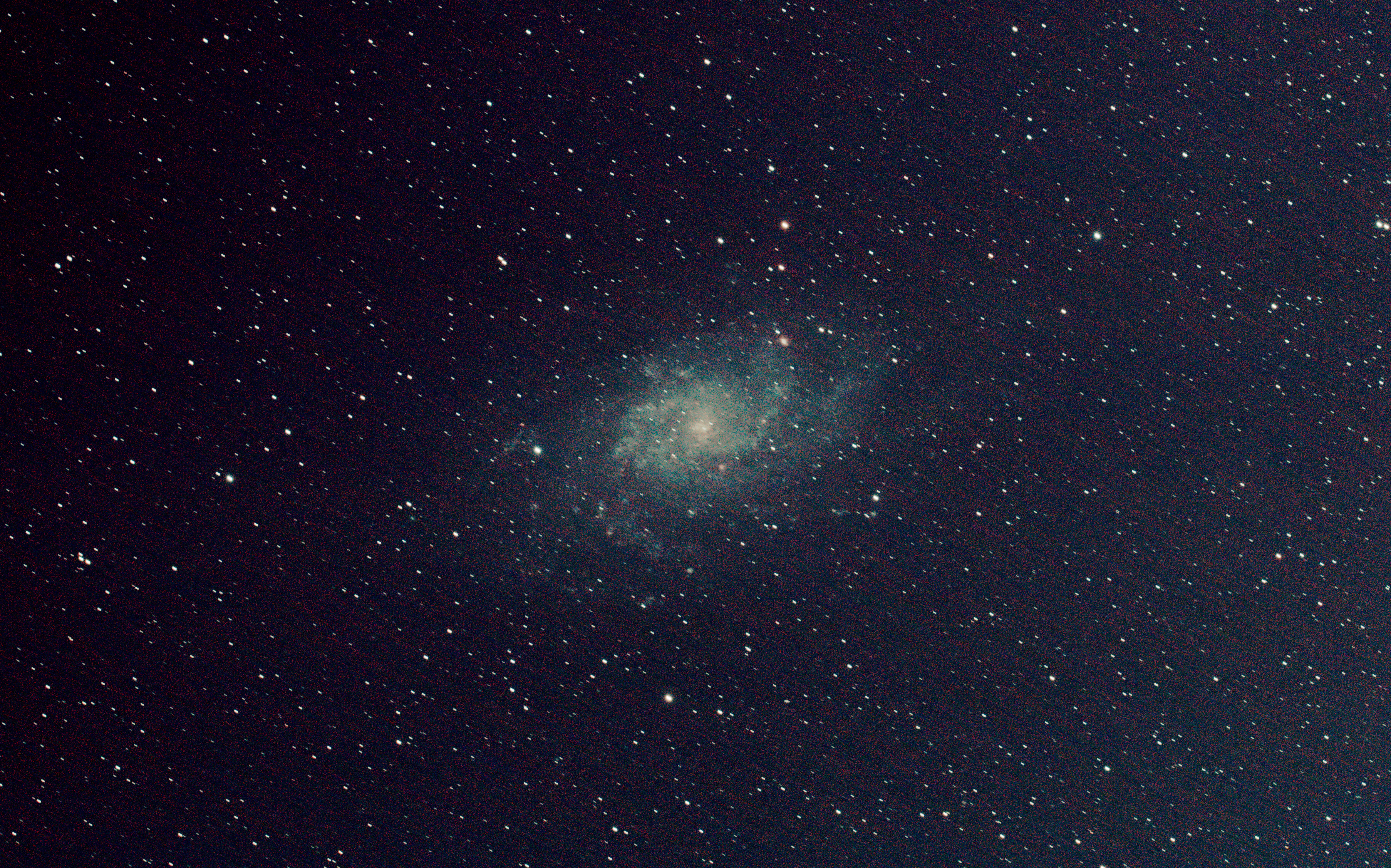
And so despite numerous setbacks and a very late night I finally arrived at an image of M33, AKA the Pinwheel or Triangulum Galaxy; confusingly M101 is also known as the Pinwheel Galaxy.  A  mere 3 million light years from Earth, it is one of the most distant objects that can be seen with the naked eye, though requires exceptional dark sky conditions, so unfortunately not much chance of seeing it on 5th November from here.  I’d like to think that I can do better once I can achieve longer exposures but for the moment it’s my first spiral galaxy.
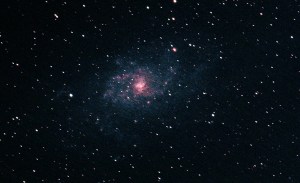
M33 - The Pinwheel Galaxy WO GT81 Canon 700D + FF | x20 90 secs @ ISO 1,600 | Kappa-Sigma Clipping

M33 – The Pinwheel Galaxy
WO GT81 Canon 700D + FF | x20 90 secs               @ ISO 1,600 | Kappa-Sigma Clipping stacking
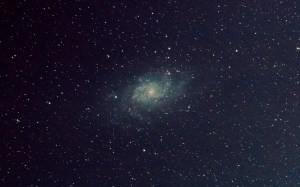
M33 - The Pinwheel Galaxy As above + Auto Adaptive Weighted Average stacking
M33 – The Pinwheel Galaxy
As before + Auto Adaptive Weighted Average stacking
It’s all about the wavelength

For the moment, putting aside the duality of light as a wave-particle (quantum) form, the behaviour of light in the visible spectrum can be both fascinating and a problem for the astronomer.  As my tracking has improved (and hopefully will get even better) it has been possible to increase exposure times from a maximum of 40 seconds (and that was pushing it), to comfortably 90 seconds and sometimes more.  The impact is that more light is gathered by the camera’s sensor and the outcome is greater detail and more colours – this all helps, a lot, when the light may travel for thousands or even millions of light years before hitting the sensor.

Unfortunately Fairvale Observatory is located on the southern edge of London and about 8 miles north of Gatwick airport, the result is that all that lovely light that has travelled from distant objects in the Universe has to compete with man-made light pollution.  Last week I therefore invested in an Astronomik CLS filter http://www.astronomik.com/en/, which clips inside the camera, just behind the lens, and blocks the spectral lines of mercury and sodium-vapour lamps, letting the remaining part of the visible spectrum and H-alpha through.

  • The horizontal axisis the Wavelength in Nanometers (nm). 400nm is deep blue, at 520nm the human eye senses green and at 600nm red. At 656nm is the famous “H-Alpha” emission line of hydrogen.
  • The transmission in %is plotted on the vertical axis.
  • The redline shows the transmission of the filter.
  • Visual filters: The greyline in the background shows the relative sensitivity of the human eye at night. The maximum is at ~510nm and drops to longer and shorter wavelengths. You can easily see, that you can´t see anything of the H-alpha line at night (even if you can during daylight!) The sensitivity at 656nm is 0% at night!
  • Photographic filters: The grey line in the background shows the sensitivity of a typical CCD sensor.
  • The most important artificial emissionlines are shown in orange. The artificial light pollution is dominated by see mercury (Hg) and sodium (Na), which are used in nearly all streetlights.
  • The most important emission lines from nebulasare shown in green. The most important lines are from ionized Hydrogen (H-alpha and H-beta) and double ionized oxygen (OIII).

The major emission lines of artificial light pollution:
| Hg 435,8nm | Hg 546,1nm | Hg 577,0nm | Hg 578,1nm |
| Na 589,0nm | Na 589,6nm | Na 615,4nm | Na 616,1nm |

The major emission lines of nebulas:
H-β 486,1nm | OIII 495,9nm | OIII 500,7nm | H-α 656,3nm

Since my recent success imaging the Orion Nebula I’ve been frustrated by bad weather, cloudy skies and a full Moon.  With a brief gap in the clouds last night I therefore couldn’t resist the opportunity to try out the new filter with the camera but without using the telescope.  Shooting two sets of pictures, with and without the filter, and using a telephoto and 50 mm standard lens, the results were both successful and perplexing.

As expected it darkens the sky, a lot, but also skews the resulting image towards blue which subsequently has to be adjusted during processing, complicating the question of what is the right colour even more.  It is a known fact that despite the obviously very large distances of astrophotography subjects, some camera lenses need to be focussed just short of the lens‘s infinity position.  However, with the standard lens the focus point was very different when using the filter, noticeably less than without the filter.  This seems quite strange and I have not quite worked out why this should be so, except the loss of and therefore change in wavelength of the light?

It will be interesting to see how the filter works when imaging deep sky objects using the telescope once the weather clears but the preliminary tests are promising.  Certainly the ‘loss’ of light incurred will require longer exposures so I had better sort out autoguiding soon, my next challenge.

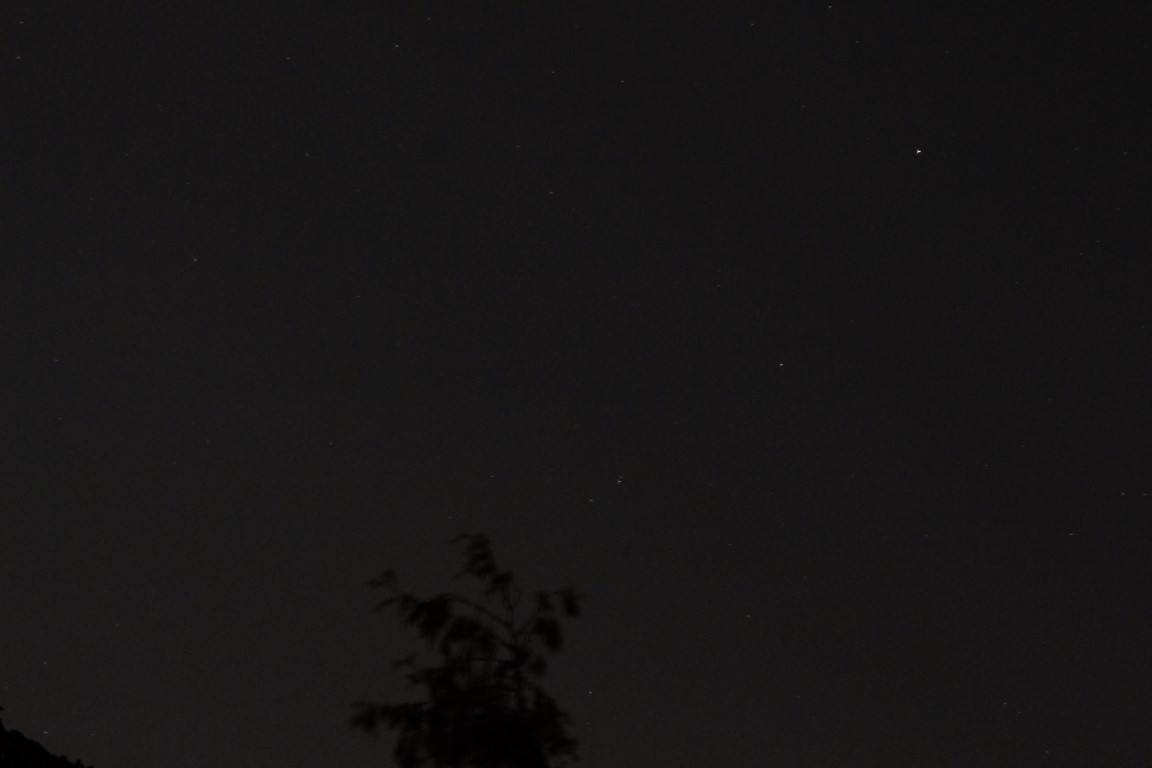
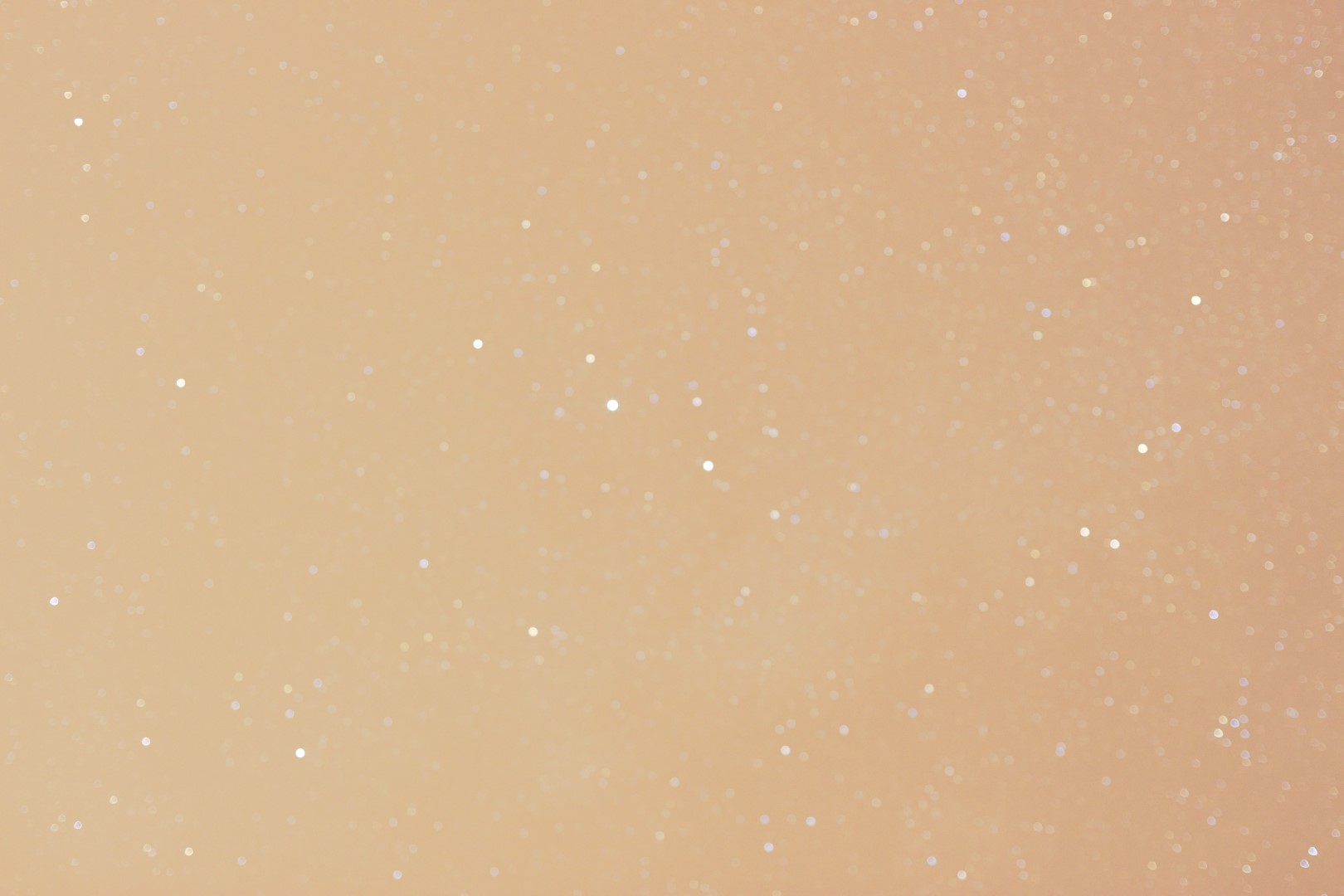
Without CLS filter, 8 secs @ ISO 800

Without CLS filter, 8 secs @ ISO 800

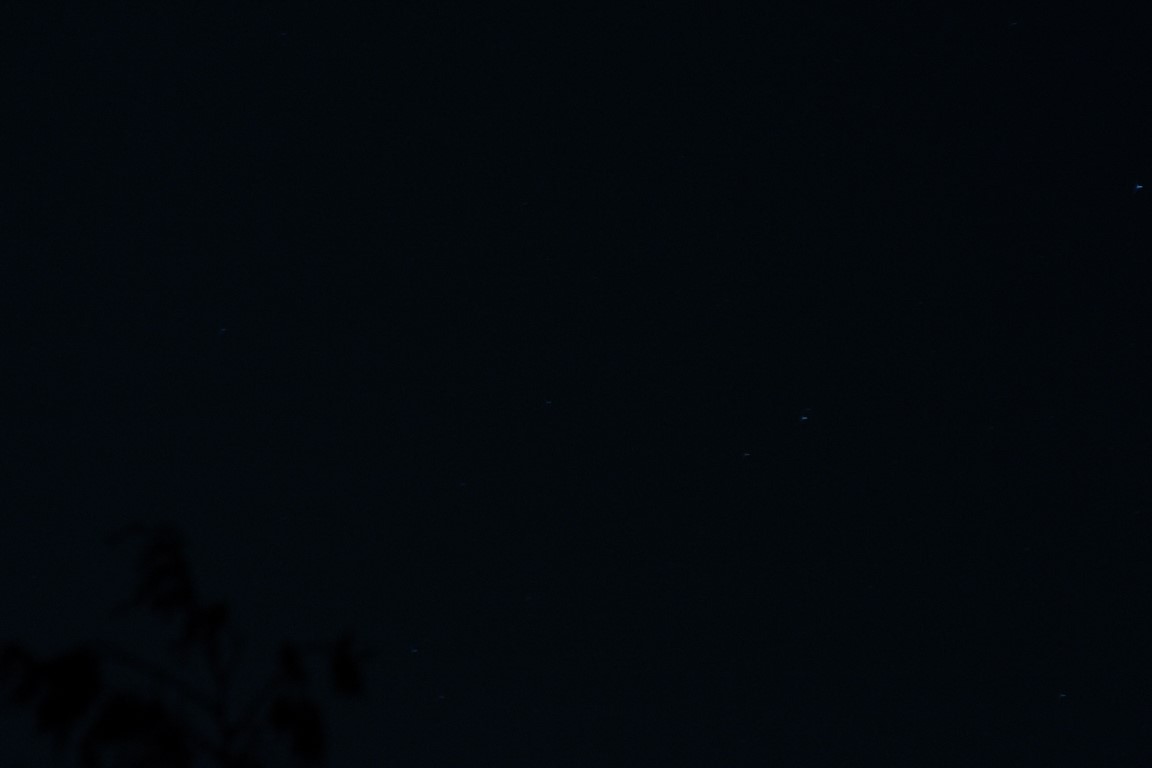
With CLS filter,  8 secs @ ISO 800

With CLS filter, 8 secs @ ISO 800

Milky Way - in the Tarazed region -  60 seconds (only!) @ ISO 800

Milky Way (Tarazed region) without CLS filter                        60 seconds (only!) @ ISO 800

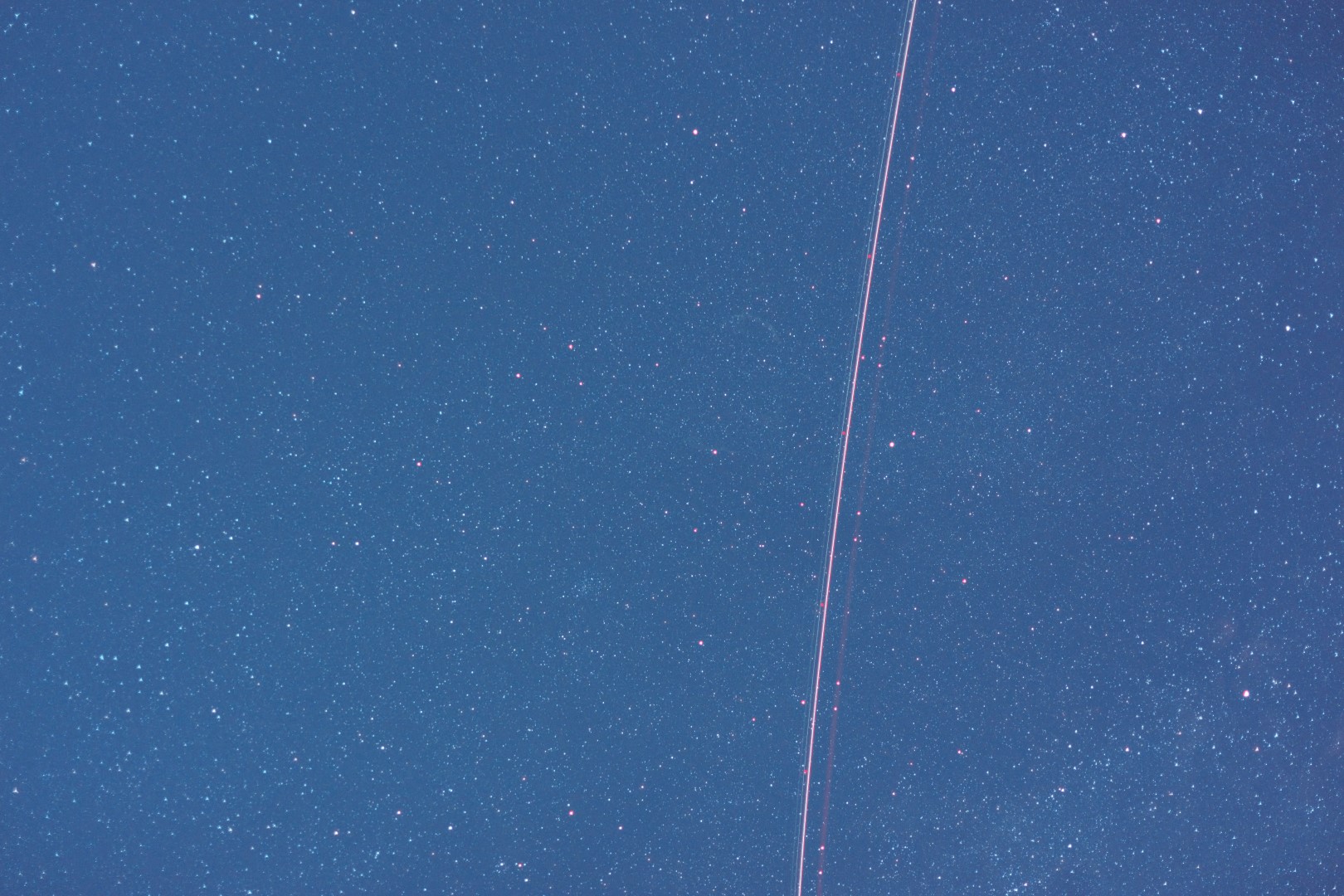
Veil Nebula, with CLS filter, 90 secs @ ISO 800 (+ plane trace!) - unprocessed

Veil Nebula (and aircraft trace!) with CLS filter              90 secs @ ISO 800  – unprocessed

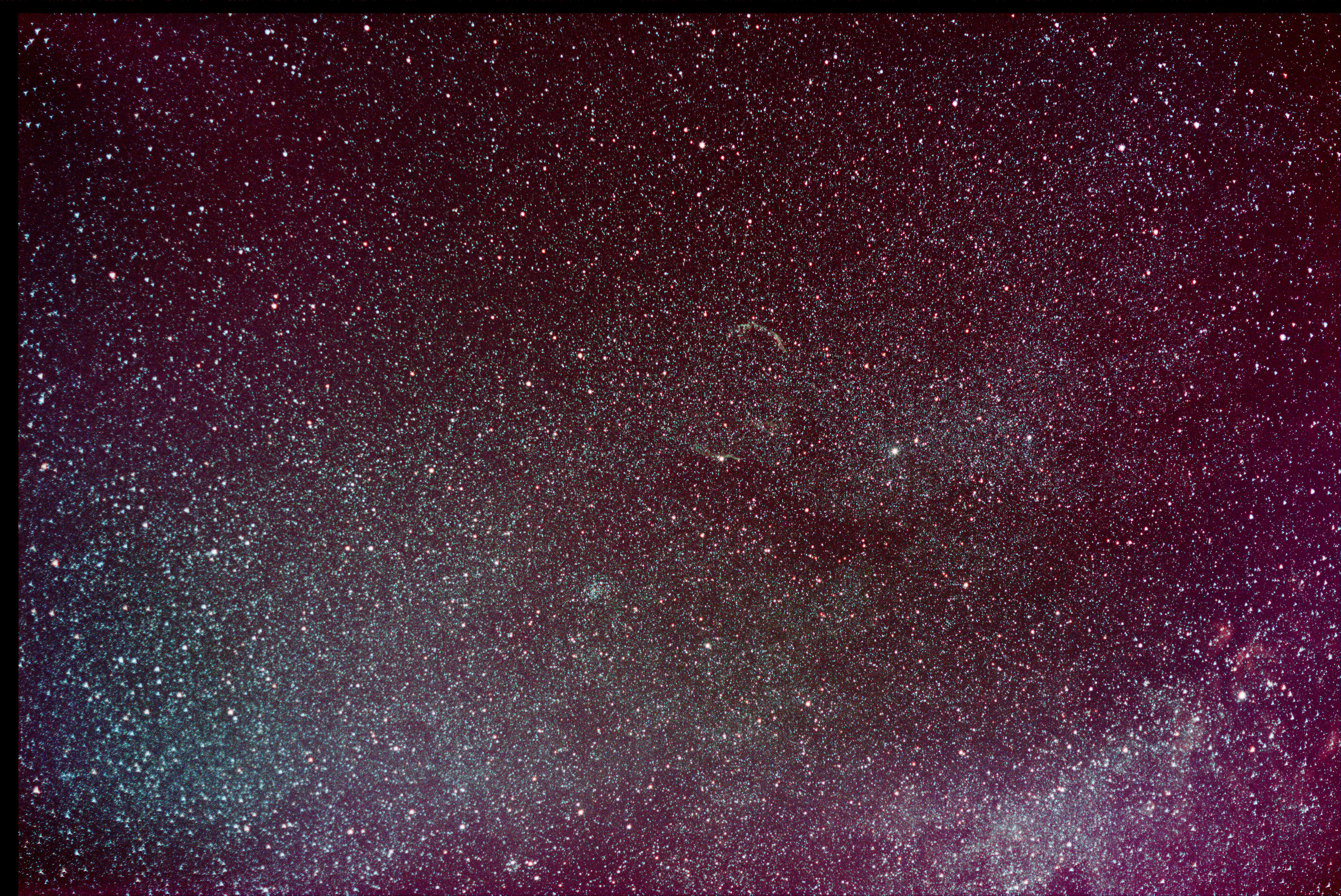
Veil Nebula Canon 700D + 50mm lens, with tracking, unguided & processed 15 x 90 secs @ ISO 800

Veil Nebula
Canon 700D + 50mm lens with CLS filter, tracking, unguided & processed 15 x 90 secs @ ISO 800

The centre of the world

As a geologist the centre of the world is very clear to me. Depending on where you are, on top of Everest, in the Mariana Trench but more relevant here at Fairvale Observatory in Redhill, the centre is approximately 7,900 miles beneath my feet.  Less geologically minded will argue this is the centre of the Earth and might instead therefore like to adopt Mr Wikipedia’s definition of the geometric centre of all land surfaces, which is  40°52′N 34°34′E (180 km northeast of Ankara, Turkey). However, for an astronomer and mankind in general wanting to navigate either the sky or the world it is the Prime Meridian, which passes just over 5 miles east of here at Fairvale Observatory – I often cycle across it, though you wouldn’t know it!

The notion of longitude was developed by the Greek Eratosthenes (c 276 – 195 BC) and Hipparchus (c 64BC – 24BC) but it was Ptolemy (c AD90 – 168AD) who first used a consistent meridian for his map in Geographia.  Subsequently various other ‘meridians’ were adopted over the following centuries by various cultures and map makers, located according to local, scientific and often political interests.

In the early eighteenth century the quest had become urgent to improve the determination of longitude at sea, leading initially to the development of the chronometer by John Harrison. But it was the development of accurate star charts, mainly by the first British Astronomer Royal , John Flamsteed, between 1680 and 1719 and continued by his successor, Edmund Halley, that enabled navigators to use astronomical methods of determining longitude more accurately.  Following the success of Neville Maskelyne’s Nautical Almanac between 1765 and 1811, today’s Prime Meridian was finally established by Astronomer Royal, Sir George Airy in 1851 at the Royal Observatory, Greenwich in London and has since formed the principal basis of all earthly (longitude) and celestial (right ascension or RA) navigation; these two are not the same but are both derived from the prime meridian as a starting point. The Prime Meridian established in 1851 passes through the Airy transit circle at 51° 28′ 40.1247″ North 0° 0′ 5.3101″ West at the Greenwich Observatory.

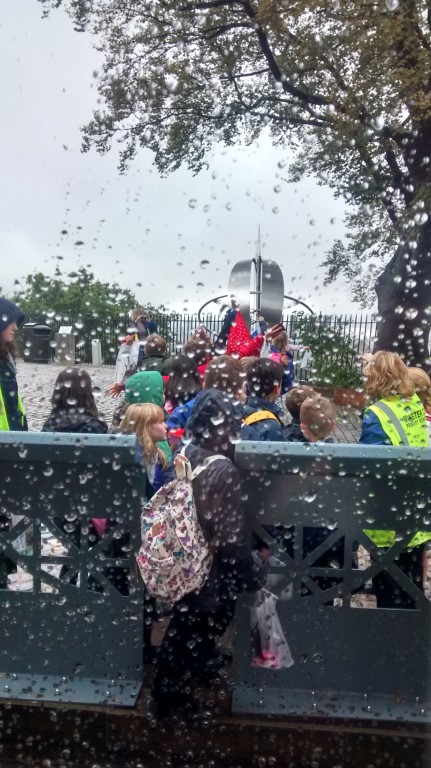
The Greenwich Meridian (marked by a stainless steel line and globe) viewed from behind Airy's transit telescope. School children line up along the line, which separates the west of the world on the left of the picture from the east of the world, on the right.

The Greenwich Meridian (marked by a stainless steel line and globe) viewed from just behind Airy’s transit telescope.  On a wet day school children line up along the meridian line, which separates the western hemisphere of the world on the left of the picture from the eastern hemisphere on the right.

I am currently a member of the Flamsteed Society, an amateur astronomy group based at the Royal Observatory and National Maritime Museum in Greenwich and earlier this week spent the day there to attend some astronomy shows and lectures, whilst also viewing exhibits, some of which I first saw as a teenager in the 1960’s. Professional British astronomy has long since ceased at the Observatory due to London’s light pollution; at first moving on to Herstmonceaux in East Sussex, then La Palma and now (I believe) Chile?  However, the site remains steeped with an unparalleled history of time, navigation and astronomy, which are fascinating and marvellous to behold – a must-see for any astronomer.

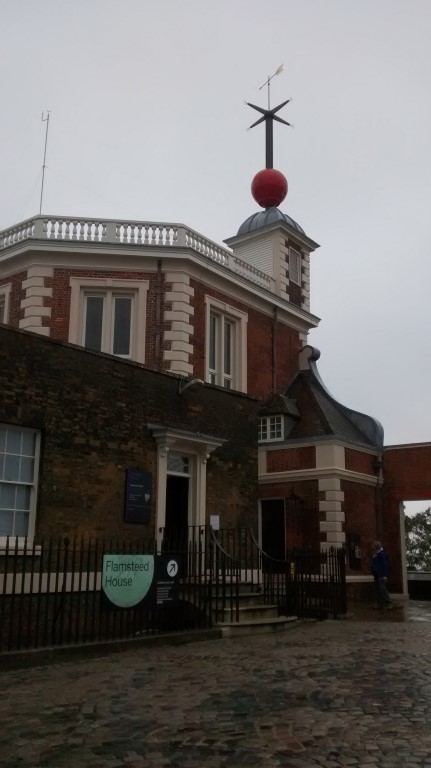
Flamsteed House designed by Sir Christopher Wren. First used in 1833, each day at exactly 12.55pm the red ball (Time Ball) on the roof rises half way up the mast and at 12.58 continues to the top, when at exactly 13.00 it drops.

Flamsteed House designed by Sir  Christopher Wren in 1675 – today the building houses various permanent and occasional exhibits related to time and astronomy.   First used in 1833, each day at exactly 12.55 the red ball (the Time Ball) on the roof rises half way up the mast and at 12.58 continues to the top, when at exactly 13.00 it drops so those around can tell the time accurately once a day.

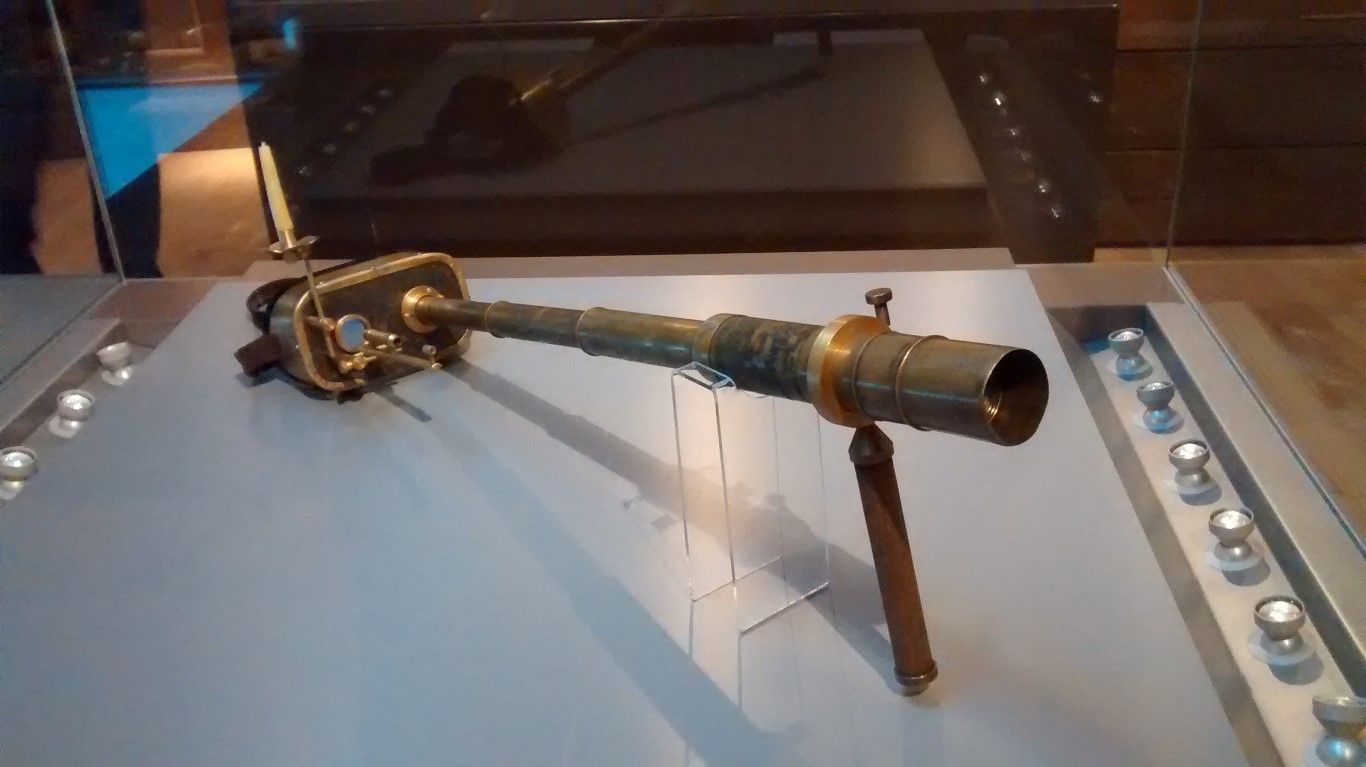
A telescope that is worn (note straps behind) and has a candle to assist with seeing where you are moving!

A telescope that is worn on the head (note straps) and has a candle to assist with seeing where you are!

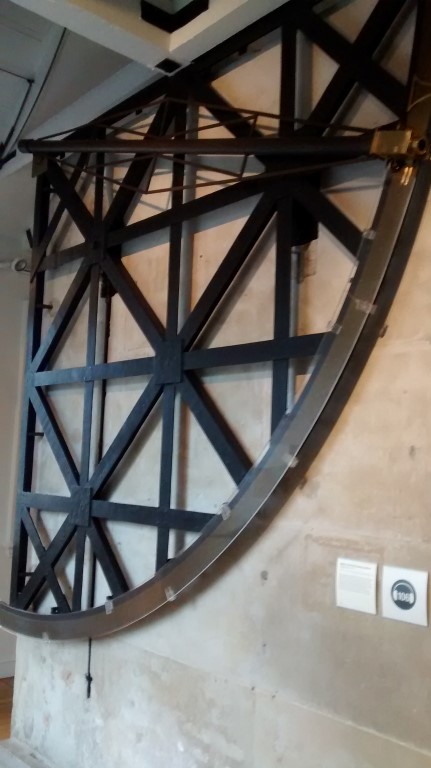
Edmund Halley's Quadrant, used to measure and record the transit of his eponymous comet.

Edmund Halley’s Quadrant, used to measure and record the transit of his eponymous comet.

I am proud of my nation’s achievements in the establishing The Prime Meridian and it is strangely of comfort that the Meridian passes close to my front door.  However, as a result of modern satellite navigation and a more accurate understanding of the Earth’s shape and gravitational effects, today’s Prime Meridian 0o 00’ 0.00” – or International Reference Meridian as it is now officially known – has shifted 5.3 arc seconds to the east of Airy’s original line (I make this a whopping 102.96 metres).  Furthermore, and pleasingly British in nature, the meridian used by the Ordnance Survey for its mapping is about six metres west of Airy’s meridian, known commonly as the Greenwich Meridian; having been previously established in 1801 by the third Astronomer Royal, James Bradley in a room adjacent to and therefore six metres away from the location of Airy’s transit instrument used to establish the Greenwich Meridian – the OS have simply continued to use Bradley’s Meridian to this day!

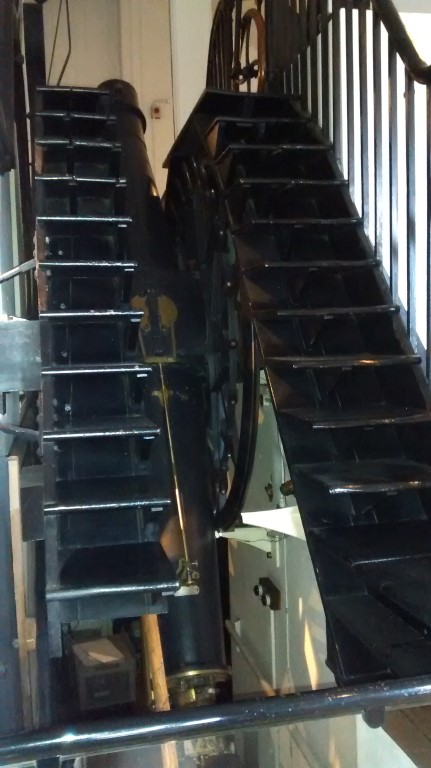
Airy's transit telescope, used to establish the Greenwich Meridian in 1851 - viewed from behind looking south i.e. east is left and west is right.

Airy’s transit telescope, used to establish the Greenwich Meridian in 1851 – viewed from behind looking south i.e. east is left and west is right.

Suits you sir

This year’s Indian summer is now just a memory; the weather is cold and wet and the skies overcast – no astrophotography then at the moment!  Notwithstanding, it’s time to think about the forthcoming winter skies, imaging possibilities, plans and what to wear?  Winter is generally recognised as a better time for astronomy (when it is dry and clear) – darker skies, exciting objects to view and image – but it does get cold.  Normally this would require more and thicker clothes but after a visit to the Longitude Punk’d exhibition at The Royal Observatory yesterday, I realise I need to raise my game.

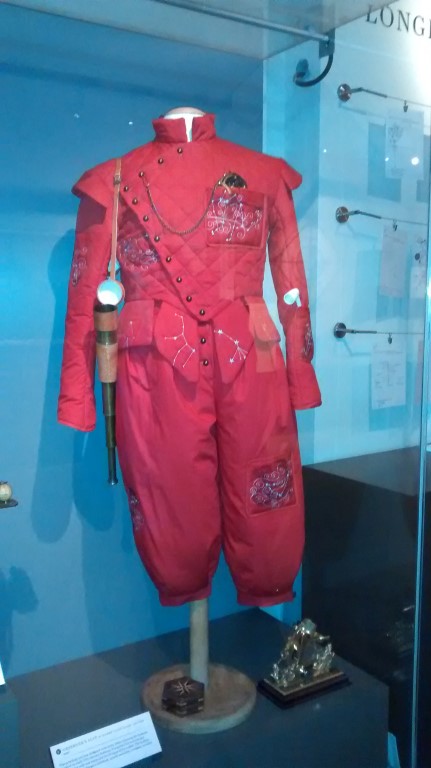
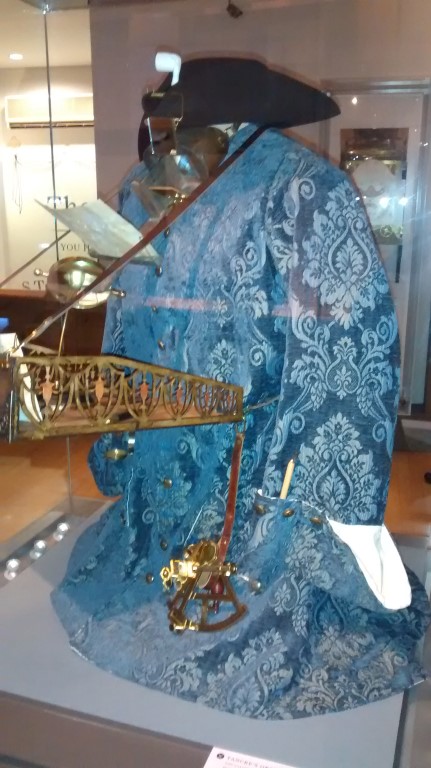
Two fetching astronomer’s outfits show that astronomy can be about style as well as substance.  A natty red observing suit particularly caught my eye or a less flamboyant but nicely eccentric blue silk jacket and brass work tray with accompanying gadgets (hand lens, mirror, sextant, candle and pipe) for recording observations etc.  Time to speak to my tailor!

IMG_20141013_144325789 (Medium)

IMG_20141013_144618128 (Medium)

Gotcha!

Two of astronomy’s most iconic images are Saturn and the Orion Nebula, M42 – one a highly distinctive planet of our Solar System, the other a trade mark of the winter sky as part of the Orion Constellation.  Both therefore seem quite familiar but still need to be seen or better still captured on camera to personally experience their magic.

The Orion Nebula or Great Orion Nebula, is a diffuse nebula located just south of Orion’s belt in the constellation of Orion.  It is approximately 1,344 light-years from earth and 24 light-years in diameter, which with an apparent magnitude of +4.0 is visible from Earth.  Studies of the nebula have revealed much about how new stars and planetary systems are formed, indeed it is considered a stellar nursery for new ‘baby’ stars, typically only a few hundred thousand years old.  Some 700 stars have been identified as formed from this nebula, most notably the ‘Trapezium’ asterism in the centre of the nebula, consisting of six bright stars. Spectacular red colours arise from hot hydrogen gas, whilst dust reflects the blue light from hot blue stars within the nebula.

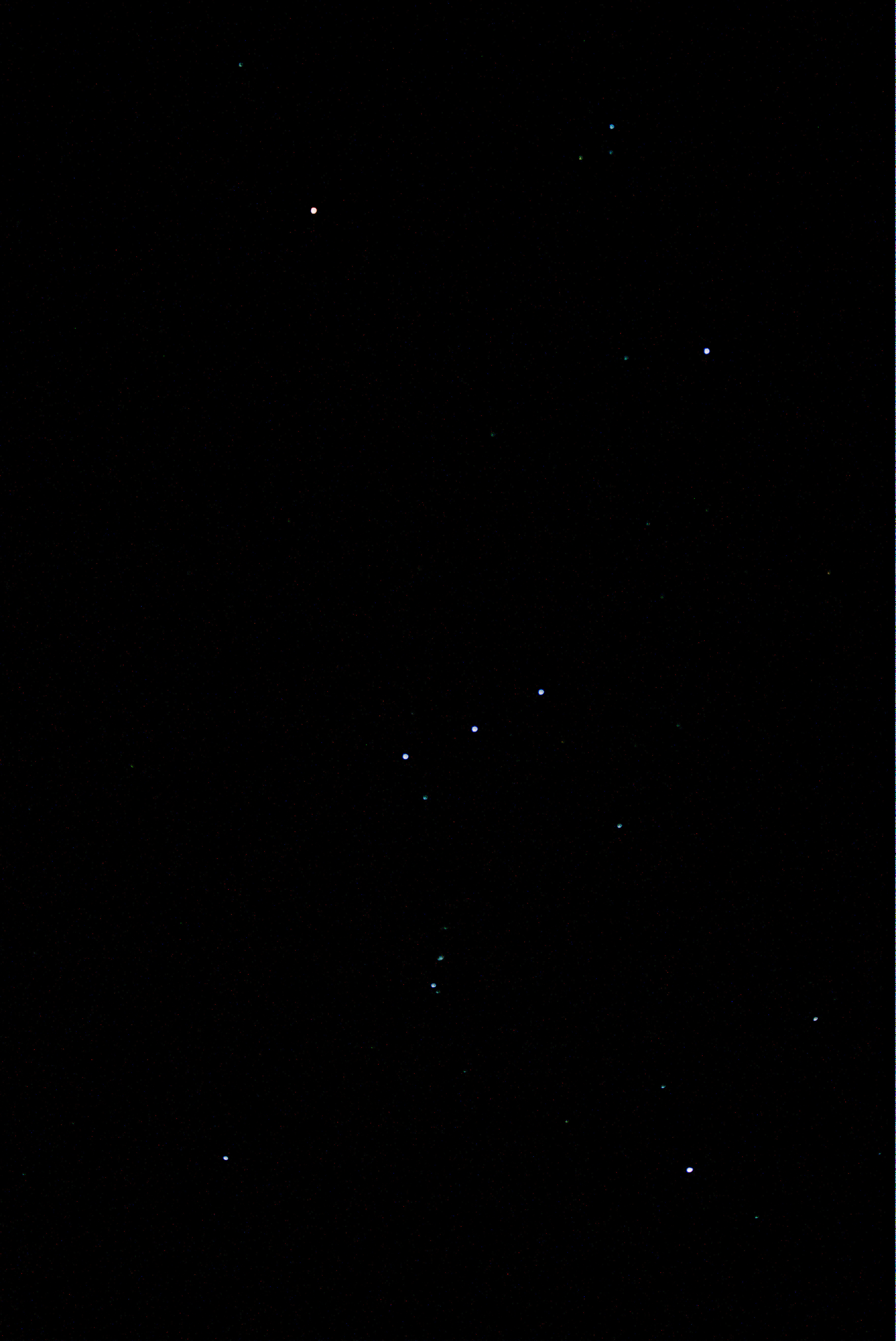
The Orion Constellation from Fairvale Observatory last year  - the Orion Nebula is just below the three central stars (Orion's belt) in the centre of the three lower stars

The Orion Constellation from Fairvale Observatory last year – the Orion Nebula is just below the three central stars (Orion’s belt) in the centre of the three lower stars (Orion’s sword)

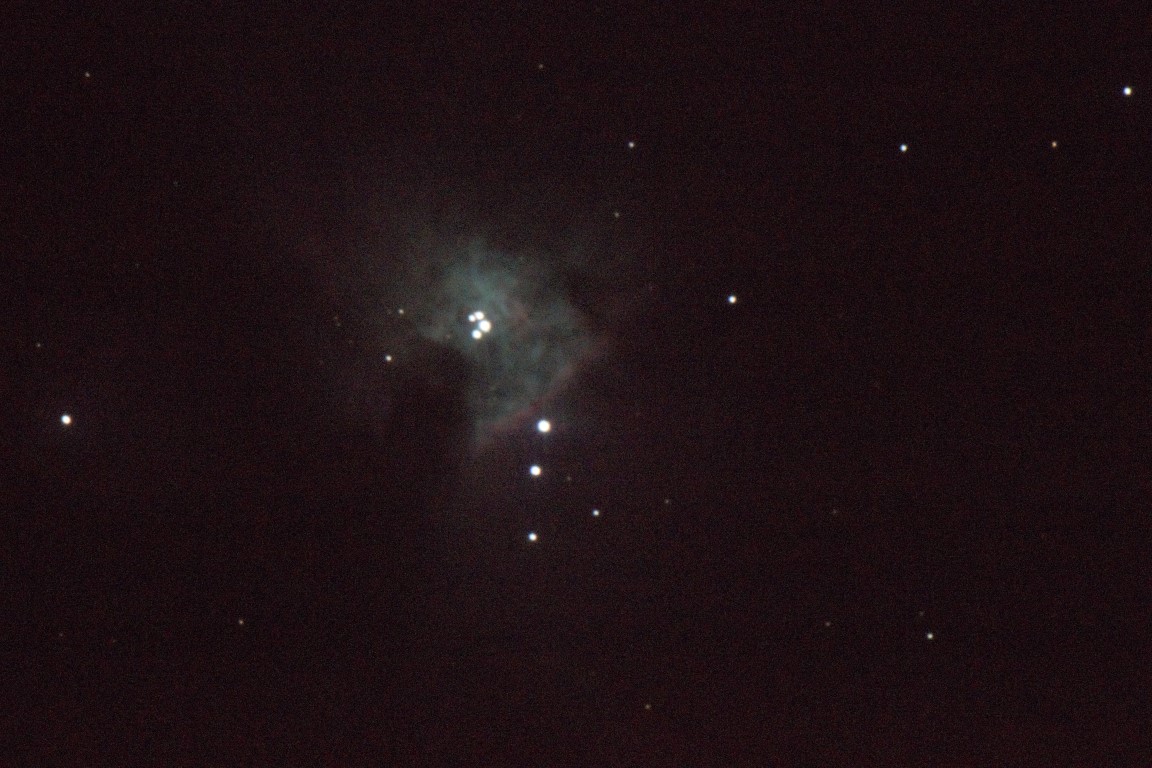
Due to its sheer beauty and notoriety I have previously dabbled with attempts to image the Orion Nebula before, initially by compact camera and subsequently by DSLR on the Skywatcher 150PL telescope, with limited success.  Notwithstanding, the colours of the nebula were evident and even four of the main stars of the Trapezium could be seen – at the time I was quite pleased but equally frustrated as I was unable to capture this magnificent object at its best.

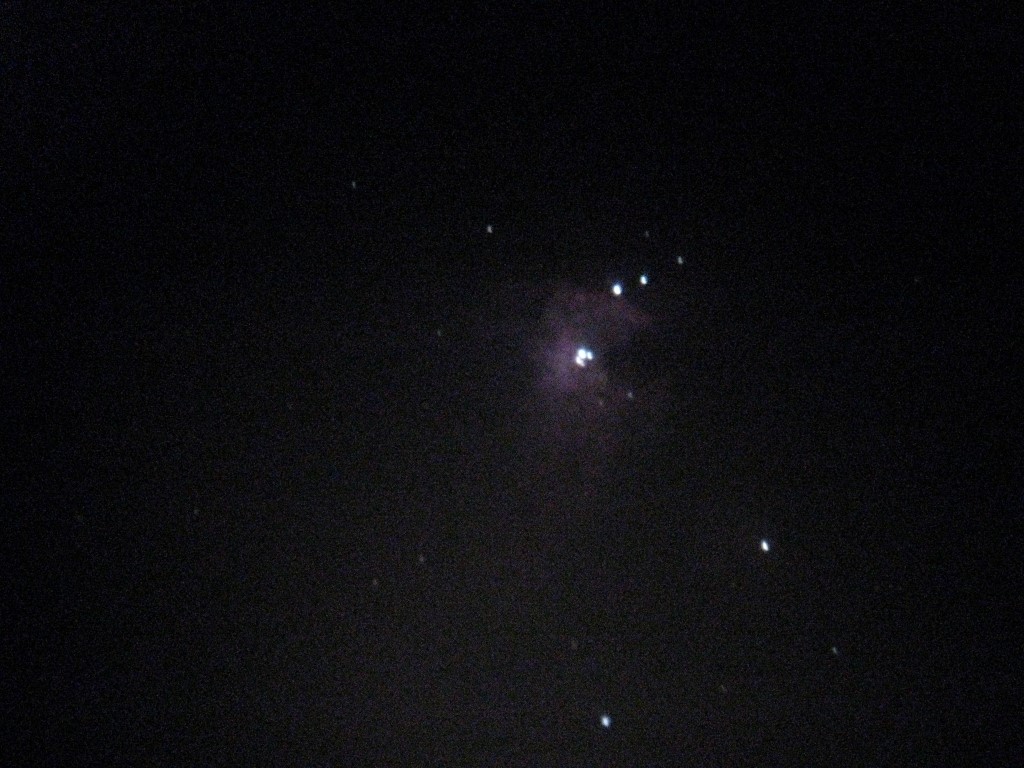
Afocal image of the Orion Nebula in 2013: I was pleased at the time with the colour is showed and even the Trapazium stars

Afocal image of the Orion Nebula in 2013: I was pleased at the time with the colour it showed and even the Trapezium stars

Orion Nebula later in 2013: DSLR & Skywatcher 150PL, single photograph, shows better colour and detail of the Trapezium

Orion Nebula later in 2013: DSLR & Skywatcher 150PL, single photograph, shows better colour and detail of the Trapezium

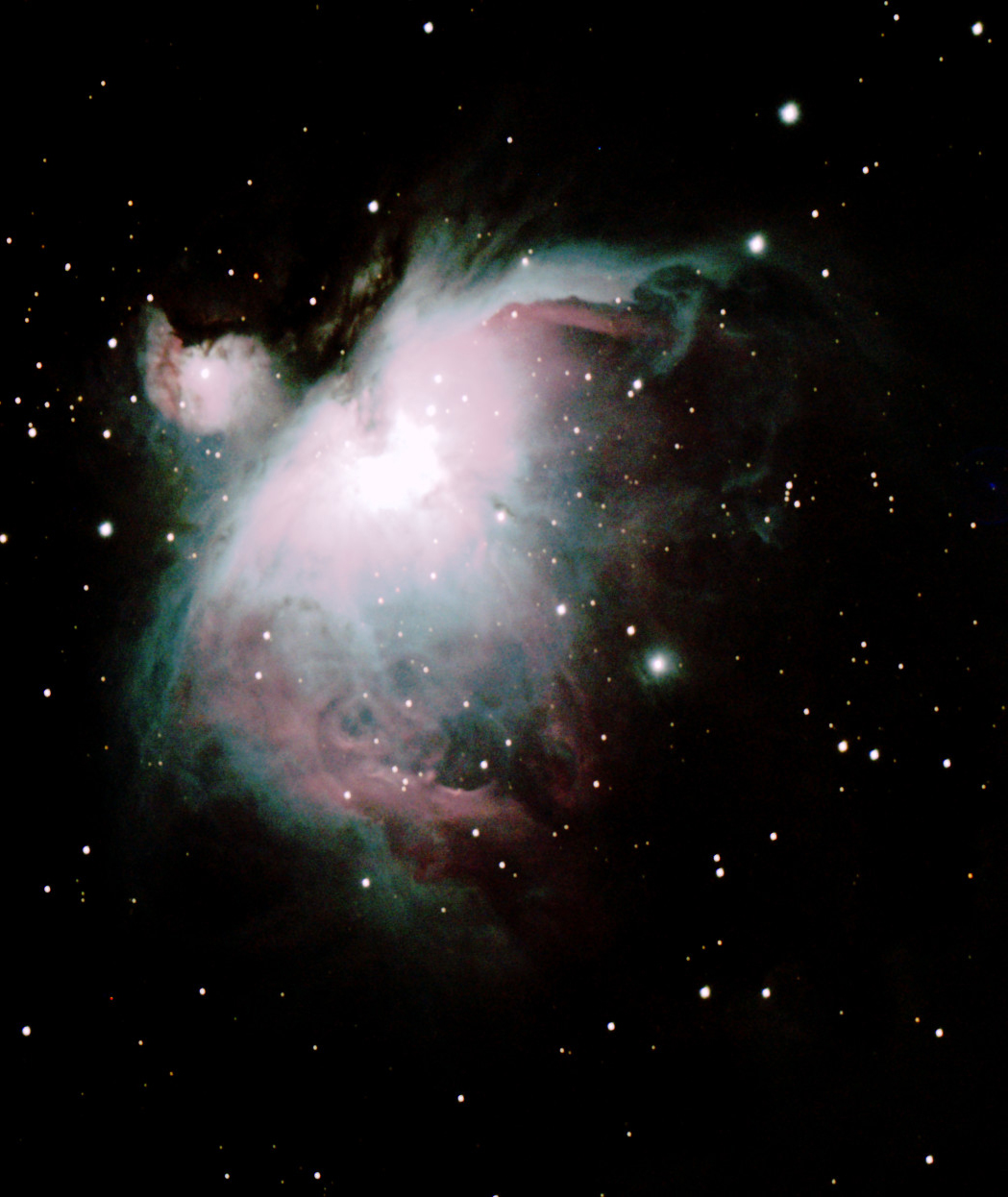
One year on, new equipment, new skills and a dark sky and all that has changed.  Very early on last Sunday morning I succeeded in imaging the Orion Nebula in all its glory, in what must be my very best astro photograph to date. Gotcha!

The Orion Nebula October 2014 - the secondary feature in the top left corner is another nebula, M43.  Orientated with equatorial North up and East to the left. Canon 700D unguided | 20 x 90 secs + darks/bias/flats @ ISO 800

The Orion Nebula October 2014 – the secondary feature in the top left corner is another nebula, M43.   Orientated with equatorial North up and East to the left.
WO GT 81 Canon 700D  + FF unguided | 20 x 90 secs + darks/bias/flats @ ISO 800


Seven Sisters

“I have all the all the seven sisters that I need.

I am from Finsbury Park and am having a lark.”

Public Image Ltd (John Lydon et al), This is PiL 2012

220px-PiL_This_Is_PiL

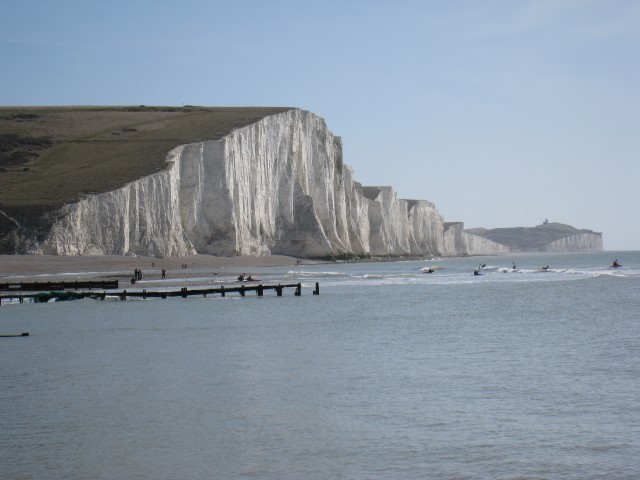
The Seven Sisters chalk cliffs on the Sussex Heritage Coast, one of Britain’s finest unspoilt coastlines.

IMG_2138 (Small)

Seven Sisters London underground station on the Victoria line, in the borough of Haringey

800px-Seven_Sisters_stn_Victoria_line_roundel

Seven sisters – seven major oil companies, which formed the “Consortium for Iran” cartel that dominated the global petroleum industry from the mid-1940s to the 1970s.

fig_002


What is it with seven sisters?  Mr Google returns 1,490,000 search results.

444 light years from Earth in the constellation of Taurus, with an apparent magnitude of +1.6, M45 or The Pleiades is one of the most prominent objects in the sky.  To the naked eye, the Pleiades look like a Little Dipper style asterism and with good eyesight it is possible to identify seven particularly bright blue stars.  This ‘young’ open star cluster actually contains over 1,700 stars, dominated by hot, blue stars.  M45 is currently passing through an interstellar dust cloud within the Milk Way, with the blue light from the brighter stars reflected off the dust, thus forming a distinctive blue nebulosity that can be seen surrounding the cluster.

M45 is generally considered to be a winter object in the Northern Hemisphere but, having just passed the Autumn Equinox at the end of September, it can already be seen in the late night / early morning sky.  Furthermore, as we leave the astronomical twilight of summer behind, the darkening skies are a real benefit to astro photographers; pity about the moon at the moment, which lingers until about 2.30am but thereafter leaves a still black sky, perfect for imaging.

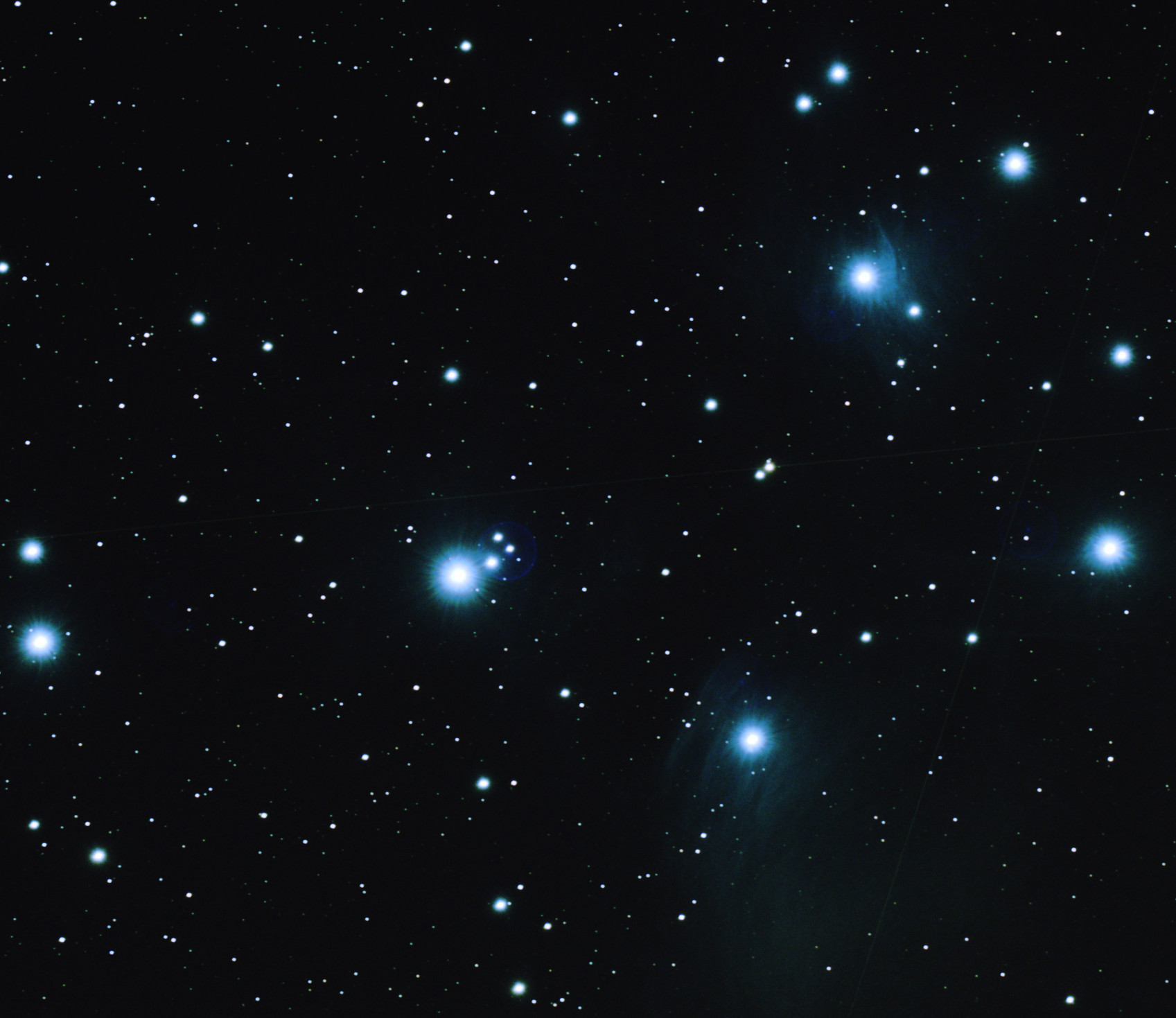
Saturday night was the first time I have had to photograph the Pleiades using the new equipment so, given the prospect of a night long clear sky, there was no alternative but to get up early, very early – but it was worth the effort to capture this beautiful star group at its best: M45, the Pleiades AKA the Seven Sisters.

M45, The Pleiades or Seven Sisters star cluster Canon 700D unguided | 26 x 90 secs darks/bias/flats @ ISO 800

M45, Pleiades or Seven Sisters star cluster
Canon 700D unguided | 26 x 90 secs darks/bias/flats @ ISO 800


The Witch’s Broom

With polar alignment and tracking now working quite well, I have been hunting around for potential new targets before moving on to the next challenges of computer control and auto-guiding.  Within the constraints of my limited sight lines, light pollution, weather and a rapidly encroaching full moon, I decided to tackle the somewhat elusive Veil Nebula.  Although the apparent magnitude of 7.0 is not unduly challenging, the delicate nature and low surface brightness of this very large ionized gas cloud can make it difficult to image.

Located in the Cygnus constellation, the Veil Nebula is a very large but feint supernova remnant about 1.400 ly from Earth that exploded between 5,000 and 8,000 years ago i.e. quite recently.  The Veil Nebula, Cirrus and Filamentary Nebula usually refer to those parts that can be viewed, the rest of the feature not being in the visible spectrum; the Veil is one of the largest, brightest features in the x-ray sky.  So big is the Veil that various sections are recorded as separate NGC numbers: 6960, 6992, 6995, 6974, 6979 and IC 1340.

Located close to the binary star system 52 Cygni, the classic view is of the Western Veil or NGC 6960, AKA the “Witch’s Broom”, “Finger of God or “Filamentary Nebula”, which spans across 35 light-years and I therefore set out to photograph.  Following the recent success of the North America Nebula I undertook a test shot at the same settings: 90 seconds at ISO 1,600.  However, the resulting picture looked excessively washed out and so changed to 90 seconds at ISO 800, which seemed to work better – though you never really know until the late stages of post-processing.  Despite forecasts to the contrary, the cloud rolled in after just six shots but two hours later and still tracking, the clouds parted leaving a clear sky and just enough time to take another twenty shots.

Initial processing was not encouraging.  Truth be told there’s still a lot to learn with this part of astro-imaging but, with some difficulty and courtesy of Mrs G, a good image of the Witch’s Broom was eventually teased from the data.

NGC 6960 AKA The Witch's Broom Canon 700D | 20x90 sec + darks.bias/ flats @ ISO 800

NGC 6960 AKA The Witch’s Broom
Canon 700D | 20 x 90 sec + darks/bias/ flats @ ISO 800


Star wars

A big surprise to me since starting astronomy has been star clusters, which I was strangely unaware of before.  They come in two basic varieties – globular and open – their general nature is, as so many things astronomical, mind blowing.  The Milky Way has about 160 globular clusters, with highly elliptical orbits to the galaxy, whilst more distant galaxies such as M87 have over 13,000.  Each globular cluster typically contains hundreds or even millions of stars held together by gravitational forces in a roughly spherical form, generally packed into regions of ‘just’ 10 ly to 30 ly diameter.

Globular cluster stars are considered to be some of the oldest known objects in the Universe, formed just a few hundred million years after the formation of the Universe itself, and appear to be some of the first produced during galaxy formation.  Most of the stars are red and yellow Population II stars or ‘metal poor’, which have formed after a supernova.  More rare blue stars, known as blue stragglers, may also exist in globular clusters and are thought to be formed in the dense inner regions of stellar mergers.  Notwithstanding, the origin of globular star clusters is still poorly understood but research suggests they may be survivors of galactic mayhem 13 billion years ago.

http://www.mpa-garching.mpg.de/mpa/institute/news_archives/news1202_aaa/news1202_aaa-en-print.html

No known globular clusters display active star formation today, which is consistent with the view that globular clusters are typically among the oldest objects in the Universe and were some the first collection of stars to form.

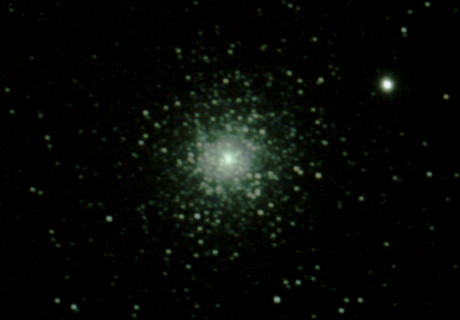
And so the other evening I turned the camera on a globular cluster, M15 or NGC 7078, located by the constellation of Pegasus.  Estimated at 12 billion years old, it is one of the oldest globular clusters, 33,000 ly from Earth and one of the more densely packed clusters in the Milky Way,  containing some 100,000 stars.  Notably M15 contains a number of variable stars, pulsars, one neutron star and also unusually, a planetary nebula.  All-in-all quite a catch though I am still mystified and intrigued by their occurrence!

M15 Globular Cluster Canon 700D unguided | 20 x 90 secs + darks /   bias / flats @ ISO 800

M15 Globular Cluster
Canon 700D unguided | 20 x 90 secs + darks / bias / flats @ ISO 800


Vision Technician

Appearances can be deceiving. WYSIWYG was a term used in 1980’s computing (maybe it still is?) when printing, to indicate that what you saw on the computer screen e.g. formatting and layout, would be the same when printed: What You See Is What You Get.  Being the early days of computing for the ordinary ‘man’, when Microsoft and Apple were just emerging from being start-up companies, the growing choices of hardware and software were not always fully compatible, frequently resulting in a lack of WYSIWYG’ness or put plainly, rubbish printing output.  Even in the 21st century everything is still not WYSIWYG.

I have just completed building and now started to use the new External Astronomy Control Centre (EACC) at Fairvale Observatory.  I am unable to have a full blown, dedicated observatory here at Fairvale, so have to set-up and take down all the astronomy equipment on the patio outside each time I want to carry out viewing or imaging.  It’s a chore, particularly since getting the new and much heavier AZ-EQ6 GT mount and many other pieces of equipment and gizmos; I know this accumulation of equipment and related computing will only continue for the foreseeable future – I am now certain this is an immutable law of astronomy!

Central to controlling all this equipment is the computer.  Currently its main function is for planetarium software and image control and capture: camera settings-up and auto-capture, thus making the large number of images required (subs, darks, bias and flats) less of a chore and, in general, easier to carry out.  I soon hope to extend such computer control to the mount, auto-guiding and tracking correction, plus linking all this to the planetarium for easier navigation.

For the moment this requires that I take my laptop computer outside in order to connect it to the various pieces of equipment, which as the longer, colder nights become more prevalent, exposes it to potentially damaging conditions e.g. dew; I may eventually be able to move the computer inside but for the moment it has to be outside. Furthermore, even using red-screen software to produce a red hue over the computer screen in order to reduce light spilling during image capture (it also helps the eyes to remain adjusted to night vision), the resulting red light is still quite bright and potentially detrimental to imaging.  As a result of these issues I decided to embark on the construction of the aforesaid EACC.

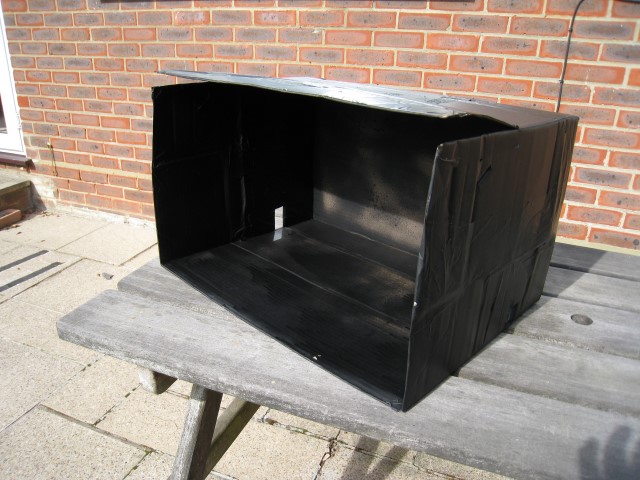
The EACC design needed to be such that it is light, mobile and easy to set-up, whilst primarily achieving two main functions to combat the above problems: (i) protect the computer and leads from the environment – mostly cold and dew, and (ii) as much as possible, contain and thus restrict light spillage from the computer screen.  After detailed consideration of possible designs, the resulting EACC has so far proved to be very successful in meeting these objectives. However, acronyms and fancy names can be deceptive – the EACC is a cardboard box!

EACC in development

EACC in development

EACC completed (there have been a few minor amendments)

EACC completed (there have been a few minor amendments)

Notwithstanding, it is turning out to be a very useful cardboard box.

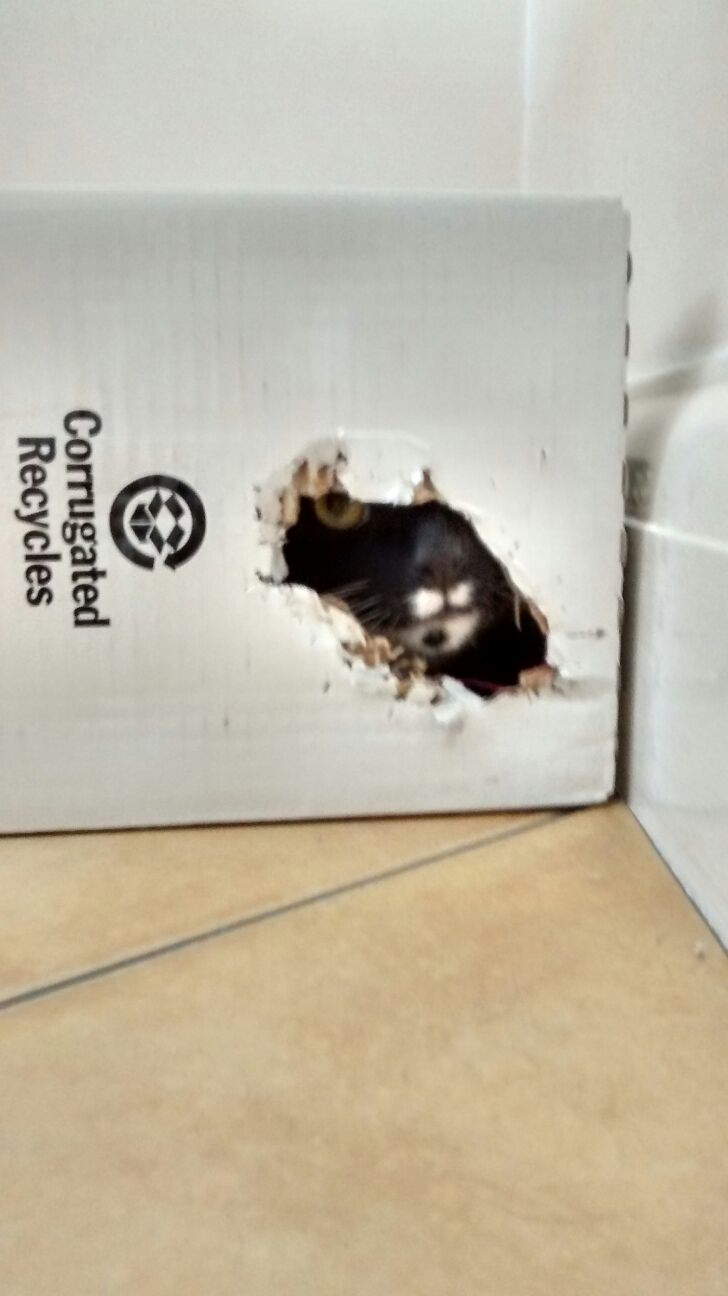
Other recent cardboard box developments - in this case my daughter Alison's cat Alan looking out of a box, he is particularly keen in attacking and 'catching' feather dusters offered up to the hole.
Other recent cardboard box developments – in this case my daughter Alison’s cat Alan looking out of a box, he is particularly keen on attacking and ‘catching’ feather dusters offered up to the hole.
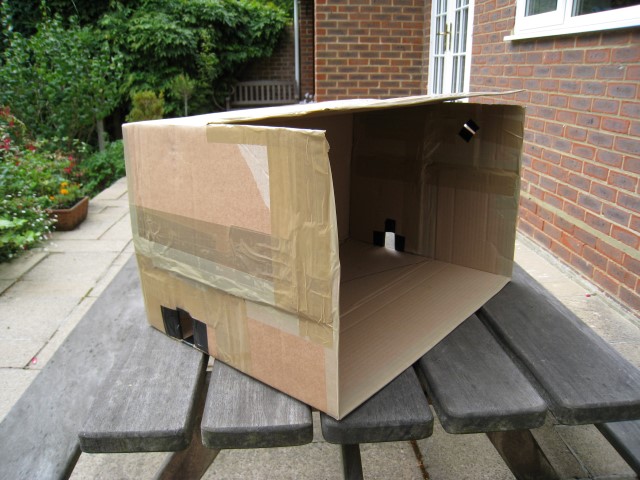
Of course, it won’t stand up to extreme weather conditions but then I won’t be carrying out astronomical viewing and imaging in such conditions. It has been very successful in restricting light, though it is still important that the AP (AP = access portal = front) is directed away from the telescope in order to direct light spillage away.  Once I had established its usefulness, I sprayed it with a mat black paint to further reduce reflected light and make it a little more damp resistant – it is after all cardboard.  All-in-all a very useful EACC (cardboard box), which however is not what it might at first appear to be – much like the vision technician, or window cleaner!
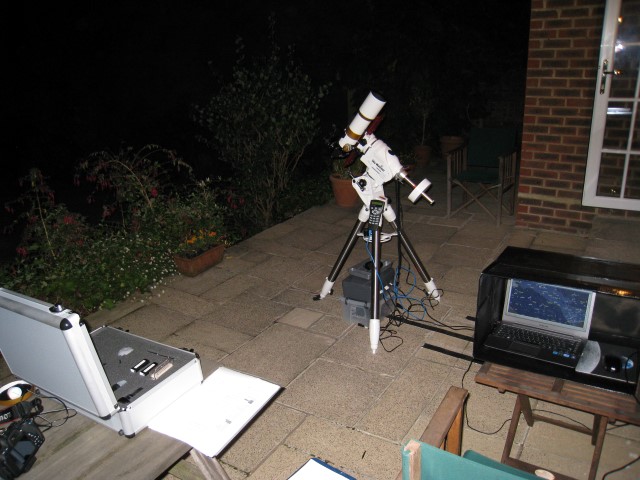
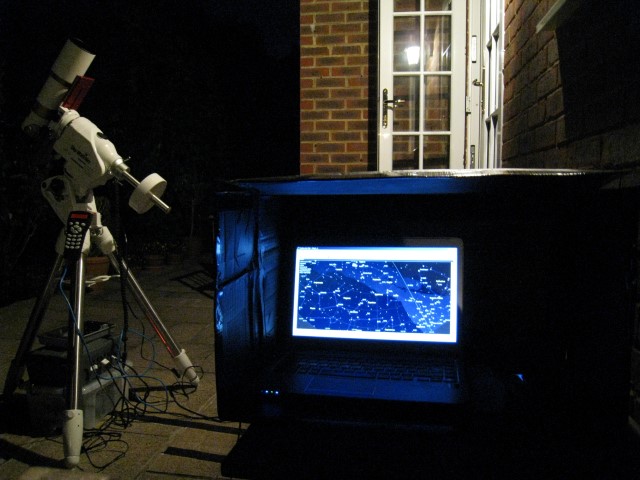
Last night the EACC in use

Last night the EACC in use

The cunning EACC design usefully deflects computer screen light away from the telescope & camera whilst imaging

The cunning EACC design usefully deflects computer screen light away from the telescope & camera whilst imaging