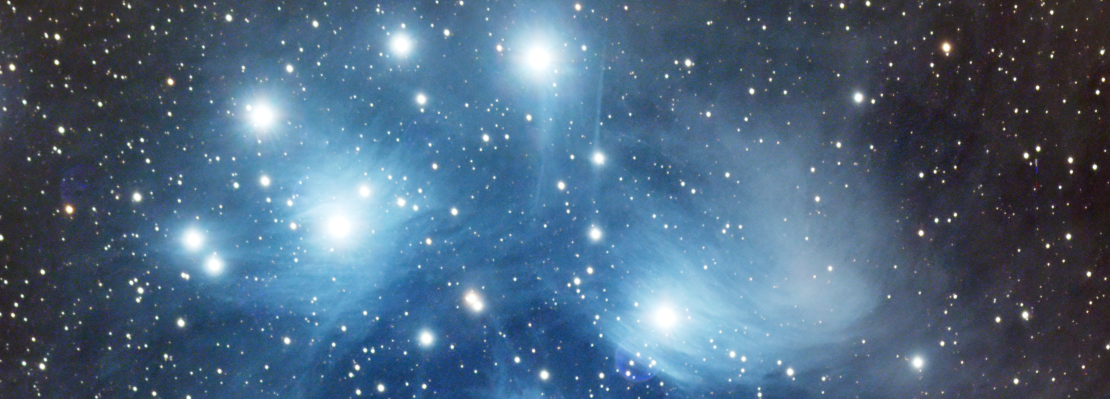
My brain hurts! The Talking Point section of the recent October edition of the Astronomy Now magazine really poses a serious problem for astronomers, if not the Universe itself; matters don’t get much bigger. The matter being, Is the Universe a Hologram? It transpires that one of the theoretical consequences of quantum physics and, in particular, very small matter, is that at the smallest scale the Universe may be two dimensional. The third dimension, emerging in the same sense that an impressionist painting is the macroscopic effect of thousands of spots of coloured paint that, when viewed close up, gives no clue to the overall scene. I am not making this up. So serious is this question that Fermi National Laboratory Accelerator Laboratory (Fermilab) in the USA is currently undertaking an experiment to assess the answer; what happens if it is a hologram, do we disappear? As a result of this devastating possibility, I have read around but frankly am battling to fully understand the concept and its consequences. http://www.smithsonianmag.com/science/what-universe-real-physics-has-some-mind-bending-answers-180952699/?no-ist
In the event that the answer is in the affirmative, then what have I been photographing out there?
Astrophotography seems to consist of many black arts, not the least of which, in my case, is Polar Alignment. Since getting into this astronomy malarkey I have, wherever possible, taken the easy route – unfortunately this is no longer compatible with my ambitions and I must deal with my astronomy fears: polar alignment, computer control and using a guide scope. All are essential if I am to improve my pictures and bag some of the more elusive DSOs as well as more mundane objects. Initial use of the AZ-EQ6 GT mount has already been rewarding through the use of star alignment but without good polar alignment too, a critical piece of information for finding and tracking objects is missing. In order to track objects across the celestial sphere using an equatorial mount, it is essential to line up the axis of the mount with the Polaris star, which marks the central point around which the celestial sphere effectively rotates.
The AZ-EQ6 GT mount does have a polar scope through which to look directly at the Polaris star and line up the mount. Alas I cannot use it as my house is directly in the way of Polaris and I don’t really feel like knocking it down, though you never know. However, there are cunning ways to overcome this problem (i) using another sequence programmed into the mount’s SynScan control handset to achieve polar alignment without a polar scope (see manual #11.3) or (ii) drift alignment, a technique of iterative realignment of the altitude and azimuth by linking the telescope to specific computer software (I believe it can also be undertaken by just using a star trace obtained by a DSLR or CCD camera).
For the moment I am having great difficulty attempting to use the SynScan routine. Having spent much of Sunday studying the technique, subsequent hours of practice at night brought little success; despite my best attempts, the SynScan handset routine does not seem to be the same as that outlined in the Manual – not a good start. Sometimes the operation of this complex equipment seems elusively to be driven by smoke and mirrors, let’s hope the Universe fairs better at Fermilab.
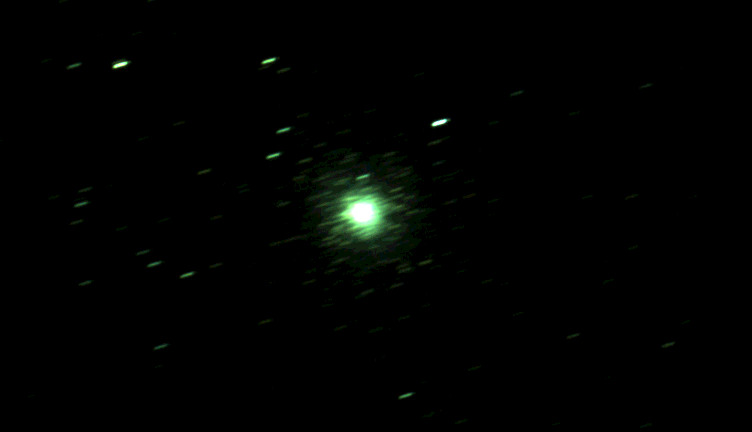
M2 Star Cluster; after hours of preparation and attempts to apply the SynScan polar alignment routine, without the Polar Scope, success proved elusive and tracking was poor.
Canon 700D | 15×30 sec @ ISO 800
 WATCH THIS SPACE(MAN)
Wow! Looks like you’ve been very busy. I’ve got lots of reading to catch up on. Lovely pics, as ever! x
LikeLike