WOW!

Preparation + perseverance = progress, and what progress.

Another clear night last Wednesday, so with my new found success of polar alignment, I started early in the evening in order to try and photograph NGC 7000, or the North America Nebula (it looks like North America).  I had been inspired by images of NGC 7000 on SGL and had already tried a few times to capture it but without success.  With the much improved polar alignment (I went through two star and polar alignment sequences this time) and therefore better tracking, I figured it was also time to increase the stakes overall: a larger set of x20 images (previously 10), speed increased to ISO 1,600 (previously ISO 800), increased exposure time to 90 seconds (previously 30 to 40 seconds) and shooting a full set of additional dark, bias and flat images in order to reduce hot pixels and sensor noise.

And so it was that I managed to successfully photograph the mighty NGC 7000. The very nature of the nebula meant that I did not know if I had the picture until late in the processing phase but it was there.  This emphasises the importance of preparation and the set-up in order to subsequently rely on the scope’s orientation, focus and tracking – you are literally working blind whilst taking a photograph of such an object this way.
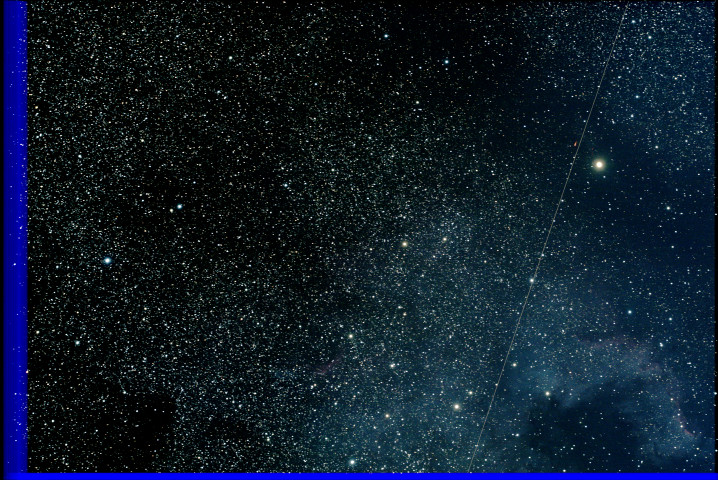
NGC 7000 or North America Nebula - after stacking and basic post processing in Photoshop (note aircraft trace).  Canon 700D ( unmodded) | 20x90secs @ ISO1,600 & darks + bias + flat frames, unguided

NGC 7000 or North America Nebula – after stacking and basic post processing in Photoshop (note aircraft trace, subsequently removed).
Canon 700D ( unmodded) | 20 x 90secs @ ISO 1,600 & darks + bias + flat frames, unguided

NGC7000 is located within the constellation of Cygnus, some 1,600 ly from Earth. The North America Nebula is an emission nebula and most of the light emitted is H-alpha (red), most of which is unfortunately filtered out by any normal camera, such as mine the Canon 700D DSLR, by an infra-red filter that is fixed over the sensor.  As a result the basic image captures predominantly OIII (Oxygen Three) light, which is a bluish green colour and is not removed by the camera’s filter.  Many DSO objects have such characteristics and I had been hoping to avoid this problem for a while.  There is a solution, which is to remove the filter, to modify or ”mod” the camera,  the resulting images would then reflect the full light spectrum.  The downside in doing this is twofold, which is why I have not done it to my camera: it’s not cheap to do and it renders the camera useless for normal, earth bound photography! Oh well, something else for the Christmas list.

In the meantime, the red has been put back into the image by using Photoshop. Either way it’s a great image and I am thrilled. Wow indeed!
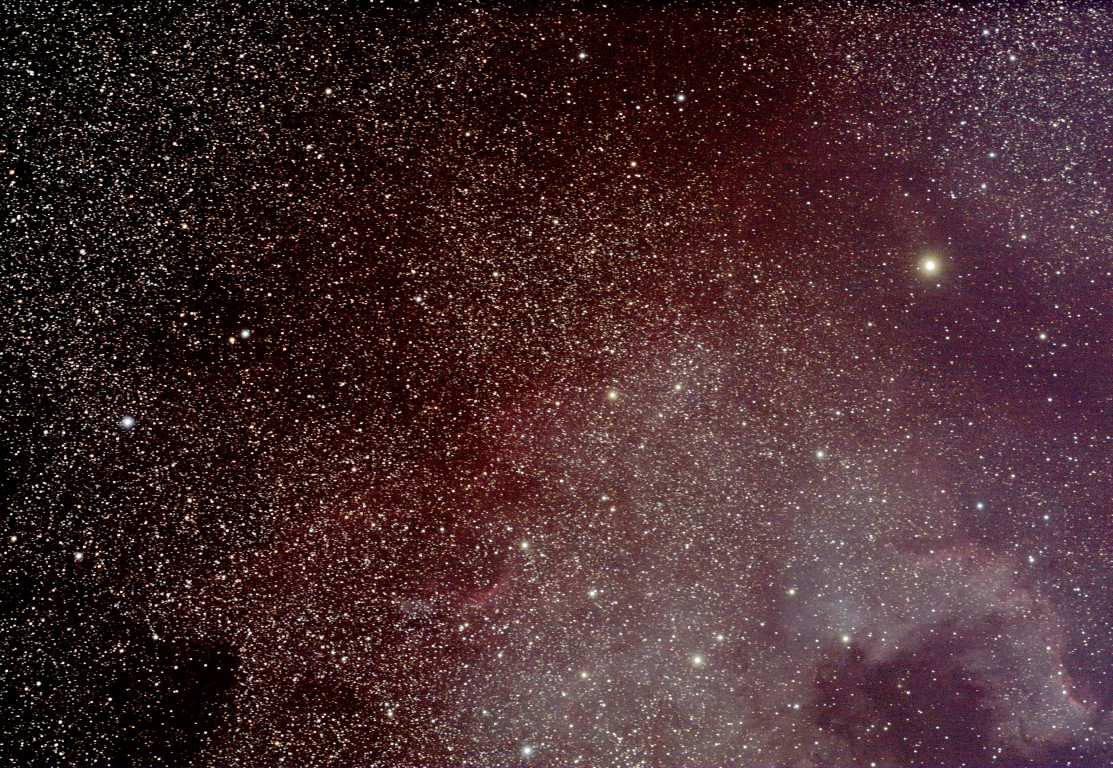
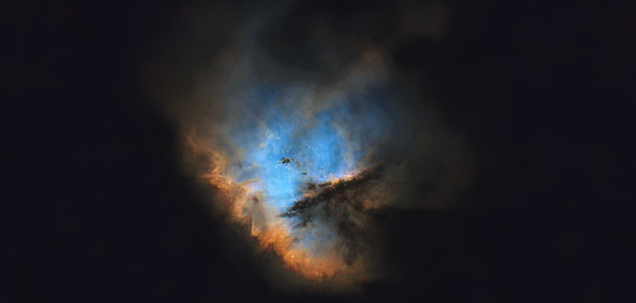
NGC 7000 North America Nebula, with curves & levels adjustment in Photoshop
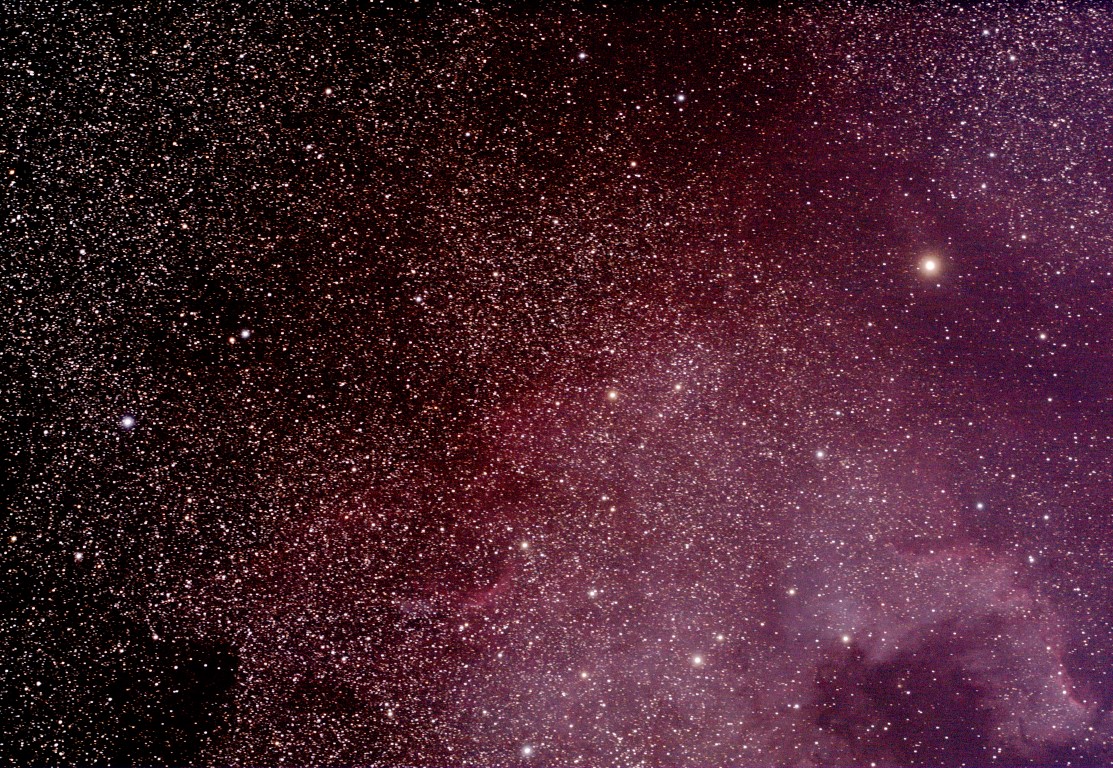
NGC 7000 North America Nebula, with curves & levels adjustment in Photoshop

NGC 7000, North America Nembula, with curves, levels and colour balance Photoshop adjustment
NGC 7000, North America Nembula, with curves, levels and colour balance Photoshop adjustment
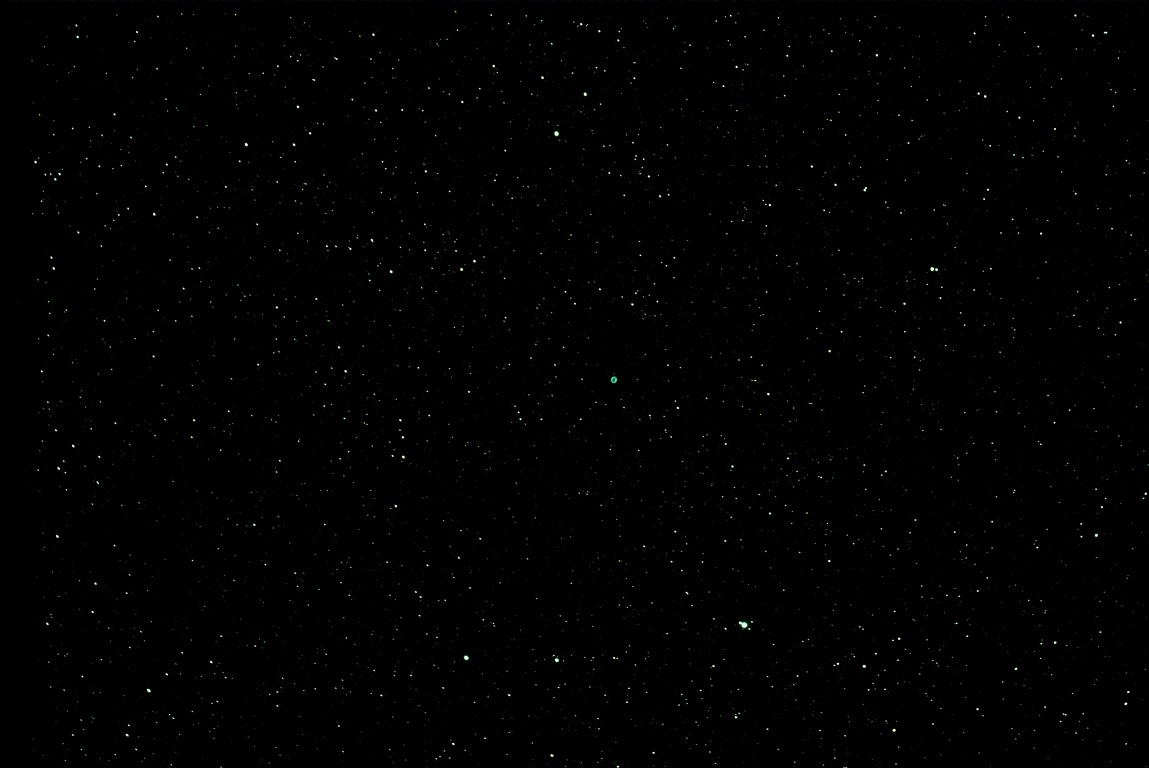
The devil’s in the detail

The process of DSLR astrophotography can be broadly divided as four main steps:

  1. Preparation – equipment, targets / photographic plan;
  2. Set-up – mount, telescope, camera, control (mount & computer);
  3. Capture – settings (exposure, ISO, f-stop), frames (Subs, darks, bias & flats), tracking;
  4. Processing – stacking & post-processing.

I am only just starting to delve into the final phase, which is another of those black arts and can, which if understood and used well, unlock detail otherwise hidden in each picture.  This is where the difference between film and digital photography becomes most evident.

A digital photo is made up of a series of pixels. Each of the pixels in a digital photo corresponds to a photosite (also called a pixel) on the camera’s sensor.  When hit by light (a photon) the photosite generates a small electric current, which is measured by the camera and recorded in a file – commonly as JPEG or in DSLR astrophotography the RAW format.

JPEG files record the colour and brightness information for each pixel with three eight bit numbers, one for each of the red, green and blue channels.  DSLR cameras (like computers) use the binary system number system (a series of two digits – I or 0); the highest number in 8-bit notation is therefore 11111111.  As a result each eight bit channel records on a colour scale of 1 to 255, or a theoretical maximum of 16,777,216; the human eye can detect between 10 and 12 million colours maximum.

RAW files dedicate more bits to each pixel, which does not equate to more colours but greater tonal graduation – the image is said to have more colour or bit depth.  The theoretical number of tones recorded by my 700D 14bit DIGIC sensor is therefore 4.39 trillion!!!  Post processing such RAW files     therefore has potential access to vast amounts of information, resulting in the possibility of greater detail and subtlety.

At the moment my DSLR processing software is quite basic (relatively, it’s still very sophisticated):

Deep Sky Stacker – used to compile the sequence of original RAW images in order to produce a single, optimized picture containing the ‘best’ data set possible from all the images.  Other correction images may be also combined in this process to reduce such problems as sensor noise but, for the moment, I have limited these to just ‘darks’ (taken with the lens cap on) to help eliminate so-called hot pixels.

GIMP – free online post processing software use to finish the stacked image, by ‘stretching’ the colour ranges levels and adjusting tones and sharpness hitherto unseen detail emerges, often transforming the original photograph; the detail was originally captured by the camera in the RAW file but must be processed in this way to ‘release’ detail that would not otherwise be seen .

Through the application of these techniques modern astrophotography is able to reveal new and transform details of old wonders of the Universe.

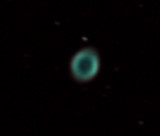
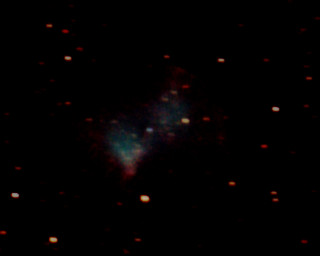
Whilst GIMP is very good, a better (more detailed and expensive) post-processing software used in astrophotography and by photographers and graphic designers is Photoshop. Mrs G uses an old version of Photoshop and taking the previous images of M27 and M57 has teased further detail, in particular colour, from these images with great effect. With 4.39 trillion potential colour tones the devil is in the detail and is always worth looking for.

M57 - additional Photoshop post-processing brings out more colour (see previous blog for comparison)

M57 – additional Photoshop post-processing brings out more colour (see previous blog for comparison)

M27 - Photoshop post processing has also 'found' more colour in this image too

M27 – Photoshop post processing has also ‘found’ more colour in this image too

Dialling up the Universe

What a difference a day makes. Following the difficulties of polar alignment the previous day and faced with another great night of clear sky, the only thing to do was to get back on the horse and try again.  I was a little more careful with the basic set-up using two star alignment (Vega & Markab) before attempting the polar alignment again (without the polar scope) using Rasalhague; with the sight-lines at Fairvale Observatory blocked by houses, hedges, trees and the inevitable light pollution, even finding suitable stars is proving difficult and requires some pre-planning.  Following the previous confusion between the Manual and the SynScan handset on this matter, this time I decided to ignore the Manual sections dealing with separate adjustment of latitude and azimuth and, as the SynScan handset instruction prompted, carry out both procedures at the same time.

Having not previously owned the mount’s more basic brother, the EQ6, I am not able to say what all the differences are but, having read reviews of the AZ-EQ6 GT before purchasing, it is my impression that the T-bolt altitude combined with the more traditional azimuth knobs are a new invitation, making simultaneous adjustment of both easier.  For this reason I also suspect that the procedure has been changed in the SynScan firmware (V 3.33), which is not reflected in the Manual; Skywatcher and others please note – these apparently small anomalies can cause great confusion for leaners such as me.  And so it was that this time the polar alignment worked, reducing the error from about +/-3 to less than 10.  Furthermore and notwithstanding my previous point on ignoring the Manual, having re-read the final part of the instructions, it is made clear that on repeating the process the accuracy can be reduced even more.  Therefore after two alignment routines – star and polar alignment – the latitude (MEL) and azimuth (MAZ) polar errors were reduced to a mere few seconds.  This was by far the best I have ever achieved, which was subsequently reflected in the operating accuracy of the mount’s search function (so-called GOTO) and tracking.

I had already experienced the wonder of punching in search objects using the AZ-EQ6 mount – solar, Messier, NGC etc – but with mixed results due to poor alignment.  Now, for the first time with very good alignment, having entered in the desired object the mount slewed gracefully to its location so that on a test camera exposure the object was dead centre in the resulting picture and perfectly focussed.  Another seminal moment in my pursuit of astronomy and imaging the Universe and all its wonders.  I was thrilled, and still am.

Having established this set-up and with a clear sky overhead most of the night, what else was there to do but dial up the Universe using SynScan and start taking pictures, lots of them.  SynScan has an object database of over 40,000, so it might take a while.

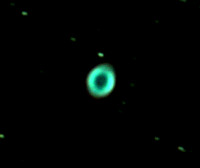
M57 Ring Nebula, wide-field view, with polar alignment. Canon 700D | 24x30sec @ ISO1600

M57 Ring Nebula, wide-field view, with polar alignment.
Canon 700D | 24x30sec @ ISO1600

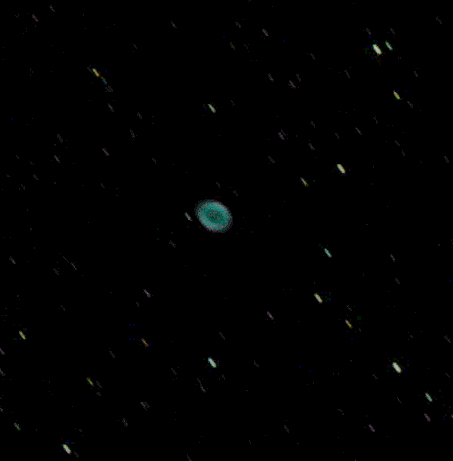
M57 Ring Nebula, close-up with polar alignment. Canon 700D | 24x30sec @ ISO 1,600

M57 Ring Nebula, close-up with polar alignment.
Canon 700D | 24x30sec @ ISO 1,600

M57 The Ring Nebula, cropped from the main image above.

M57 The Ring Nebula, without polar alignment.

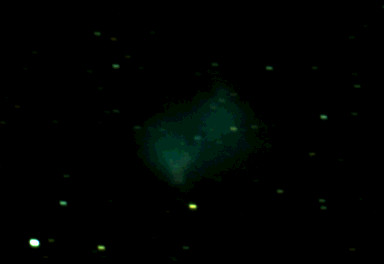
M27 Dumbbell or Apple Core Nebula, with polar alignment. Canon 700D | 20x40secs @ ISO800

M27 Dumbbell or Apple Core Nebula, with polar alignment.
Canon 700D | 20x40secs @ ISO800

M27 cropped from previous photograph; it will be interesting to see how much clearer pictures can eventually be obtained with better alingment and longer exposures

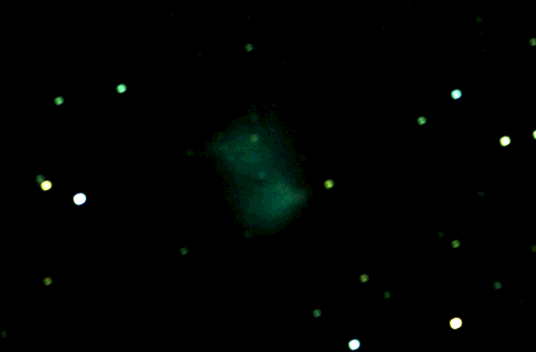
M27 without polar alignment

Smoke and mirrors

My brain hurts! The Talking Point section of the recent October edition of the Astronomy Now magazine really poses a serious problem for astronomers, if not the Universe itself; matters don’t get much bigger. The matter being, Is the Universe a Hologram?  It transpires that one of the theoretical consequences of quantum physics and, in particular, very small matter, is that at the smallest scale the Universe may be two dimensional.  The third dimension, emerging in the same sense that an impressionist painting is the macroscopic effect of thousands of spots of coloured paint that, when viewed close up, gives no clue to the overall scene.  I am not making this up.   So serious is this question that Fermi National Laboratory Accelerator Laboratory (Fermilab) in the USA is currently undertaking an experiment to assess the answer; what happens if it is a hologram, do we disappear?  As a result of this devastating possibility, I have read around but frankly am battling to fully understand the concept and its consequences.   http://www.smithsonianmag.com/science/what-universe-real-physics-has-some-mind-bending-answers-180952699/?no-ist

In the event that the answer is in the affirmative, then what have I been photographing out there?

Astrophotography seems to consist of many black arts, not the least of which, in my case, is Polar Alignment. Since getting into this astronomy malarkey I have, wherever possible, taken the easy route – unfortunately this is no longer compatible with my ambitions and I must deal with my astronomy fears: polar alignment, computer control and using a guide scope.  All are essential if I am to improve my pictures and bag some of the more elusive DSOs as well as more mundane objects.  Initial use of the AZ-EQ6 GT mount has already been rewarding through the use of star alignment but without good polar alignment too, a critical piece of information for finding and tracking objects is missing.  In order to track objects across the celestial sphere using an equatorial mount, it is essential to line up the axis of the mount with the Polaris star, which marks the central point around which the celestial sphere effectively rotates.

The AZ-EQ6 GT mount does have a polar scope through which to look directly at the Polaris star and line up the mount.  Alas I cannot use it as my house is directly in the way of Polaris and I don’t really feel like knocking it down, though you never know.  However, there are cunning ways to overcome this problem (i) using another sequence programmed into the mount’s SynScan control handset to achieve polar alignment without a polar scope (see manual #11.3) or (ii) drift alignment, a technique of iterative realignment of the altitude and azimuth by linking the telescope to specific computer software (I believe it can also be undertaken by just using a star trace obtained by a DSLR or CCD camera).

For the moment I am having great difficulty attempting to use the SynScan routine.  Having spent much of Sunday studying the technique, subsequent hours of practice at night brought little success; despite my best attempts, the SynScan handset routine does not seem to be the same as that outlined in the Manual – not a good start.  Sometimes the operation of this complex equipment seems elusively to be driven by smoke and mirrors, let’s hope the Universe fairs better at Fermilab.

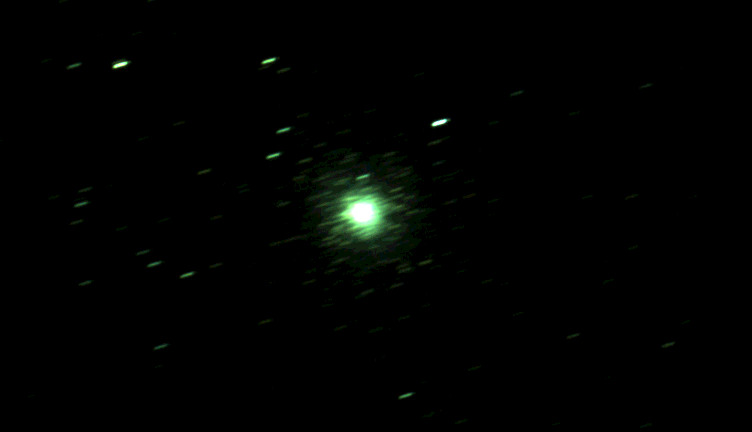
M2 Star Cluster; after hours of preparation and attempts to apply the Synscan polar alignment routine, with the P{olar Scope, success proved elusive and tracking poor. Canon 700D | 15x30 sec @ ISO 400

M2 Star Cluster; after hours of preparation and attempts to apply the SynScan polar alignment routine, without the Polar Scope, success proved elusive and tracking was poor.
Canon 700D | 15×30 sec @ ISO 800

Très Bon

My astronomy has been limited over the past couple of weeks as a result of the aforementioned cycle tour of the Loire.  After an 11 hour night crossing of Le Manche from Portsmouth, we headed south from Saint-Malo along the River Rance via Rennes and thence to the Loire, just east of Nantes.  Thereafter, just like the river, we meandered slowly upstream taking in vineyards and chateau, eventually reaching Blois before returning to Tours to take the easy way to the Ouistreham ferry by train.  All-in-all we cycled 428 miles and had a great time, in no small part due to fantastic weather the whole time.

One of the advantages of cycle camping and the inevitable call of nature during the night, is that you get to see the sky and what a sky! From the first night at Tinténiac the night skies were crystal clear, with wonderful horizon-to-horizon views not unlike that seen at home at the moment but without the clouds and light pollution – with such clarity the great spectacle of the Milky Way was always present.  The downside of cycling is that you can’t take astronomy equipment with you.  However, on the first night by laying my compact camera on the ground pointing upwards and set manually, I managed to get a good picture of the sky (it’s about 2am and I was a bit sleepy).  Such skies and better continued throughout the whole trip.

The night sky at Tinténiac

The night sky at Tinténiac

t’s therefore interesting and not unsurprising, that the following night sky map of France shows that much of the country is free from excessive light pollution.  It is however surprising that they were only awarded their first dark sky status last year – the Pic di Midi International Dark Sky Reserve  in the Pyrénées.

http://ftapissier.free.fr/pl/zoom.html

I wonder if the nobility of the Loire appreciated the great skies they had – they would have (theoretically) had the use of a Newtonian telescope for a while before the revolution put an end to their indulgent lifestyles?

Challain-la-Potherie Chateau - nice place if you can affofd it!

Challain-la-Potherie Chateau – nice place if you can affofd it!

About the same time (1730 – 1817) Charles Messier certainly put the quality of the French skies to good use when he catalogued 110 Messier objects, consisting of nebulae, galaxies and star clusters, which today still forms a fundamental platform for astronomers.

My own ambitions over the coming winter months will be to view and image many of the Messier objects, which makes his work nearly 300 years ago seem all the more incredible – but then he did have clear skies. Très Bon.

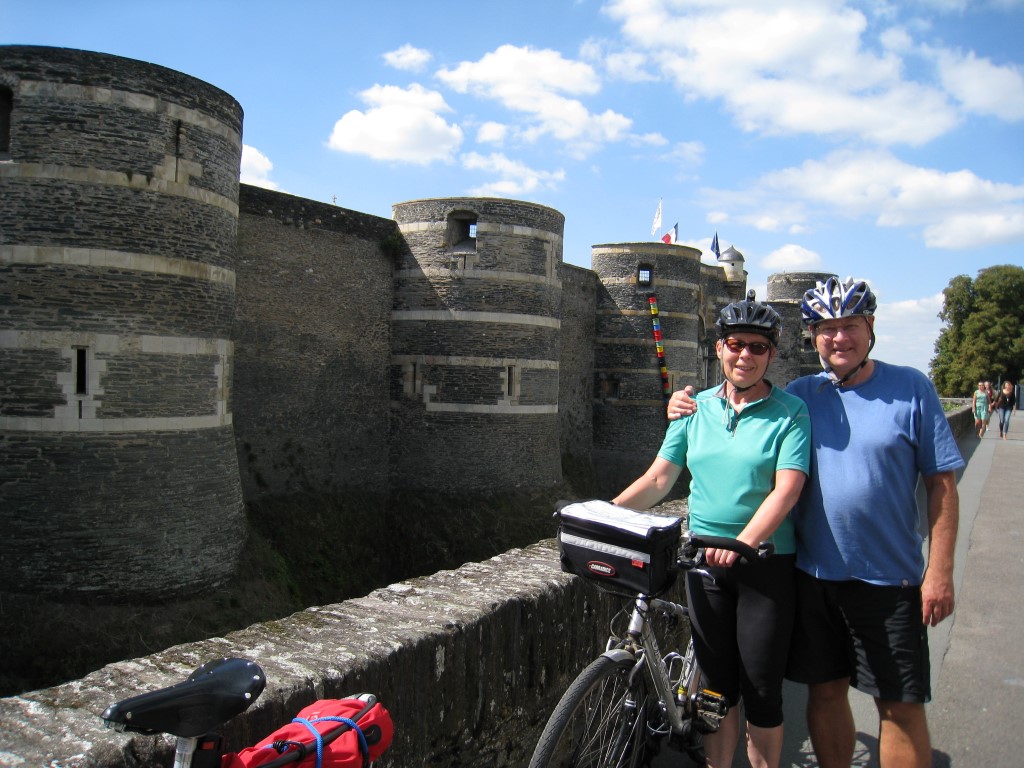
Loire cycle team in Angers.  Chapeau!!!

Loire cycle team in Angers. Chapeau!!!