
Fairvale Observatory Part-1 dealt with my initial entry into astronomy and, in particular, my equipment.
I have established that I enjoy astronomy and, more so, determined that the way forwards for me should be Deep Sky Objects (DSO) and their imaging. I can now see that imaging is not just a means of acquiring what are often beautiful, indeed spectacular pictures of features and objects in space but it is a tool with which to see what otherwise is at best elusive and most of the time, invisible to the eye – even viewing through a telescope. As a professional geologist, it is comparable to my hand lens with which to open doors of knowledge and wonder in rocks and fossils, or my hammer with which to split rocks and unlock time capsules of the earth and its history. The comparison with astronomy is, in my opinion, very close and probably one of the reasons I have now decided to pursue astronomy. Given the scale of the Universe it is inevitable that DSO objects form the majority of what’s out there and therefore the quest to observe and understand them seems a natural, almost necessary way forwards. And so it is that to pursue this new goal it has become necessary to upgrade my equipment.
The shortcomings of my initial equipment, a Skywatcher 150PL and EQ3-2 mount, helped in understanding what I was looking for in upgrading:
- OTA too slow – for DSO objects the scope speed needs to be at least f6 or lower;
- OTA open – a closed OTA reduces the impact of cold (dew) and warm (thermal currents) air on the light path and thus the eventual image, as well as requiring less maintenance;
- Focus mechanism too coarse – to achieve focus when DSO imaging, in particular when using a field flattener, requires a focus to within a fraction of a millimetre – the 150PL lacks such finesse;
- The mount is too light – in order to take long exposures a stable mount is essential, inevitably this requires sturdier, heavier equipment;
- RA / DEC motor drives lack accuracy – to find, lock onto and finally track DSO objects a high degree of alignment and tracking precision is needed;
- EQ3-2 mount cannot be programmed – both to improve the accuracy of finding and tracking, feedback loops between the mount, the OTA, the guidescope and various planetarium software is desirable.
OTA (optical telescope assembly) – William Optics GT81 FPL3 Triplet ED APO
Reading around I quickly came to the conclusion that an 80mm ED APO refractor was the best way forwards. A refractor telescope might be thought of as a ‘typical’ telescope, in that the light passes straight through the object lens, which is then viewed directly at the other end or, for convenience using a diagonal. With the introduction of glass lenses the problem that now needs to be overcome is chromatic aberration (coloured light ‘fringing’), caused by bending the light as it passes through the object lens to focus at the other end of the scope where it is viewed; such bending causes the light to ‘split’ like a rainbow.
The solution is to use a series of lenses, ground in different ways so that as the light bends through one lens it is corrected in the next and so on an so forth, until as near as possible white light is viewed at the point of focus (viewing) without the effect of chromatic aberration. As might be expected the success in achieving such a result is mixed and not surprisingly directly linked to price. Of course there is no shortage of ED APO refractors and my shortlist was narrowed down to Explore Scientific or William Optics (WO). The elimination of chromatic aberration is such an important feature that I chose the WO GT81 f5.9 triplet refractor with five lenses of extra-low dispersion (ED) glass; triplet is the holy grail object lens made of three lens elements. Once focused, the result is a crystal clear view or image of the object – beautiful. I chose WO as reviews were unanimously positive and it seemed that WO had a better range of accessories suited to imaging – I have not been disappointed. The manufacturing is exquisite, beautifully finished and the scope is a pleasure to handle and use.
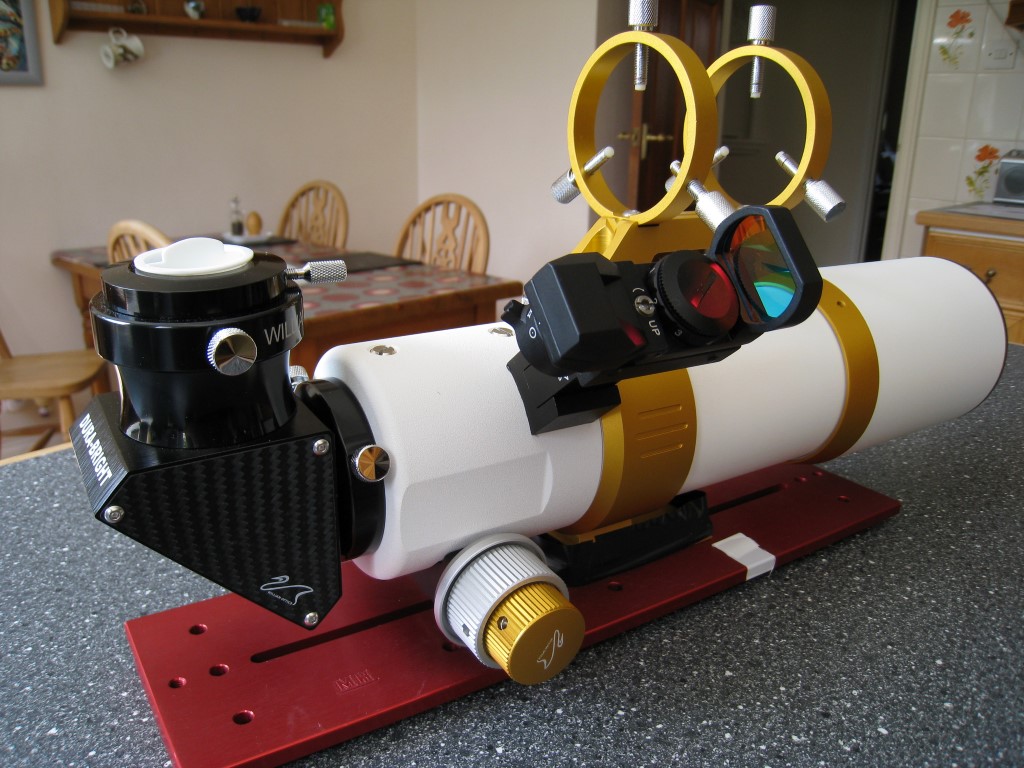
William Optics GT81 FPL3 Triplet ED APO Refractor attached to a 4″ Losmandy plate
Aside from the optics, the rack and pinion focus mechanism provides fine or, through a secondary gold coloured knob, very fine adjustments, which can subsequently be locked to ensure there it does not shift as the scope is moved around or a camera is attached, thus changing the balance. It comes with a base / foot that will attach directly to a standard dovetail slot, such as that on the EQ3-2 mount, though such is the excellent overall anodised finish it seems I pity to rough it up – I’ve therefore taped it over. However, for regular use with the new mount the scope is bolted to a Losmandy plate, which has a number of holes and slots in order to vary its positon depending on requirements, which slots neatly into the head of the new mount with robust plastic topped screws to secure the plate. The GT81 comes with two anodised top rings for a guide scope, the fixing screws of which are brass and plastic tipped to protect the finish of the guide scope – a thoughtful touch which says all you need to know about the attention to detail which is evident throughout. Finally, I purchased a WO RDF which fixes neatly on either side of the OTA and does the job nicely.
All in all, the WO GT81 is a great piece of equipment, which is a pleasure to use and delivers great results. It is significantly smaller than the 150PL scope but delivers a much bigger punch, in all respects.
The Mount – Skywatcher AZ-EQ6 GT
The mount was always going to be one of the more advanced Skywatchers but which one?
I started with the EQ5 Pro in mind, as it seemed to have most of the technical facilities of its bigger brother the EQ6 but was lighter, which makes it easier to handle and move about – an important consideration given I have to move this out and in from the house all the time. However, the EQ6 is not the choice of many experienced astronomers for nothing and, on closer inspection, it was apparent that its better technical credentials and larger payload capacity for greater stability made it the obvious choice. By comparison the EQ6-EQ5-EQ3 capacities are respectively 18.2kg-13.7kg-5,5kg. Finally when it came to purchasing, I went the next step and got the AZ-EQ6 GT Pro which, amongst other better features, is belt driven and therefore smoother when tracking and takes an even larger payload of 20kg. I’m not sure if I will get any use from the alternative Alt-AZ function, as the Equatorial mode is more suited to imaging, but it is a great mount – works beautifully with excellent features.
In use the general balance of the mount is easy to adjust thanks to a lever operated clutch for the RA and a capstan-like wheel located at the top of the counterweight rod for DEC, which are both simple to release and secure at any time. The mount comes with two saddles, so that two telescopes can be used in parallel if required. Dual-coder technology usefully allows the telescope to be moved manually in either axis without the mount losing its positional information! Although not yet used, the mount has an autoguider port and periodic error correction (PEC). Level and height are adjusted by means of adjusting and locking the stainless steel legs with well-made metal screw clamps, unlike the flimsy EQ3-2 equivalent. The RA and DEC motors and belts are contained in the main body and work accurately and smoothly, with the power source provided by a separate DC power unit; I’ve placed this in a water resistant box with the various power leads sitting neatly on top.
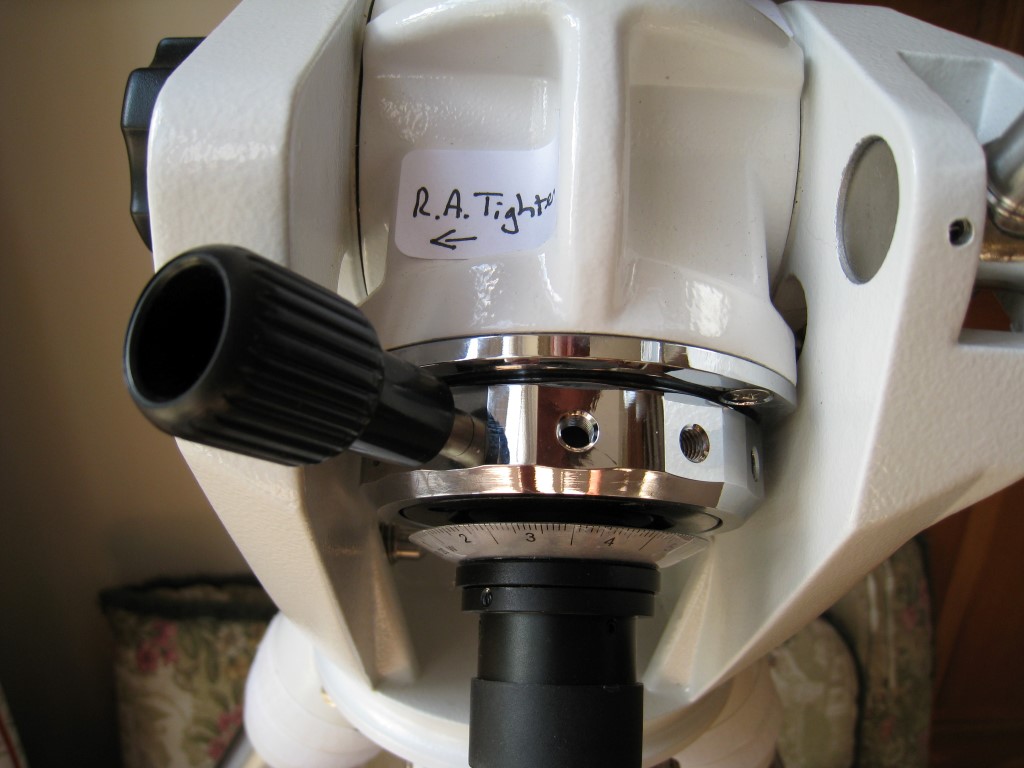
RA clutch – simple and easy to use

DEC clutch

Saddle with Losmandy plate fitting
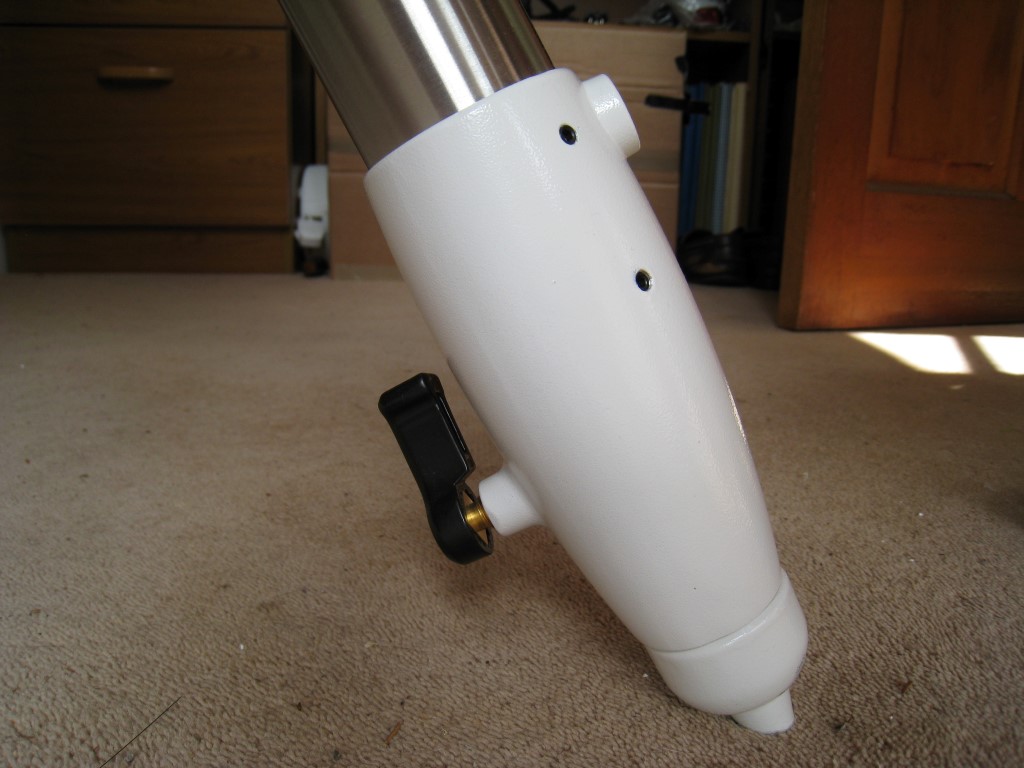
Stainless steel legs with robust adjustment clamp, unlike its younger brother the EQ3-2, you get what you pay for

AZ-EQ6 Mount: Power & control centre
Control of the mount is via a handheld Synscan handset, the results of which are nothing short of amazing with over 42,900 celestial objects programmed! Following a built-in 1, 2 or 3-star alignment process, a vast array of viewing or imaging opportunities can be programmed though the handset and then located, with the mount moving gracefully with a sinister whirr at a rapid slewing speed of 4.2”/sec and a tracking accuracy of 0.1436 arc minutes. Having previously undertaken this by hand with the EQ3-2 mount it is a new and delightful experience.
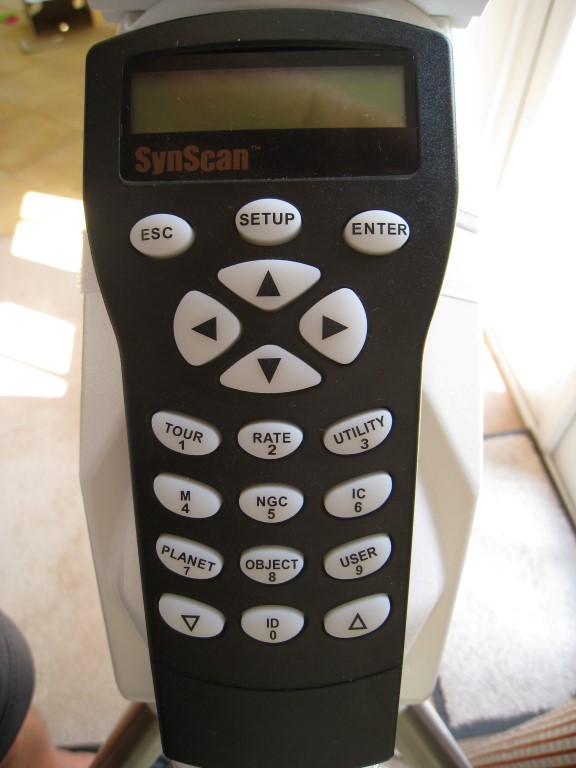
Synscan handset – the world (or in this case the Universe) at your fingertips, literally!
Accessories
All the existing lenses and other basics can be used with the new set-up. However, following advice I did purchase three other items:
1. A 50mm William Optics guide scope, which will be clamped above the main OTA using the existing rings which, together with the ZWO 120MC webcam, will assist in tracking and maintaining a fix on objects during imaging – I have not yet put this to use.
2. A 2” William Optics dielectric diagonal, to make observing more comfortable; the ‘dielectric’ part is a mirror coating process, reputed to increase reflectivity and be more resistant – we shall see.
2. A William Optics field flattener, which is used for DSLR imaging, in order to ‘remove’ any apparent distortion of the image at the edges, with excellent results; though I found it very, very difficult to find the focus point at first. Furthermore, the optics of the field flattener also acts as a x0.8 focal reducer, thereby changing the scopes speed from f5.9 to f4.7, which places it into the ‘serious’ category for DSO imaging.
All-in-all, the new equipment is a joy to use, with good results and holds great promise once all the features and software are fully up-and-running.

William Optics GT81 + AZ-EQ6 Mount set-up & imaging. Nice one!
Comments
Since taking up astronomy just over a year ago I have made good progress and now feel, with the new equipment, that this will keep me more than busy before the next upgrade needs to be made. However, such is the quantum leap the new equipment provides, I expect that such changes in the future will be more incremental, such as scopes for specific tasks and various ‘must have’ accessories; notwithstanding, I can see that astronomy retailers are likely to do well for some time to come!
Summary of Equipment currently at Fairvale Observatory
Scopes: William Optics GT81 FPL3 Triplet APO refractor f5.9, William Optics 50mm f4 guide scope & Skywatcher 150PL f8 Newtonian & 30mm finder scope
Mounts: AZ-EQ6 GT & EQ3-2 (+RA & DEC Motor Drive)
Lenses: Barlow: x2, Plössl 32mm, 25mm Wide Angle, 10mm, 6mm Ultra Wide Angle
Bins: Helios Naturesport Plus 10×50 wide-angle; Cameras: Canon 700D, ZWO ASI 120MC
Filters: Baader ND0.9 Moon, UHC, Light Pollution, Baader Astro Solar Safety Filter
Other Stuff: William Optics Field Flattener x0.8 Focal Reducer, William Optics 2” dielectric diagional, William Optics RDF, Telrad, Bahtinov Masks, Canon EOS T-piece, intervalometer, afocal camera bracket, Manfrotto binocular clamp, binocular RDF, Samsung laptop + numerous leads and connectors
 WATCH THIS SPACE(MAN)